If you haven't seen the first video in our A Family Like Mine series, covering diverse families raising kids with disabilities, check it out. Rob and Dave, above, are a married couple who adopted Owen, who has autism. They talk about their adoption journey and how Owen has settled into their family and thrived.
And in other news:
'I didn't feel strong enough'The Telegraph Brilliant animated account of a dad whose daughter is born with medical problems and diagnosed with cerebral palsy.
When it comes to disability, is it better to look 'different' or 'normal?' BBC Ouch podcast Adults with disabilities talk about pressure to improve their appearance. Should a woman with a prosthetic eye wear dark glasses? Should a woman who is a double amputee wear skirts? "It's the people staring that really gets on my nerves," one says.
Guinea pigs are autistic child's best friendThe New York Times When playing with guinea pigs at school, children with autism spectrum disorders are more eager to attend, display more interactive social behavior and become less anxious, according to a series of studies.
Esme can readThe New York Times The mother of a child who can't speak, point or sign writes about realizing her daughter can read.
Texas to require cameras in special-ed classroomsDisability Scoop "We heard testimony from students with special needs and parents whose lives have been forever changed by mistreatment in the classroom," state Sen. Eddie Lucio, Jr., who authored the legislation, said.
Is special education racist?The New York Times "Black children face double jeopardy when it comes to succeeding in school," write two researchers. "They are far more likely to be exposed to the gestational, environmental and economic risk facts that often result in disabilities. Yet black children are less likely to be told they have disabilities, and to be treated for them, than otherwise similar white children," according to a new study.
When doctors become patientsA Better NHS blog Amazing accounts of doctors who become patients and how it transforms their practice.
TDSB school asked my autistic student not to attend graduationHeart Learning Centre blog An after-school program writes about a kindergarten child with autism being asked to come in later one morning so that she misses graduation ceremonies. Holly, Alex and Jaxson 1,000 Families Project
A gay couple begin the adoption process with one request: They want a child with Down syndrome.
Doctors go online for medical information, tooWall Street Journal
When a child has a rare condition, doctors look to online groups for families who can shed light on their experience. Our BLOOM contributor Barb Farlow is referenced in this article, as is a paper she and two doctors published in Pediatrics on the experience of parents of 272 children with Trisomy 13 and 18.
Horrified family finds daughter's photo on prenatal screening adCTV
Without the Canadian family's consent, a photo of a girl with Down syndrome that had been posted on her mother's blog was used in a building-size banner advertising a Swiss prenatal test to detect Down syndrome.
Why isn't it the right time for NEO Kids?Northern Life
An eye-opening editorial about the obstacles a proposal for a pediatric hospital in Greater Sudbury is facing, despite widespread parent and medical support. Includes disturbing statistics about the health of children in Northern Ontario vs the Ontario average.
Complete our BLOOM survey by June 30, and you'll be entered in a draw to win a framed Stephimal by autistic artist Steph Coveart (above).
The joy that bounces from Steph's drawings of cats and dogs—each coloured in bright, bold markers, floating on white space and with quirky facial expressions—has attracted the attention of artists and animators.
Thank you to everyone who's already taken five minutes to tell us what they like, and don't like, about BLOOM, and how we can do better. Help us push our respondent voices higher! Louise
Here is the first video in A Family Like Mine, a new BLOOM series covering diverse families raising children with disabilities. Meet Rob and Dave, two dads who adopted a son with autism. “We have a nephew with special needs and we’ve seen
what they’ve had to go through and fight for,” Dave says. “We thought it was
the right thing to do.”
Initially their son was fascinated with the movement of
trains, doors, locks and washing machines, but as he’s grown comfortable with
his new family, his ‘stimming’ behaviours have faded. He’s doing well at
school after receiving behavioural intervention (IBI) therapy.
Rob and Dave
wondered whether having gay dads would be challenging for a kid who already had
autism, but he’s thrived. You may remember this BLOOM post Rob wrote about their adoption. This video will be captioned this week. Hope you enjoy!
My dear friend Janis Purdy is speaking today on a SickKids panel celebrating PRIDE week. Here she writes about parenting a child who was born with serious medical problems and the hospital care—often kind and empowering and sometimes challenging—she and her partner experienced as two gay moms. Thank you Janis! Louise
By Janis Purdy
I remember all the people and intensity in the room when Jonny was born. I remember him being whisked away from me and wondering if I would ever hold him.
I remember touching his hands and feet. I remember his omphalocele looking bigger than his body. I remember his curved spine, his yellowish pallor and his old-soul eyes.
I remember his isolette, his PICC line, his NG tube, the IV in his head, his wound dressings twice a day. His daily dose of medications. His failure to thrive. I remember infections and green bile and TPN.
I remember a spontaneous bowel perforation. I remember emergency surgery. I remember praying desperately. As Anne Lamott writes, all my prayers were either “Help”, “Please” or “Thank you.”
I remember six long months in the NICU.
I remember two open heart surgeries, chylothorax, chest tubes, pain in his eyes, and a hernia surgery. I remember three months in the cardiac intensive care unit. I remember the NJ tube, low tone and the discharge plan.
I remember all the good, smart and kind people. I remember the sharp looks, the insensitive comments, the mistakes.
I remember leaving Sick Kids. I remember being so happy and so scared at the same time.
I remember emergencies and admissions and back and forth and in and out for a year. I remember feeds every three hours around the clock and dressing changes and meds that got stuck in his tube and I remember being very tired.
I remember his abdominal closure surgery. I remember a nurse in the surgery recovery room bringing him a brand new Thomas the Train toy.
I remember little friends who got better and some who didn’t.
I remember how much Jonny always loved his big brother. From the moment they met. And I remember his remarkable will to live and his incredible spirit of life and love.
I remember OT and PT and speech and language and oral aversion. I remember being completely humbled by Jonny’s strength and endurance.
I remember growing up being taught that lesbian and gay people were dangerous to children. And that trans people were mentally ill. I remember a lesbian who lost custody of her children when she came out. I remember hiding and covering up and feeling ashamed.
I remember a nurse in the NICU asking if Diane and I were married. I remember that opened a door to a lovely conversation.
I remember a nurse practitioner in the NICU asking me, of my older son, “Does he call you mommy or mama?” It showed a wonderful level of insight.
I remember introducing our children’s biological Dads to the staff, and their grandparents, and their aunties and uncles of all genders and being amazed at how nice they all were in trying to understand and support our unconventional family.
I remember the receptionist calling Diane, Mr. Purdy once. She was so apologetic when she realized her mistake. Like red-faced and tripping over herself. I felt sorry for her. I began to call Diane Mr. Purdy after that as a joke.
I remember an older nurse sharing that she was gay too. That was nice and it helped us feel understood and comfortable. I appreciate that she shared that confidence in us.
I remember a younger nurse discussing the finer angles of lesbian motherhood with us.
I remember a GI doctor we’d never met before. We were not having a good day and he walked into our room without knocking, as they are want to do. “I’m Doctor X” he said looking between us. Then he asked, “Who is the mother?” I responded “We both are.” He seemed irritated. “Who is the BIOLOGICAL mother?” Instant tension. My partner tried to diffuse it with a joke “It sounds amazing but we both are!” He looked at her without smiling. “Who are you and why do you need that information?” I said. Sound of horns clacking. “There are many medical reasons we need to know who the biological mother is.” That was a bad start. Hard to get over a bad start.
I remember a social worker in the cardiac ICU asking us the kindest, most thoughtful questions about our family situation. She was concerned about whether we had enough support going home. Gender was not an issue.
I remember sometimes feeling angry at the world and dark and ready for a fight.
I also remember feeling so lucky and thinking, if anyone can handle this, we can. With our age, our experience, our families, our friends, our financial security, our good health… we’re going to be able to handle this. I remember thinking, Jonny chose the right family. And feeling so grateful.
I remember meeting moms and dads from all over Ontario, from little towns here and there and some who were very religious and some who had never met a lesbian before but it was all okay because here we were all surviving and hanging in there together. It was all about the kids and the diagnosis and the treatment and the prognosis.
I met people at SickKids, and made friends here, with people I’m not sure I would have crossed paths with in any other way. And that was good for me.
I remember a doctor here, someone I deeply respect, and will always love in a kind of hero-worship way, telling me that he thought Diane and I were great parents. I think I burst into tears, which would have been disconcerting for him, but that is how much I appreciated what he said.
When you grow up thinking you can’t or won’t be a parent, or you’re holding onto an ancient fear that other people will judge you, or dislike you before they’ve met you, or when you’re used to fighting and you’ve got your dukes up for no good reason, those little compliments and small indications of care, and empathy, well they can blow up your well-constructed walls and bring down all your defenses and really soothe your soul. Which is a really good thing for any parent of a sick child.
By Louise Kinross This is a picture my son took at Cherry Beach as we sat on a log. Dogs are drawn to him. Because he's so small, he's afraid they may jump on him and knock him down. In keeping with our series about courage, I was reminded of an interview I did with Dr. Jacob Towery, a psychiatrist at Stanford who's found cognitive, and other types of therapy, useful for parents of kids with complex disabilities. I just went back and read it and it's so packed with useful, practical information I want to print it out. Dr. Towery uses techniques that get at common distortions in the way we think that can lead us to feel anxious and depressed. Here's a small excerpt about how we can choose to focus on what our kids can do, instead of what they can't do. "There's probably a certain amount of sadness that is appropriate and healthy for a parent of a child with multiple challenges," Dr. Towery says. "To know your child will have to struggle more than other children do is unfair. Sometimes parents don't give themselves permission to grieve the loss of the healthy child they expected and therapy can provide the space to experience that sadness. But once you have grieved, continuing to tell yourself 'My child will never do anything' might be an overgeneralization. Is it really true that your child will never do anything? What if we focus on what the child can do? Perhaps the child can make eye contact now, but didn't used to be able to. Maybe your child can smile and generate a smile in you as a parent. Maybe they can give another person a hug and make that person feel good. It's all about what we focus on. We can focus on the 100,000 things that a child can't do, or on some of the things that they can do, and we will feel differently depending on our focus." My son does all kinds of practical things this year that he couldn't do before (or, at least, we thought he couldn't do them and didn't expect him to). Things like getting into the van on his own and doing up his seatbelt, which is hard for him to reach, doing up buttons (he never wore shirts with buttons due to an aversion), and brushing his teeth (he has an unusually small mouth that makes it hard to get a toothbrush in). The other day he came in really sweaty and hot, and I said "You should change your shirt." And lo and behold, 10 minutes later he came down with a new shirt on. That made me smile because he wouldn't have taken that initiative in the past. My son is always making progress, but sometimes it's easy to dismiss it because it's not what other people his age do. Which reminds me of something Dr. BJ Miller told us in an interview. Dr. Miller was a successful Princeton sophomore when he was injured in a prank with some buddies that left him a triple amputee. He's now a palliative care doctor. When asked what the greatest challenge was in coming to terms with his new life with disability, he said "how to see things differently. "By pulling me out of my anything-approaching ‘normal’ frame of reference it really helped me upend that endless cycle we humans engage in of constantly comparing ourselves with those around us. Am I smart enough, rich enough, skinny enough? Compared to what? That’s the question I got to open up. I was given a way to let myself off that hook and be my own frame of reference... "When I talk to school kids they’ll say 'Don’t you miss having two hands?' and I’ll invariably say 'Yea, I do, but don’t you miss having three hands?' Because for me personally it’s as ludicrous to go around thinking about having two hands as it is for them to think about having three. 'I don’t sit around missing them anymore than you sit around missing three,' I’ll say. This frame-of-reference issue is a powerful thing." If we're constantly focused on what our child can't do because of their disability, we can't delight fully in the things they can do. The other day my son and I went to see my mother, but she wasn't at her condo. We drove over to a nearby park where we found my mother "guerrilla gardening." She no longer has the large gardens that she tended to while we grew up, so she's planted a garden around a log in a nearby park. My son and I were excited to see her in the distance. I called to her, and my son, who can't speak, also attempted to holler, which made me smile. She was very surprised to see us. When we got up to the garden my son asked in sign what each of the flowers were. Then a couple of older women my mom knows walked by and said hello. Ben shook hands with them. Then he spontaneously gave each of them a hug. It wasn't what someone his age would have done, but it was heartfelt and heartwarming. I'm writing this down because so often I slip from focusing on these good and wonderful things. I let my thoughts drift to what can't be. Using Dr. Miller's analogy, it would be like him walking around constantly wishing he had two hands again. Ludicrous, as he said. Now that we're trying to figure out my son's life post school, I wanted to share a couple of links. Connectability is a website run by Community Living with some great resources for people with developmental disabilities. This one lists all of the day and recreation programs available, at a cost, in Toronto. I know people have very strong opinions about day programs because they are segregated. But we are looking into all opportunities. This is a list of post-secondary options. And this Facebook group Ontario Developmental Services Housing Task Force has families and professionals looking at innovative housing options. We'd love to run stories from other parents who are looking for courage in the face of a challenge with their child with disability. If interested, please e-mail me at lkinross@hollandbloorview.ca
By Louise Kinross Sometimes I feel like I can't find the courage I need. Most recently it's happened when my son, who has severe disabilities, left the school system at age 21. At a time when most parenting 'gigs' are winding down, it feels like mine is ramping up, as I try to help him carve out a meaningful life. My son's disabilities, particularly his lack of speech and behaviour issues, make it hard for him to fit into a typical employment or school setting. We didn't get the funding we'd hoped for from the government, or the planning support we've been on the wait list for. And I didn't save for this time. As he grew up, I always felt we had to spare no expense in therapies and activities and products and camps that might promote his development as well as make him happy. So we need to get creative ourselves. We'll be working with someone to help us develop a support network to bring people to the table who can help us figure out what a good life for our son would be, from activities or employment or volunteer work to friends. It's not easy asking for help, as all parents of kids with disabilities understand. So I thought I would start this column called The courage project. Maybe we can encourage all of our readers to share situations where they feel lacking in courage. Perhaps I can tell our story as we go alone, and others can share their stories, and we can support each other. The medals above are some of my Dad's, from WWII. He lay communication lines between the frontlines and headquarters through all of the major battles, and landed with the allies in Normandy on D Day plus 1. He was 19 at the start of the war and served for over six years. I think I'm going to take one of his medals and put it on a chain and wear it. Let me know if you'd like to share a story about parenting that calls for courage, particularly if you are struggling to find it.
5 things a doctor wishes parents knew about 'disabled' kids
By Dr. Peter Rosenbaum
1. The most important word and idea we can share with parents—from the beginning of their journey into “childhood disability”—is DEVELOPMENT. Children—including those with disabilities—change and develop; as parents we develop as our kids grow and change, and as a result we usually become more skilled as parents. Of course some children’s development will likely always remain compromised and therefore slow.
2. Parenting is a dance led by the children! If we can be attentive to our kids and adapt to their emerging skills and abilities, we parents will probably do okay!
3. Be ready to brag about your “disabled” child every day. Professionals spend too much time on problems, and what kids can’t do. Forget about conventional milestones and the “normal” way of doing things. Look at what’s working, what you like, and what makes your child special! This is important for every child, regardless of the extent of their impairments.
4. Don’t blindly accept what professionals (or even your family members) tell you your child will NOT be able to do. Professionals are not good at predicting the future of an individual child (though we wish we could) and anyway, the kids never listen to what we say!
5. Parenting any child is a marathon, and not a sprint. Keep at least one eye—and often both eyes—on the big picture, and the future. This helps us to plot a course to adulthood. That helps us help our children to become as competent, self-assured and self-confident as possible, regardless of how well they can do this or that activity or skill.
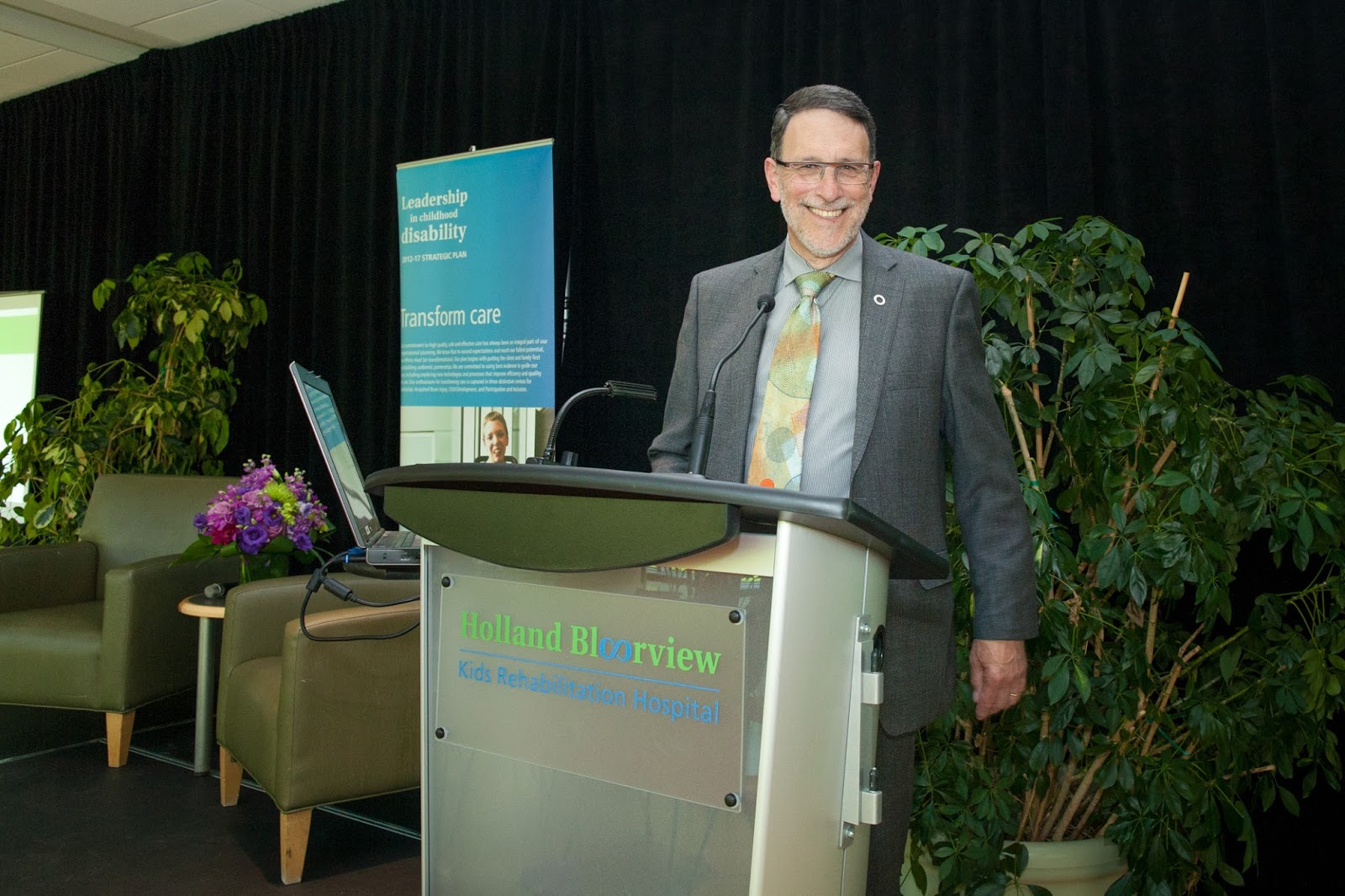
Dr. Peter Rosenbaum is the inaugural recipient of Holland Bloorview’s Medal of Excellence in Childhood Disability. Peter is co-founder of the CanChild Centre for Childhood Disability Research at McMaster University and was chief of medical staff here at Holland Bloorview from 1997 to 2000. He revolutionized the health model for children with cerebral palsy by developing the Gross Motor Function Classification System, which is used worldwide.




 Posts
Posts


