Showing posts with label illness. Show all posts

Tuesday, April 16, 2019

Hope: 'We cannot take it away from parents'


By Louise Kinross

Imagine coming to the scene of a car accident and being told it’s your child that’s been hit. But your child is not there. She's been taken to the trauma centre, a 30-minute drive away.

Or entering a room and finding your teen unconscious from a self-inflicted injury.

Or hearing a code blue called after taking your child to Emergency with what you thought was the flu. He's suddenly developed a life-threatening illness.

For almost three decades, Holland Bloorview family therapist Caron Gan has heard hundreds of stories from parents whose children suffered a brain injury as a result of unexpected trauma or illness.

“One of the most important things I’ve learned from working with families is the power of supporting hope,” Caron says. “We cannot take it away from parents. Hope is what helps parents keep going for their child. It helps them to catch their breath, so they can be at their best for their child, and be active in their care.”

According to the National Child Traumatic Stress Network, 80 per cent of parents who witness a child’s accident, self-injury or sudden, serious illness experience symptoms of traumatic stress. For about 20 to 30 per cent, these problems will persist in a way that affects everyday life.

“I see a range of responses,” Caron says. “Some parents need to talk openly and candidly about how awful or horrific the experience was. Then I have parents who are not yet ready to talk. It’s way too painful. Avoidance is a common feature of traumatic stress. I know underneath, they’re all experiencing high levels of distress, but coping with it differently.”

Parents often struggle with sleep. They may have trouble falling asleep. They may have nightmares, or wake up in terror, recalling how they found their child, or what doctors told them at the hospital. “They remember every word and detail, and when they describe those earlier experiences, it’s seared into their memory,” Caron says. “Common things I hear from parents are that they were told their child will not walk, or talk, or be able to go to school like they did in the past. Some parents are even asked about organ donation.”

Supporting parent hope is essential, Caron says. “My role is to gauge where the parent is at, and to walk alongside them in that journey. It’s not uncommon for a distraught parent to say ‘I don’t want to hear anything about my child’s brain injury unless I know he or she will have a 100 per cent recovery.’ I've learned that if I don’t hear what that parent is saying about how they want to remain hopeful, and launch into education about what can happen after brain injury, I’ve lost that parent. That parent will have difficulty opening up and trusting me to have further conversations.”

Parents’ readiness to accept their child’s current situation is a process that can’t be rushed. Hope is fluid, Caron says, and changes over time. “Initially, their hope may be that their child will live, and they are so relieved that their child survived. Then it may move to hope that my child will recover fully from their injury or illness. That may morph into hope that my child will make gains in rehab, will walk again or return to school, or adjust to their new normal. It changes from hope for survival, to hope for a full recovery, to hope for the child to live a good life, in spite of their illness or injury.”

Caron embraces the journey. “It’s not something I would try to change by giving a blunt reality check, or telling them what the literature says about outcomes. Families need time to slowly absorb the information, and their hope narrative will change over time.”

Caron says there are variations in how children heal from brain injuries, and offering the range of possibilities helps parents. “They want to know recovery can range from worst-case to best-case scenarios, and that there is no crystal ball. They want honesty from their healthcare providers, but the way it’s delivered can either shut them down, or help them hear what’s said.”

Knowing that most parents in their situation experience depression, anxiety, irritability, guilt and blame helps to normalize their feelings. “When I show parents a handout about what we call pediatric medical traumatic stress, 
I often hear a sigh of relief. They’ll say ‘You mean I’m normal?’ They need to be given permission to feel what they feel, and to know that it's okay. Acknowledging your feelings doesn't mean you are giving up hope, or will stop fighting for your child. 

Caron shares tools to help parents calm their symptoms of distress. It may be teaching grounding strategies if they're having flashbacks, to remind them that they aren’t reliving the event. For example, they may learn to name five things they see, hear, feel in their body, and smell, so they know they’re not “back in that nightmare.” They may be taught deep breathing exercises, to visualize a calm place where they feel safe, or to track their emotions in a journal.

Telling their story, in a guided way, is an important part of healing. “I really listen carefully, and with compassion, when families share the details,” Caron says. “They need to reprocess what they’ve been through, otherwise the distress gets locked in the emotional memory of their brain, and can be reactivated when they least expect it.” For example, when they hear a code blue on the unit.

Caron keeps a celebration board in her office where former inpatients have posted graduation pictures. “It helps to cut through some of that despair or fear of hearing the worst-case prognosis. I can talk about how these young people got to know their brain injury, and how it affects them. That these young people had hoped for 100 per cent recovery, but they all had some persisting effects. However, they learned strategies to help them manage those effects, graduate from school and live a good life worth celebrating.”

Acquired disability happens out of the blue, and changes the child the family knew. In this way, it’s different from learning your child has a disability at birth, Caron notes. “These parents had memories and an imagined future with their child that didn’t involve disability. These parents have to mourn the loss of the child as he or she was.”

Brain injury may alter a child’s abilities and personality. “Psychologically or emotionally, the child may feel to the parent like a very different person. Mourning, and letting go of the child that they remember, is really difficult. And outsiders don’t always make it easier.”

That’s because children with brain injury often have an excellent physical recovery, and the lingering effects on thinking, concentration, memory, personality and mood are invisible.

“People will say ‘It’s so great that Johnny’s walking now. He’s in rehab and he’s going to get back to the way he was.’ That creates more distress for families who are grieving inside. They may be told ‘It’s time to move on. Just focus on the positive, and put this behind you.’ But that type of positivity is almost dismissive of the pain they’re going through. Parents may shut down or isolate themselves when their feelings are misunderstood or minimized.”

Sometimes, changes in a child’s abilities, behaviour or emotions may not show up for years, when some people have forgotten that the child even had a brain injury. Often these changes emerge in the teen years, so it's difficult to know if they're due to the brain injury or to adolescence.

Being part of a support community where other parents understand exactly what you’re going through helps. Caron is working with eight parents at Holland Bloorview and the Ontario Brain Injury Association (OBIA)to co-design a four-hour parent workshop that will be launched here in September, and then rolled out across the province. “It’s a place where parents can be comforted, validated and supported, all while learning from one another.”

Traumatic stress in parents tends to be under-identified, Caron says. “There may be a tendency to dismiss the severity of trauma for parents. People may think ‘parents weren’t the ones who went through the traumatic event—it was their child.’ We know that these events have a huge impact on families.”

Clinicians need to remind themselves that they often don’t have the full story of what a parent experienced before arriving here. “If the parent is irritable, or questions staff around what we’re doing, we can’t take it personally. We know from narrative groups with parents that many had to take their child to multiple Emergency rooms before anyone would listen to them. 


“Sometimes, when parents are reactive, or presenting with high stress and anxiety, we need to take the time to hear what their fears are. Learning their back story helps put a different spin on it for us, as clinicians. It’s not about us. It’s about the parent needing to ensure their kid isn’t going to fall through the cracks, like they did before.”

You can register for the OBIA parent education and training program, or, for more information, e-mail Caron at cgan@hollandbloorview.ca.

Tuesday, November 28, 2017

This parent's essay didn't sit right with me

Photo by Elinor Carucci in The Cut

By Louise Kinross

On Sunday, I clicked on this piece in New York Magazine: Every Parent Wants to Protect Their Child. I Never Got the Chance.

There’s this adorable
 image of a toddler who appears healthy, but who, we learn, has cystic fibrosis (CF). CF is a progressive genetic disease that causes damage to the lungs and digestive system. It shortens life, although some people with the condition are living into their '40s and '50s.

His mother, Jen Gann, says she chose to have prenatal genetic testing while pregnant because “if something were wrong,” she would abort.

Due to human error, Gann never received the results, which showed she was a carrier for the CF genetic mutation. That meant her husband wasn’t advised to get tested. He also is a carrier. They found out their son Dudley has cystic fibrosis when he was a few weeks’ old.

The rest of the piece is about the intense guilt Gann experiences and her decision to sue her health providers in a case of wrongful birth.

I feel empathy for Gann. Every mother hopes she will be lucky enough to give her newborn child a clean slate at life.

Perhaps where we differ is that I don't view my child's health as an entitlement guaranteed through science. I have a son with a rare genetic condition. After he was born, I stopped counting the number of doctors who said: 
But he had a normal amnio!

Gann's piece is problematic for me in a couple of ways.

At one point she envisions telling her older 
son: “I’m sorry I didn’t save you, from your own life.”

Oddly, we don’t hear from any adults with cystic fibrosis in Gann’s piece, people who could speak firsthand to the complexities of their lives. Will Dudley grow to wish he were not alive? Does his opinion, when he’s able to render it, matter?

Instead, we read about a conversation Gann had with Dortha Jacobs.
 Jacobs established the legal concept of wrongful birth in 1975, when she sued her doctor for not diagnosing her rubella when she was pregnant with her daughter Lesli. As a result, Lesli was born with severe disabilities. 

This is where I felt an editor should have applied the brakes.

Lesli isn’t offered any agency in the piece. Gann says Lesli lives in supported housing, can’t see, hear, talk or walk, has intellectual disabilities and has had over 20 surgeries. “It’s a life sentence,” is how her mother Jacobs describes her parenting experience.

I empathize with the challenges experienced by Jacobs and her daughter,
 and the struggles Gann anticipates with her son. But nothing about disability, or illness in the case of CF, is ever black or white.

We aren't told about how Lesli communicates. Why do we not hear from this marginalized person, or from other people with disabilities?

Gann says if she’d gotten her test results, she could have chosen to get pregnant using IVF to ensure a healthy embryo. She then asks: “Would I still have made Dudley, this exact son, only without his disease?”

Well, uh, no. Her son Dudley was the son that she would have terminated, prior to trying again with IVF. Another child would have been another child.

And that’s the sticking point, isn’t it? When a child is born with a disability or chronic health condition, it’s part of their identity. It doesn’t sit, like an inert blob, separate from the human being. It’s a part of all of their experiences, good and bad, part of the way they see the world and interact with it.

Jacobs
 says she’d like to replace the term “wrongful birth” with something like “parental choice.”

What about choice in how we live our lives with our children, in the here and now?


Today I listened to Keith McArthur's podcast with Fabiana Bacchini, author of From Surviving to Thriving. McArthur, who writes The Instruction Manual, is dad to a son with a rare genetic condition. Bacchini struggled with infertility, then got pregnant with twins. One child died in utero, and the other was born severely premature, with many complications, and later diagnosed with cerebral palsy. 

This line from Bacchini stuck out: You have to be making a choice everyday, a conscious choice, that this is a good journey, despite the hardness and sadness and the unknown.

That's the one choice we all have.

Monday, October 17, 2016

Why I can't be 'for' the 'SickKids vs' ad


By Louise Kinross

Disability is personal. It’s part of identity. When your child has significant disabilities, it becomes part of your identity too.

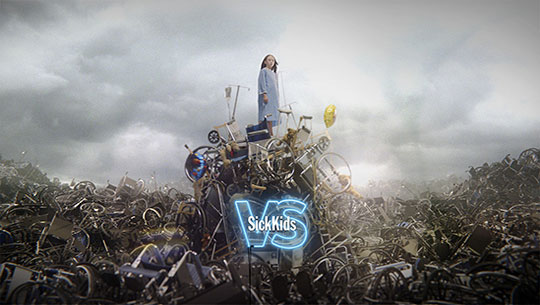
Perhaps this is why the Hospital for Sick Children's latest campaign video SickKids vs—which positions the hospital and its patients against cancer, kidney failure and autism, and includes this image of a girl standing defiantly atop a huge pile of discarded wheelchairs—feels like a betrayal. It’s trending now on YouTube with close to 200,000 views.

“We’re on the front line every day. And we are winning,” says the copy on the foundation page. Indeed, in the video, patients join a simulated battle line with armed 'Fort York' soldiers, hop in a boxing ring to fight cancer and smash apart a kidney dialysis machine with a bat.

I get why it’s so appealing. Viewers are encouraged to choose a fight and donate. Who doesn’t want to be a “winner?” 
From a fundraising perspective, I'm sure this ad has hit the ball out of the park.

But what about the messages it sends to kids and families who aren’t on the winning side?


When you define things in simple terms, you also imply that those who don’t beat their illness or disability are “losers.” Were they not as tough as the kids wearing the super hero costumes in the video? SickKids vs. plays to the song Undeniable by Toronto rapper Richie Sosa. The chorus goes We undeniable.

Are the kids who live with permanent disabilities or chronic illnesses, or who die from their condition, not “undeniable” enough? The word “defeat” flashes during the video. Does that mean some kids “surrender?” Do we really want to believe that children have that much control over their medical conditions? And at some point, doesn’t the concept of fighting just miss the point when we're talking about health and healing?

In her 2015 book Malignant Metaphor: Confronting Cancer Myths, science writer Alanna Mitchell writes about why the battle metaphor isn’t helpful to cancer patients and their families (she also writes about why it's not a great analogy for the latest clinical treatments). “A main concern is that when someone dies of cancer, the message that remains is that that person just hasn’t fought hard enough, was not a brave enough soldier against the ultimate foe, did not really want to win,” she writes.

Many children with congenital disabilities or complex medical problems are patients at SickKids. Their conditions and disabilities are not ones that can be defeated. Did they, or their parents, not try hard enough?

And is it really so easy to define “the enemy?”

The inclusion of autism in the video as something to be battled against is surprising given our current understanding. Autistic adults tell us that accepting and valuing their differences is the way to go. To them, eradicating autism isn’t possible without eradicating who they are as people. Most people in the disability field don’t believe autism can be “cured,” any more than sexual orientation can be changed. Even Autism Speaks just removed cure as an objective from its mission. The focus now is on helping people live good lives that they value.

I honour and respect the families who participated in the video. I understand why viewing their kids as warriors is empowering. I certainly think of my son, and our family, as warriors, but as fragile ones.

From a health organization, I expect a more complex, nuanced depiction—one that includes all kids, whether their disease is cured or not. One that shows that there are many rich ways of living, and dying. In the video, all of the triumphant patients stand on two feet. I’d like to see one rocking a wheelchair, because that’s how she’ll get around for the rest of her life. And I’d like to see more images of kids who look different, like my son, due to their genetic conditions or disabilities. These kids are SickKids patients as well. I’d like to see a video that expands our conception of human value, beauty and diversity. 

We are fierce, but we are also afraid. As parents, we often feel inadequate to the enormity of our child's illness or disability. And that's okay. My dad, who served for almost six years in World War II, told me: You learned to live with fear. 

We don't need to buck ourselves up with flashing neon lights that say: 
Sick isn't weak. For one, who ever said that patients and families were weak? And for two, what is wrong with weak? Weak just means vulnerable. It's who we humans are. 

As someone whose child has had close to 20 surgeries at SickKids, I would say the humanity, the compassion, of the doctors and nurses, is what's made all the difference in our care. 

I asked Alanna Mitchell what she thought of the ad.

“Yeesh!” she wrote back. “Imagine if they had those patients dancing, instead of fighting.
” 

At the end of her book, she asks readers if dance, rather than battle, might be a more apt metaphor for cancer. I think it’s a useful one for any disability or difference. Indeed, for any life. “Not a win or a loss,” she writes, “but a pirouette.”