


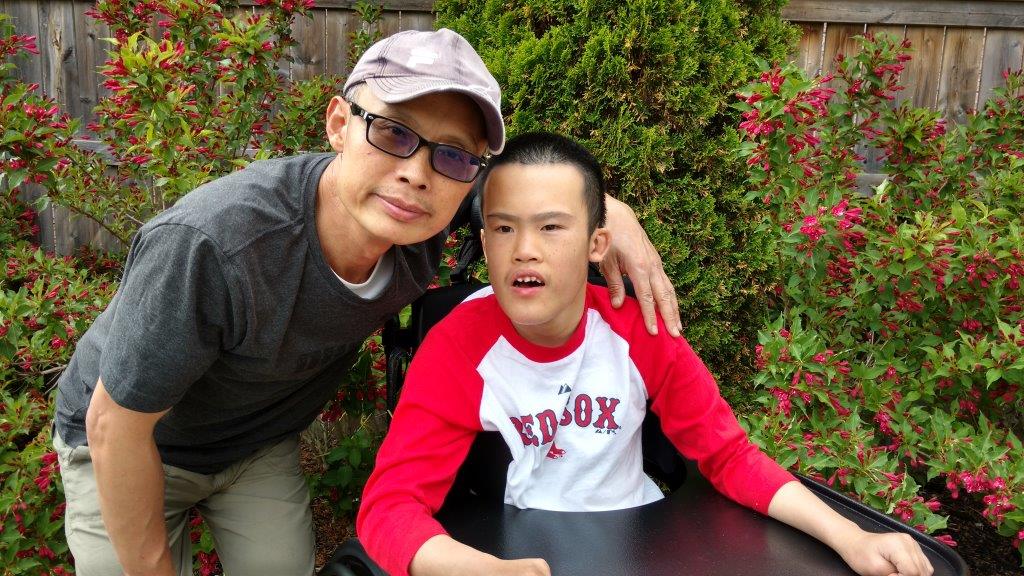
Samuel Cheng (above left) is a decision support analyst at Holland Bloorview. He spoke at a Schwartz Rounds recently about what it’s like to have his professional and personal life intersect, as his son Timothy (right) has disabilities. I wasn’t able to attend the event, but many colleagues told me they were profoundly moved by Samuel’s story, so I interviewed him.
BLOOM: Tell us a bit about Timothy.
Samuel Cheng: He’s 14 and he has a genetic disorder and requires 24-7 care. He can’t walk, but he moves, he can stand. He can crawl and he needs to be watched to be safe, which is demanding. He has his favourite games and favourite videos. He doesn’t speak, but he points and gestures and people close to him know what he wants.
He was diagnosed with autism and he has seizures and a heart problem. His health is fragile. He loves music. Whenever he hears music he will be jumping around and smiling a lot and laughing. He likes to press sound-and-effect toys. He’s come to Holland Bloorview on Sundays for respite and he likes to go on the elevator and press the up and down buttons. He goes to a special class in an integrated school.
BLOOM: Does he like school?
Samuel Cheng: I think he likes it, but we don’t really know because we can’t go inside his world to understand what he’s thinking. I know in the morning we see him excited and happy to go to school and when he comes home we see he’s even more excited!
BLOOM: Does he have a close relationship with anyone?
Samuel Cheng: Only his mother. There is something special there. After his shower everyday when he sees his mother he has endless things to talk to her about. He speaks with her, face to face and with facial expression, making sounds. It’s like he’s trying to tell her whatever story he has. He’s never talked to me like that. I feel bad sometimes because I look at him and this is my son, but I feel remote with him. I’m only someone to be in charge. It seems to me that to him I am only someone, ‘anyone.’ This is a really bad feeling.
BLOOM: Do you think it’s possible that he knows that you are someone important to him, even if he can’t tell you that?
Samuel Cheng: Maybe, but I don’t know. There are lots of unanswered questions.
BLOOM: You mentioned you have another son.
Samuel Cheng: Yes, Aidan is nine years old.
BLOOM: What kind of relationship do Aidan and Timothy have?
Samuel Cheng: Aidan knows he has a brother with special needs but they’re so distinct in what they enjoy doing and they don’t communicate a lot. I know that Aidan loves Timothy so much. Sometimes if there’s a dangerous situation, Aidan will yell and run to us to let us know Timothy needs help. Whenever we ask Aidan to help with Timothy’s care, he loves to help.
BLOOM: When is Timothy most happy?
Samuel Cheng: He enjoys being outside in this weather, but lots of times we feel discouraged because it’s not easy to bring a wheelchair to push him in and people in the community look at you differently. So he enjoys being out, but sometimes we are discouraged. I feel like we live in a subculture or a subgroup that is outside the ‘normal.’
BLOOM: I understand that feeling. Have you connected with any families who have children with disabilities?
Samuel Cheng: No, we don’t have friends within the disability community. I always feel that I’m different. I have no social life and for many years I just go home and come here to work.
BLOOM: What is the greatest challenge of raising Timothy?
Samuel Cheng: Everyday facing uncertainty in terms of his health. This morning he had quite a severe seizure that lasted a few minutes. I don’t feel there’s anything I can do about it. The first time he had a seizure 13 years ago, I rushed to him and was so worried. It seems that I’ve lost that emotion over the years. Because the situation keeps recurring, I become less emotional. I feel guilty, and I’m not happy that I don’t feel more emotion. Inside I feel I owe it to him. He’s my child and he’s fragile.
BLOOM: It sounds like you're very hard on yourself. I think parents of children with disabilities often feel inadequate because they can’t change the situation in the way they would hope. So we always feel we are coming up short.
Samuel Cheng: Yes, I feel that I’m not doing enough. Sometimes I come here for appointments and the therapists say ‘you need to do this and you need to do that’ and I’ll say ‘yea, yea, yea,’ but actually, I don’t fully follow the instructions they’re giving me. Because it’s become a routine, and I don’t believe it’s something that will help anyways.
BLOOM: I can imagine that when your child has so many needs, you could be working with him 24 hours a day and you still couldn't fit everything in.
Samuel Cheng: Timothy has such a long list of problems. He has everything! If he only had one of these problems, it would be big. For example, if he only had seizures. Or if he only couldn’t talk. Or if he only couldn’t walk. Or if he only had a heart problem.
Sometimes I think about what I would say if a wizard told me he could take away one of his diagnoses. But the list is so long I don’t know which one to pick. Can I take five? Can I take 10?
I’m not talking about small things you can do something about. I’m talking about life and death situations. There’s a huge uncertainty that drags all the energy out of you. All of the uncertainty and the emotion, everything is linked together like a web. You pull on one thread and the whole thing collapses. It’s too much.
Now, if we are given one more diagnosis for Timothy, I’ll say ‘just add it to the list.’ I don’t know where to go. Every day I tell myself and I tell my family, my wife: ‘I’m here. I’ll try my best to carry through one day.’
BLOOM: Did you have experience with disability before Timothy was born?
Samuel Cheng: No, I had no experience. That’s why it was really a shock. Through this whole journey, every step you see something you’ve never seen before, but it’s not good. And then sometimes you ask yourself: ‘Did I do anything wrong?’
BLOOM: You ask yourself why this happened to your child?
Samuel Cheng: I’m not complaining. I just feel guilty that maybe I did something. I feel that I was so self-centred. From the beginning I wanted to go to university, I wanted to get good marks. I wanted to graduate and find a job and a lady and have a family. Everything is a want: 'I want, I want.' And then I come up with this situation. I feel that I did something that is impacting everybody.
BLOOM: I think it's natural for parents to agonize over a reason why this has happened, particularly when their child has many struggles. But I don’t think it's true that you caused Timothy's disabilities, and I don’t think people around you feel that way.
Before my son was born, I believed there was some kind of justice in the world. I thought if you were a good person, mostly good things would happen to you. I couldn't understand how my son was born with a genetic deletion that was a random change at conception.
Since then I’ve come to believe that there’s a lot that's random in the world, and outside my control, and that helps me not feel so guilty about it. Sometimes things just happen, and there is no 'reason.' It can be hard to accept. We want to attach a story to what's happened as a way of feeling like we have control, that there's some kind of order in life.
Samuel Cheng: The bad feeling is not because of how I feel about all of the hard work. It’s because of the people around us who are impacted. I worry about the people around me, that it’s not fair to them.
I feel sorry for Timothy, for my wife, and my family. For example, my mother is 80 and without her we can’t live everyday because she helps to take care of Timothy. And on Saturday and Sunday, when you see people out and so happy because it’s the weekend, somebody has to be home taking care of Timothy. So they can’t be out.
BLOOM: Maybe your mother feels that her contribution to Timothy’s care is very important.
Samuel Cheng: Yes, she loves Timothy very much.
BLOOM: Do you ever have workers come to your house so you can get out for a little while and have a bit of a break?
Samuel Cheng: No, we don’t. And we don’t use the overnight respite at Holland Bloorview. I don’t go on vacation often, but when I do, I will always bring Timothy.
BLOOM: I think it’s very hard if you don’t get breaks from caring for your child when they need you around the clock. I think you need even very short breaks, to help you re-energize.
Samuel Cheng: Yes, it’s like a battery, getting lower and lower.
BLOOM: What do you like about your job here?
Samuel Cheng: I’m a part of this whole business—disability, healthcare issues. Before I came to work here I’d come for appointments and knew the place, so when I heard they were looking for an analyst, it was the perfect match.
I know what we’re doing here. As a parent I always feel I’m a second set of eyes to look at things. I can look at the system and identify something we can do a little better, and tell my manager or tell the system. Instead of just sitting here, I can do something to make it a little better.
BLOOM: Do you ever talk to other staff who have children with disabilities?
Samuel Cheng: Not really. We are so isolated. We’ve built a wall around us—well, around me. I’m facing it, so I’m here, but with the wall around me.
BLOOM: What was it like to listen to the other staff, who are also parents of children with disabilities, at the Schwartz Rounds?
Samuel Cheng: I feel I related to them. And I feel so sorry for them. I know that people here care, because when they hear my story, they send me notes of encouragement. They may not be able to do much to help, but at least they care.
BLOOM: Tell us a bit about Timothy.
Samuel Cheng: He’s 14 and he has a genetic disorder and requires 24-7 care. He can’t walk, but he moves, he can stand. He can crawl and he needs to be watched to be safe, which is demanding. He has his favourite games and favourite videos. He doesn’t speak, but he points and gestures and people close to him know what he wants.
He was diagnosed with autism and he has seizures and a heart problem. His health is fragile. He loves music. Whenever he hears music he will be jumping around and smiling a lot and laughing. He likes to press sound-and-effect toys. He’s come to Holland Bloorview on Sundays for respite and he likes to go on the elevator and press the up and down buttons. He goes to a special class in an integrated school.
BLOOM: Does he like school?
Samuel Cheng: I think he likes it, but we don’t really know because we can’t go inside his world to understand what he’s thinking. I know in the morning we see him excited and happy to go to school and when he comes home we see he’s even more excited!
BLOOM: Does he have a close relationship with anyone?
Samuel Cheng: Only his mother. There is something special there. After his shower everyday when he sees his mother he has endless things to talk to her about. He speaks with her, face to face and with facial expression, making sounds. It’s like he’s trying to tell her whatever story he has. He’s never talked to me like that. I feel bad sometimes because I look at him and this is my son, but I feel remote with him. I’m only someone to be in charge. It seems to me that to him I am only someone, ‘anyone.’ This is a really bad feeling.
BLOOM: Do you think it’s possible that he knows that you are someone important to him, even if he can’t tell you that?
Samuel Cheng: Maybe, but I don’t know. There are lots of unanswered questions.
BLOOM: You mentioned you have another son.
Samuel Cheng: Yes, Aidan is nine years old.
BLOOM: What kind of relationship do Aidan and Timothy have?
Samuel Cheng: Aidan knows he has a brother with special needs but they’re so distinct in what they enjoy doing and they don’t communicate a lot. I know that Aidan loves Timothy so much. Sometimes if there’s a dangerous situation, Aidan will yell and run to us to let us know Timothy needs help. Whenever we ask Aidan to help with Timothy’s care, he loves to help.
BLOOM: When is Timothy most happy?
Samuel Cheng: He enjoys being outside in this weather, but lots of times we feel discouraged because it’s not easy to bring a wheelchair to push him in and people in the community look at you differently. So he enjoys being out, but sometimes we are discouraged. I feel like we live in a subculture or a subgroup that is outside the ‘normal.’
BLOOM: I understand that feeling. Have you connected with any families who have children with disabilities?
Samuel Cheng: No, we don’t have friends within the disability community. I always feel that I’m different. I have no social life and for many years I just go home and come here to work.
BLOOM: What is the greatest challenge of raising Timothy?
Samuel Cheng: Everyday facing uncertainty in terms of his health. This morning he had quite a severe seizure that lasted a few minutes. I don’t feel there’s anything I can do about it. The first time he had a seizure 13 years ago, I rushed to him and was so worried. It seems that I’ve lost that emotion over the years. Because the situation keeps recurring, I become less emotional. I feel guilty, and I’m not happy that I don’t feel more emotion. Inside I feel I owe it to him. He’s my child and he’s fragile.
BLOOM: It sounds like you're very hard on yourself. I think parents of children with disabilities often feel inadequate because they can’t change the situation in the way they would hope. So we always feel we are coming up short.
Samuel Cheng: Yes, I feel that I’m not doing enough. Sometimes I come here for appointments and the therapists say ‘you need to do this and you need to do that’ and I’ll say ‘yea, yea, yea,’ but actually, I don’t fully follow the instructions they’re giving me. Because it’s become a routine, and I don’t believe it’s something that will help anyways.
BLOOM: I can imagine that when your child has so many needs, you could be working with him 24 hours a day and you still couldn't fit everything in.
Samuel Cheng: Timothy has such a long list of problems. He has everything! If he only had one of these problems, it would be big. For example, if he only had seizures. Or if he only couldn’t talk. Or if he only couldn’t walk. Or if he only had a heart problem.
Sometimes I think about what I would say if a wizard told me he could take away one of his diagnoses. But the list is so long I don’t know which one to pick. Can I take five? Can I take 10?
I’m not talking about small things you can do something about. I’m talking about life and death situations. There’s a huge uncertainty that drags all the energy out of you. All of the uncertainty and the emotion, everything is linked together like a web. You pull on one thread and the whole thing collapses. It’s too much.
Now, if we are given one more diagnosis for Timothy, I’ll say ‘just add it to the list.’ I don’t know where to go. Every day I tell myself and I tell my family, my wife: ‘I’m here. I’ll try my best to carry through one day.’
BLOOM: Did you have experience with disability before Timothy was born?
Samuel Cheng: No, I had no experience. That’s why it was really a shock. Through this whole journey, every step you see something you’ve never seen before, but it’s not good. And then sometimes you ask yourself: ‘Did I do anything wrong?’
BLOOM: You ask yourself why this happened to your child?
Samuel Cheng: I’m not complaining. I just feel guilty that maybe I did something. I feel that I was so self-centred. From the beginning I wanted to go to university, I wanted to get good marks. I wanted to graduate and find a job and a lady and have a family. Everything is a want: 'I want, I want.' And then I come up with this situation. I feel that I did something that is impacting everybody.
BLOOM: I think it's natural for parents to agonize over a reason why this has happened, particularly when their child has many struggles. But I don’t think it's true that you caused Timothy's disabilities, and I don’t think people around you feel that way.
Before my son was born, I believed there was some kind of justice in the world. I thought if you were a good person, mostly good things would happen to you. I couldn't understand how my son was born with a genetic deletion that was a random change at conception.
Since then I’ve come to believe that there’s a lot that's random in the world, and outside my control, and that helps me not feel so guilty about it. Sometimes things just happen, and there is no 'reason.' It can be hard to accept. We want to attach a story to what's happened as a way of feeling like we have control, that there's some kind of order in life.
Samuel Cheng: The bad feeling is not because of how I feel about all of the hard work. It’s because of the people around us who are impacted. I worry about the people around me, that it’s not fair to them.
I feel sorry for Timothy, for my wife, and my family. For example, my mother is 80 and without her we can’t live everyday because she helps to take care of Timothy. And on Saturday and Sunday, when you see people out and so happy because it’s the weekend, somebody has to be home taking care of Timothy. So they can’t be out.
BLOOM: Maybe your mother feels that her contribution to Timothy’s care is very important.
Samuel Cheng: Yes, she loves Timothy very much.
BLOOM: Do you ever have workers come to your house so you can get out for a little while and have a bit of a break?
Samuel Cheng: No, we don’t. And we don’t use the overnight respite at Holland Bloorview. I don’t go on vacation often, but when I do, I will always bring Timothy.
BLOOM: I think it’s very hard if you don’t get breaks from caring for your child when they need you around the clock. I think you need even very short breaks, to help you re-energize.
Samuel Cheng: Yes, it’s like a battery, getting lower and lower.
BLOOM: What do you like about your job here?
Samuel Cheng: I’m a part of this whole business—disability, healthcare issues. Before I came to work here I’d come for appointments and knew the place, so when I heard they were looking for an analyst, it was the perfect match.
I know what we’re doing here. As a parent I always feel I’m a second set of eyes to look at things. I can look at the system and identify something we can do a little better, and tell my manager or tell the system. Instead of just sitting here, I can do something to make it a little better.
BLOOM: Do you ever talk to other staff who have children with disabilities?
Samuel Cheng: Not really. We are so isolated. We’ve built a wall around us—well, around me. I’m facing it, so I’m here, but with the wall around me.
BLOOM: What was it like to listen to the other staff, who are also parents of children with disabilities, at the Schwartz Rounds?
Samuel Cheng: I feel I related to them. And I feel so sorry for them. I know that people here care, because when they hear my story, they send me notes of encouragement. They may not be able to do much to help, but at least they care.


 Posts
Posts


