Showing posts with label dads. Show all posts

Thursday, June 9, 2016

Make room for dads

By Louise Kinross

In the world of children’s rehab, it’s often moms who become experts on their child's disability or injury, take their child to therapy and medical appointments and carry out interventions at home.

We even ascribe a culture to them, calling them warrior moms or Mama Bears.

But what role does this leave for dads?

A largely invisible one, according to a new fact sheet from the Parenting Matters research team at the Centre for Research on Children and Families at McGill University in Montreal.

Parenting Matters is studying what it means to parent a child with a disability like autism, Down syndrome or cerebral palsy.

“Integrate fathers and increase their visibility in clinical practice and research” is one of four main recommendations in Why Focus on Father-Inclusive Practice? The strategies come from 83 parents, clinicians, managers, researchers and policy-makers who participated at a 2014 symposium for the Canadian Network of Children and Youth Rehabilitation and the Canadian Family Advisory Network.

Other recommendations include:

-create flexible service hours, including evenings and weekends, and use technology like Skype to allow working fathers to participate in clinic visits


-focus on gathering information from all parents or caregivers, recognizing that each family is unique

-and develop fathers’ groups that involve dads in an activity and informally provide the opportunity for peer support.

Before drafting these ideas, participants heard about findings from a doctoral study on the role of dads raising children with disabilities by researcher and social worker Aline Bogossian. They also discussed the myth that “fathers aren’t interested in being involved in their child’s care plan.”

BLOOM: Why don't we see fathers more often in children’s rehab?

Aline Bogossian: One of the reasons dads are invisible is likely the way work is distributed between parents—with mothers being present with the child in clinic and fathers being out in the work world.

The other is that in research, when we talk about parenting, we’ve been talking about mothering. I was involved in a large, comprehensive, systematic review of literature on parenting kids with disabilities that spanned over 25 years, and studies that included dads in their samples were few and far between. That may be because it’s easier for researchers to access someone who is in clinic than to ask for the parent who’s not there.

There are also a lot of single-parent families where the fathers are hard to reach and we haven’t attempted to find them. So we don't hear dads' voices in research.


BLOOM: What are the downsides of not having fathers involved in their child's care?

Aline Bogossian: Fathers who are interested in being in their children’s lives are important to their children and must be supported. The kids want their dads. We can’t assume that dads are not interested just because we don’t see them in clinics.

There is also the downside of having mom doing all of the work, which means that the burden of all of that work remains on her. She becomes the expert and more and more, over time, is the one called upon. So that restricts the role the dad can take on.

BLOOM: Something I found challenging as the primary caregiver when my son was young was that I often had to convey diagnoses or difficult news to my husband, and that can create a lot of stress.

Aline Bogossian:
Yes, that’s huge. It’s different when a parent hears something from a clinician as opposed to a partner. The mother may not have, or remember, all of the information. She may not have the tools to answer the questions the father has. We all have different information-seeking styles and needs. Having mothers assume that burden could drive a wedge in the family.


The other thing that happens when dads aren’t at clinic visits is that they aren’t able to access support. I’m a clinical social worker and also the parent of a child who had a pretty serious chronic illness early on. I was the one in clinic getting all of the information, but I was also in clinic feeling supported. I was able to break down there and have someone to speak to, which is another thing a spouse who isn’t there misses.

BLOOM: I think the roles that parents play is a very sensitive topic. I think if you were to ask moms if they’d like their partner to be more involved, they’d say yes. But to be honest, in some ways, I think they might push back when asked to give up some of that control.


Aline Bogossian:
Yes, it can be tricky to give up those parts of yourself. While caregiving is very difficult work, it’s also extremely meaningful work. I think most important is not to make assumptions that one person can adequately speak for the experience of two.


BLOOM: What were the most important ideas you heard on better including dads?

Aline Bogossian: It came out strongly that the clinic should be an inviting place where dads can see themselves as welcome. Perhaps there are images or pictures that include dads with their kids, or by using language that is inclusive. So refer to mother and father, instead of parent.

Clinicians need to be more creative in their use of technology or in the way they organize important meetings where decisions have to be made, to ensure that both parents can participate. So perhaps Skype is used to make a space for dad, or maybe advance notice is given so that dad can attend.

We need to recognize that each family is unique.

BLOOM: Some of the recommendations are about changing clinic hours to evenings or weekends, so that parents who work can participate. Have you seen rehab centres make these kind of changes?


Aline Bogossian: I’ve been on the road with some of this work and I've seen some clinics create shifts so that some staff work in the morning till around 2 or 3, and others come in later and work until 9. And they offer these extended hours once or twice a week.

BLOOM: Your fact sheet says that dads report feeling invisible in children’s rehab. Does this lead them to feel inadequate, which then makes it less likely that they will get involved?

Aline Bogossian: Fathers speak to me about feeling invisible. They say ‘Even when I’m here, no one asks me anything.’ There are also fathers who are on a solitary, lonely journey. They feel their role is to support their partner, who is doing a lot of the work, and they don't want to burden her psychologically. They don’t feel there’s a space where they could ask for help or talk about their suffering.

BLOOM: I interviewed a single dad who is raising his daughter with disabilities. And he mentioned that when his daughter was hospitalized, if her mother visited, the doctors and nurses would start addressing all of their questions to her, and ignore him
.


Aline Bogossian: What you’re describing is a culture that says a dad can’t be a primary caregiver. These are popular stereotypes that we need to be aware of and change. That came up in our recommendations. If dad is in clinic or hospital with mom, do not direct all questions to mom. Ask both parents what they think.

BLOOM: This same dad had attended some support groups for parents of children with disabilities and found he was the only dad there and didn’t feel very comfortable.


Aline Bogossian:
We recommend peer support for dads, but not in the traditional ways where mothers get together and talk. The idea is to get dads together to do an activity. For example, there’s a group for bereaved men that walks on Mount Royal here in Montreal. Apparently they start talking about sports or whatever, and then they eventually get into a space where they feel supported and conversations about what they’re going through naturally emerge.


Aline Bogossian is a social worker, a researcher coordinator at the Centre for Research on Children and Families, and a doctoral student in the School of Social Work at McGill University.
Monday, June 6, 2016

A dad asks: 'Did I do anything wrong?'

By Louise Kinross

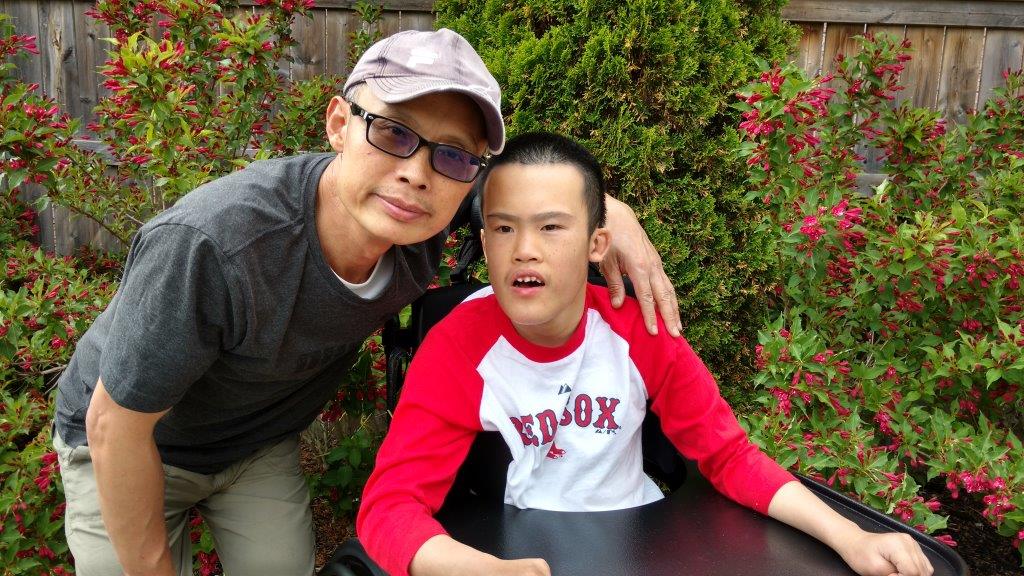
Samuel Cheng (above left) is a decision support analyst at Holland Bloorview. He spoke at a Schwartz Rounds recently about what it’s like to have his professional and personal life intersect, as his son Timothy (right) has disabilities. I wasn’t able to attend the event, but many colleagues told me they were profoundly moved by Samuel’s story, so I interviewed him.

BLOOM: Tell us a bit about Timothy
.


Samuel Cheng: He’s 14 and he has a genetic disorder and requires 24-7 care. He can’t walk, but he moves, he can stand. He can crawl and he needs to be watched to be safe, which is demanding. He has his favourite games and favourite videos. He doesn’t speak, but he points and gestures and people close to him know what he wants.

He was diagnosed with autism and he has seizures and a heart problem. His health is fragile. He loves music. Whenever he hears music he will be jumping around and smiling a lot and laughing. He likes to press sound-and-effect toys. He’s come to Holland Bloorview on Sundays for respite and he likes to go on the elevator and press the up and down buttons. He goes to a special class in an integrated school.


BLOOM: Does he like school?

Samuel Cheng: I think he likes it, but we don’t really know because we can’t go inside his world to understand what he’s thinking. I know in the morning we see him excited and happy to go to school and when he comes home we see he’s even more excited!

BLOOM: Does he have a close relationship with anyone?

Samuel Cheng: Only his mother. There is something special there. After his shower everyday when he sees his mother he has endless things to talk to her about. He speaks with her, face to face and with facial expression, making sounds. It’s like he’s trying to tell her whatever story he has. He’s never talked to me like that. I feel bad sometimes because I look at him and this is my son, but I feel remote with him. I’m only someone to be in charge. It seems to me that to him I am only someone, ‘anyone.’ This is a really bad feeling.

BLOOM: Do you think it’s possible that he knows that you are someone important to him, even if he can’t tell you that?

Samuel Cheng: Maybe, but I don’t know. There are lots of unanswered questions.

BLOOM: You mentioned you have another son.

Samuel Cheng: Yes, Aidan is nine years old.

BLOOM: What kind of relationship do Aidan and Timothy have?


Samuel Cheng:
Aidan knows he has a brother with special needs but they’re so distinct in what they enjoy doing and they don’t communicate a lot. I know that Aidan loves Timothy so much. Sometimes if there’s a dangerous situation, Aidan will yell and run to us to let us know Timothy needs help. Whenever we ask Aidan to help with Timothy’s care, he loves to help.


BLOOM: When is Timothy most happy?


Samuel Cheng: He enjoys being outside in this weather, but lots of times we feel discouraged because it’s not easy to bring a wheelchair to push him in and people in the community look at you differently. So he enjoys being out, but sometimes we are discouraged. I feel like we live in a subculture or a subgroup that is outside the ‘normal.’

BLOOM: I understand that feeling. Have you connected with any families who have children with disabilities?

Samuel Cheng: No, we don’t have friends within the disability community. I always feel that I’m different. I have no social life and for many years I just go home and come here to work.

BLOOM: What is the greatest challenge of raising Timothy?

Samuel Cheng: Everyday facing uncertainty in terms of his health. This morning he had quite a severe seizure that lasted a few minutes. I don’t feel there’s anything I can do about it. The first time he had a seizure 13 years ago, I rushed to him and was so worried. It seems that I’ve lost that emotion over the years. Because the situation keeps recurring, I become less emotional. I feel guilty, and I’m not happy that I don’t feel more emotion. Inside I feel I owe it to him. He’s my child and he’s fragile.

BLOOM: It sounds like you're very hard on yourself. I think parents of children with disabilities often feel inadequate because they can’t change the situation in the way they would hope. So we always feel we are coming up short.

Samuel Cheng: Yes, I feel that I’m not doing enough. Sometimes I come here for appointments and the therapists say ‘you need to do this and you need to do that’ and I’ll say ‘yea, yea, yea,’ but actually, I don’t fully follow the instructions they’re giving me. Because it’s become a routine, and I don’t believe it’s something that will help anyways.

BLOOM: I can imagine that when your child has so many needs, you could be working with him 24 hours a day and you still couldn't fit everything in.

Samuel Cheng: Timothy has such a long list of problems. He has everything! If he only had one of these problems, it would be big. For example, if he only had seizures. Or if he only couldn’t talk. Or if he only couldn’t walk. Or if he only had a heart problem.

Sometimes I think about what I would say if a wizard told me he could take away one of his diagnoses. But the list is so long I don’t know which one to pick. Can I take five? Can I take 10?

I’m not talking about small things you can do something about. I’m talking about life and death situations. There’s a huge uncertainty that drags all the energy out of you. All of the uncertainty and the emotion, everything is linked together like a web. You pull on one thread and the whole thing collapses. It’s too much.

Now, if we are given one more diagnosis for Timothy, I’ll say ‘just add it to the list.’ I don’t know where to go. Every day I tell myself and I tell my family, my wife: ‘I’m here. I’ll try my best to carry through one day.’

BLOOM: Did you have experience with disability before Timothy was born?

Samuel Cheng: No, I had no experience. That’s why it was really a shock. Through this whole journey, every step you see something you’ve never seen before, but it’s not good. And then sometimes you ask yourself: ‘Did I do anything wrong?’

BLOOM: You ask yourself why this happened to your child?

Samuel Cheng: I’m not complaining. I just feel guilty that maybe I did something. I feel that I was so self-centred. From the beginning I wanted to go to university, I wanted to get good marks. I wanted to graduate and find a job and a lady and have a family. Everything is a want: 'I want, I want.' And then I come up with this situation. I feel that I did something that is impacting everybody.

BLOOM: I think it's natural for parents to agonize over a reason why this has happened, particularly when their child has many struggles. But I don’t think it's true that you caused Timothy's disabilities, and I don’t think people around you feel that way.

Before my son was born, I believed there was some kind of justice in the world. I thought if you were a good person, mostly good things would happen to you. I couldn't understand how my son was born with a genetic deletion that was a random change at conception.

Since then I’ve come to believe that there’s a lot that's random in the world, and outside my control, and that helps me not feel so guilty about it. Sometimes things just happen, and there is no 'reason.' It can be hard to accept. We want to attach a story to what's happened as a way of feeling like we have control, that there's some kind of order in life.


Samuel Cheng: The bad feeling is not because of how I feel about all of the hard work. It’s because of the people around us who are impacted. I worry about the people around me, that it’s not fair to them.

I feel sorry for Timothy, for my wife, and my family. For example, my mother is 80 and without her we can’t live everyday because she helps to take care of Timothy. And on Saturday and Sunday, when you see people out and so happy because it’s the weekend, somebody has to be home taking care of Timothy. So they can’t be out.


BLOOM: Maybe your mother feels that her contribution to Timothy’s care is very important.

Samuel Cheng: Yes, she loves Timothy very much.

BLOOM: Do you ever have workers come to your house so you can get out for a little while and have a bit of a break?

Samuel Cheng: No, we don’t. And we don’t use the overnight respite at Holland Bloorview. I don’t go on vacation often, but when I do, I will always bring Timothy.

BLOOM: I think it’s very hard if you don’t get breaks from caring for your child when they need you around the clock. I think you need even very short breaks, to help you re-energize.

Samuel Cheng: Yes, it’s like a battery, getting lower and lower.

BLOOM: What do you like about your job here?

Samuel Cheng: I’m a part of this whole business—disability, healthcare issues. Before I came to work here I’d come for appointments and knew the place, so when I heard they were looking for an analyst, it was the perfect match.

I know what we’re doing here. As a parent I always feel I’m a second set of eyes to look at things. I can look at the system and identify something we can do a little better, and tell my manager or tell the system. Instead of just sitting here, I can do something to make it a little better.


BLOOM: Do you ever talk to other staff who have children with disabilities?

Samuel Cheng: Not really. We are so isolated. We’ve built a wall around us—well, around me. I’m facing it, so I’m here, but with the wall around me.

BLOOM: What was it like to listen to the other staff, who are also parents of children with disabilities, at the Schwartz Rounds?

Samuel Cheng: I feel I related to them. And I feel so sorry for them. I know that people here care, because when they hear my story, they send me notes of encouragement. They may not be able to do much to help, but at least they care.

Tuesday, September 29, 2015

'I'm ashamed to be jealous:' A special-needs dad

Yesterday this candid piece about being a special-needs dad on LinkedIn blew me away. It's such a rich account of the many emotions experienced by parents of children who don't meet conventional milestones. Author Mike Cook, a manager of Enterprise Services at Dell, Inc. in Oklahama City, said we could reprint it here. Enjoy! Louise

By Mike Cook

I have been blessed with an amazing family, starting with my wife (my rock). She is truly superwoman, and I don’t know how she does what she does, but I thank God for her every second of every day.

Between the two of us, we have four amazing boys.

Our oldest is 22 years old, recently married, and is in Air Force Intelligence. Our 20-year-old graduated valedictorian and was on the dean’s list in college. Our 12-year-old is in all-honours and read the Harry Potter series before he was five.

And last but not least is our youngest, Matthew, who will be three soon and is the happiest little man in the world. I wanted to share about all of our boys so that you realize how blessed we have been with some very bright young men.

At first glance, you would never be able to tell that Matthew is any different from other toddlers his age. No matter where we go, complete strangers always make the same comment: “That’s the happiest little boy I have ever seen.” Matthew always has a smile on his face.

What they don’t realize is that Matthew has major delays in his motor, speech, cognitive, and social skills. The doctors call it global developmental delay (GDD). In layman’s terms and what I tell everyone is: He doesn’t walk or talk yet. Doctors haven’t been able to determine what’s causing the delays yet, but for the last two years, our precious little boy has had to see more specialists than you can ever imagine.

Matthew currently has speech therapy, occupational therapy and physical therapy multiple times each week, and I must admit that raising a child with any type of delay, disability, disorder, condition, or special need is both a blessing and a challenge.

It’s a challenge for the obvious reasons. But it’s a blessing too: You can’t imagine the depths of victory and joy you experience when you see your child's reaction to overcoming his own challenges.

It’s the simplest things, like seeing his eyes light up waiting for you to acknowledge what he did when he puts his cup down softly instead of throwing it; the smile on his face when he climbs off furniture without any help, the clapping of his hands after he uses sign language to say “thank you,” or my favourite—the high-pitched dolphin-like sound he makes when he scoots over and hugs me to say “I love you!” Those moments are when I realize how blessed I am and what life is truly about.

People know me as a very open person who can usually talk to anyone. But what many don’t know is that after Matthew’s issues arose, I rarely express my deepest feelings. Instead, I internalize the problems we deal with and swallow them whole, because that’s what a strong father, husband—a strong man—is supposed to do.

I don’t want anyone to know how terrified I have been at times because I don’t want them to feel pity for me or think that I don’t love my son with all that I am. So, I want to share a few things about raising a child who has special needs in hopes of bringing a little understanding to those who don’t know what it’s like.

It’s tiring

As all parents can attest, parenting is already an exhausting endeavour. But parenting a child with special needs pushes us to an entirely new level of fatigue.

Even if I get a good night's sleep or have had time off, a level of emotional and physical exhaustion is always there, from the weight of tending to his needs.

Hospital and doctors' visits are not just a few times a year. They are typically a few times a month. Therapy sessions are multiple times each week. Paperwork and bills stack up, and spare time is spent catching up on cleaning, working with him on trying to crawl or walk, searching the Web in hopes of finding similar cases with cures to help him learn, or advocating for him in the medical and educational systems.

The emotional stress of raising a child with special needs has peaks and valleys that seem so much more extreme than those encountered in regular life. I am always so appreciative of my employer, Dell, Inc., for helping make life easier—from arranging schedules around Matthew’s appointments so I can work from home if needed, to understanding the last-minute fill-ins if my wife may not be able to make a therapy session or doctor’s visit.

It’s scary

I often worry: Am I helping him too much? Am I not helping him enough? What if I’ve missed something—a treatment or a diagnosis, and that window of time to treat it? What about his future?

Will he ever drive a car? Will he ever get married? Will he ever be able to live independently? I fear thinking of the hurts he will experience if he doesn’t catch up and is tagged as 
different by other kids in this harsh world. I am scared about finances. Finally, I fear what will happen to Matthew if anything were to happen to my wife or me.

In a way, I feel ostracized

I feel we are now outsiders due to a fear that something could happen to Matthew because he can’t protect himself the way a “normal” child can. I worry that he can’t say “stop” or “don’t” or that he won’t realize he should have said it until it’s too late. I worry that people simply won’t understand him. I’ve seen the sideways glances and rolled eyes from strangers when he throws food or does something they consider rude or disrespectful, which makes going out to restaurants even more difficult.

When my wife and I go to parties, we end up by ourselves, whether or not we have our little boy with us. If he’s with us, then we’re constantly watching him to make sure he’s okay. We don’t make our rounds and say “hi” to everyone. We simply can’t for the reasons I’ve mentioned above.

If he’s not with us, then we’re worried that something will happen to him away from us. We don’t go out with our friends the way we used to because it’s too frightening to leave him with someone who might not understand what he’s trying to say or sign. Sometimes it’s even too hard to get your own family to understand just how stressed out you are.

I’m ashamed to be jealous

Even with the beautiful family and blessings I have, I can’t help but feel a tiny pang of jealousy at times when a child younger than Matthew runs past me or calls out to his or her parent the way I want to see my son Matthew do.

What’s even worse is that this envy makes me feel as guilty as can be, because I am so proud of everything Matthew has accomplished. This little boy has worked harder than any of our other boys to accomplish everything he has been able to do, but I wish it hadn’t been so hard for him.

I hate when that little pang of jealousy hits me—this so-called “normal” child in front of me didn’t ask for my little boy to have a learning disability. This child doesn’t realize that when he calls out “Daddy,” for a split second, I think, “Why? Why did this happen to my son, and why can’t I hear him say 'Daddy'?" Then I push that thought as far away as possible because these questions are not fair to that child or to my little boy.

If Matthew ever reads this in the future, I want him to know that I have never regretted a second with him. Matthew, you have made me a better parent and a better person. You amaze me every day with every single accomplishment you achieve and the way you are always happy. I only wish I had known what I know now when your brothers were your age, for I would have spent more time with them.

I love talking about my son

My son is awe-inspiring. Some days I want to shout from the rooftop how funny and cute he is or how he accomplished something. Other times, when I'm having a rough day due to being made aware that Matthew is sick yet again, I might not say much.

I don't often share with others, even close friends and family, the depths of what I go through when it comes to Matthew. I feel as if something is always going on, and I don’t want to be a burden or seem negative. I do appreciate when people ask me about my son, but if I'm not sharing, please don't think that there isn't a lot going on underneath, or that I don't want to let you in.

Raising a child with special needs has changed my view on life. Nothing breaks this “lens” more than having a sweet, innocent child who was born with impairments that make ordinary living and normal “performance” difficult or even impossible.

My life with Matthew has helped me understand that true love is meeting someone exactly where they are—no matter how they stack up against what the world thinks they “should” be. Raising a child who has special needs shatters all the expectations that we build our lives around and pushes something else to the core: love and understanding.

I’m human

So, to our friends and family, future friends we haven’t had the pleasure of meeting yet, or strangers who know and love a special needs family somewhere in this vast world of ours:

What can you do?

Strive to include. Work to understand. Go out of your way on occasion to help a family who has a child with special needs. Realize that the stress and strain take their toll. We’re just trying our best to survive. If we seem secluded or if we’ve offended you with our words or our actions, we apologize for our moments of weakness. Hopefully, someday we can move forward together.

We do our best to make our family life look normal and to act like everything’s fine. And yet, we wish people might see through that facade every once in a while and understand that we truly appreciate the slightest effort to make us feel...special, just as our son is special.


Wednesday, April 29, 2015

Want to know how dads feel? Watch this film


By Louise Kinross

It's not often you hear fathers of children with disabilities talk candidly about their child's diagnosis and how they reacted emotionally to it. But in Do It Differently, Scott Phillips sought out four dads with kids with autism and created an environment, maybe because it was dad-to-dad (Scott also has a child with autism), where they felt comfortable. The result is an exquisite, hour-long documentary where dads bare their souls. "We said 'why us,' as well as 'what did we do?'" recounts one of them. This is a must-see for every dad, and for every mom who felt their partner didn't 'get it' the way she did. You can watch it for free on YouTube or buy a DVD at Fan Blade Films. "For all fathers who feel lost, scared, and helpless I hope the film...inspires you to want to do more for your child who is different than you expected," says director Scott Phillips. "You are not alone."

Thursday, April 16, 2015

Four dads on raising kids with autism


Wednesday, March 11, 2015

A son's injury prompts a dad to give back

By Louise Kinross

In 2011 Amir Karmali’s son Kaylum was accidently kicked in the head during a soccer game. The next morning he couldn’t walk and was hospitalized. Two days later doctors said Kaylum had suffered a stroke.

“They said they’d never seen that type of soccer injury before,” Amir recalls. “I spent the next eight hours on top of my son’s bed crying and watching him while he slept.”

Kaylum began intensive therapy as a daypatient at Holland Bloorview. But just when he was improving and about to be discharged, Amir was laid off from his job. “I couldn’t make sense of why this had happened to me. First my son getting injured, then being let go from work. I crashed and experienced a lot of stress, anxiety and depression. I googled ‘how to deal with stress and anxiety’ and a few things came up: meditation, exercise, and helping others. I decided there was a greater purpose for me, that if I didn’t use this experience to help others it would never make sense. I needed to help others make change.”

This week Amir was recognized with other Holland Bloorview staff for his role in engaging parents in the creation of clinical simulations that are used every month to train staff and students in client- and family-centered care. The team received one of Ontario’s
20 Faces of Change awards from The Change Foundation for its “patient engagement and family-focused change in the province’s health care system.”

It reflects the critical role Amir has played in building Holland Bloorview’s family leadership program, which he chose to participate in after his son’s accident as a way of giving back.

The family leadership program gives parents a voice on hospital decision-making bodies, as faculty at education events and as mentors to other parents raising kids with disabilities.

Amir joined as a volunteer on our family advisory committee, then applied for a part-time position managing the family leadership program—a radical departure from his background in the restaurant and corporate world.

“I wanted to help people. I didn’t want to let my son’s experience define us in a negative way. I vowed to use it to be a part of making change at Holland Bloorview. Yes, this happened to my son and my family was thrown a curve ball, but I wanted to hit a home run.”

Amir now works full-time as a family-centred care specialist on Holland Bloorview’s family leadership program, which has over 120 client and parents members.

“Family leadership is about family engagement, empowerment and activation,” he says. “It’s the program that brings the families’ perspective, voice and wants and needs into all of our discussions to ensure our programs and services meet their needs.”

Amir’s background in human resources and education gave him the perfect skills for recruiting and training parents, then matching them with projects in the hospital and ensuring that staff know how to “authentically engage our families. We want to know how our family will make a difference. They’re not there as a rubber stamp. I work with staff to define the purpose and goals of the family role and to set clear expectations.”

Amir says the key to the program’s success is making great matches. “We didn’t place families that we didn’t have. We had no problem saying no, we don’t have a family that matches that skill set or has that experience or has used that service. We also ensure that our families are in the right place to give solution-based feedback to the hospital because the program isn’t about advocacy or a place to vent. We want to learn from their good and not so good experiences.”

Amir says Holland Bloorview has invested in family partnership, hiring him full-time, dedicating other resources and changing the culture of how it makes decisions. “Nothing happens in here without the family’s perspective anymore. Staff come to me for family feedback at the conception of an idea, not when they’re about to launch a program.”

Amir says his son Kaylum has recovered and is playing soccer again and thriving. “I had a great support system of family and friends and I couldn’t have kept going without them.”

He hopes his experience finding a new career path encourages other families to find something positive in the challenges their children face. “I knew there was a bigger purpose. I wanted to do something that was bigger than me.”

Tuesday, September 25, 2012

Dad's age a small risk factor in autism

I was concerned about this study's impact on how our culture views a parent's role in “causing” disabilities like autism. So I was pleased to interview Dr. Evdokia Anagnostou and learn that while helping us understand the jump in autism rates in a large population, the study does not identify father's age as a major risk factor in individual cases. Louise

Father's age linked to autism risk, but overall risk is small

Men in their 40s are more likely than those in their 20s to father a child with autism or schizophrenia, but the overall risk is still low – about two per cent – according to a study published online in Nature last month.

“The majority of babies born to 40-year-olds are healthy, but the study helps explain some of the increased risk in a huge population – which helps explain some of the rise in autism rates in the last couple of decades,” says Dr. Evdokia Anagnostou, a child neurologist who leads a clinical program in autism research at Holland Bloorview.

Researchers in Iceland examined genetic material from 78 parent-child trios, where parents with no signs of mental illness gave birth to a child who later developed autism or schizophrenia, and a control group.

They found that as men aged, they transmitted more random mutations to their child at or near conception. The average child born to a 20-year-old father had 25 mutations linked to the father. This increased by two mutations a year to reach 65 for children of 40-year-old men. The mother’s age had no impact on risk.

“Lots of random genetic changes happen with age and the majority mean zip,” Evdokia said. “It’s the rare ones that lead to syndromes like autism.”

However, the more mutations a child has, the more likely he or she is, by chance, to have one of the rarer, disabling ones.

The study is important because it helps explain the biology of autism, which may aid in treatment. “If we understand the pathways from genes we discover we know where to focus our efforts.”

Evdokia emphasized that autism is “a multi-factorial disease that can’t be prevented at this point. Paternal age can now be seen as one of many contributors to risk – but it doesn’t explain the majority of risk.

“There are many, many reasons why you may end up with a child with autism and if the father is older the child gets this extra little hit. But most of the time a child needs to have many hits to get autism.”

Other factors that increase risk include a father's genetic makeup, such as having a sibling with autism; the fetal environment, including infections during pregnancy and exposure to fertility drugs; and possibly some environmental toxins.

“Some kids will have enough of a genetic hit to cause autism and some will have a genetic risk that interacts with one or more environmental factors.”

Evdokia said that the study is helpful in explaining the increase in autism rates in a huge population – but doesn't identify father's age as a major risk factor in individual cases.

“If someone asks me ‘Do you think I should not have a baby because I’m 40?’ I would say you absolutely should have a baby. The majority of babies born to 40-year-olds are perfectly healthy.”

In addition to improving our biological understanding of the disorder, Evdokia hopes that studies like the Nature one focus research on “the real reasons for autism – so people don’t get stuck theorizing about things like vaccines or power lines, for which there is no evidence.”

Friday, May 18, 2012

Buzz Bissinger on his new memoir

Monday, June 13, 2011

A short review of a dad's memoir

This is a thoughtful dad's perspective on what it's like to have a son with autism. The dad is Joel Yanofsky, a Montreal author and book reviewer. In addition to capturing the joys and frustrations of his relationship with son Jonah, we get a look at the impact of autism on a marriage. "Tantrums had become routine -- for Jonah and me," Joel writes. "He'd cry and rage, and I'd explode. I can't count the number of times I was exiled to the basement." "If you have to brood, brood there," (wife) Cynthia would say.

We follow Cynthia and Joel to counselling and through years of applied behavioural therapy. Joel gives us his take on a number of memoirs about parenting a child with autism, and interviews well-known writers and bloggers, including Estée Klar of The Joy of Autism and Emily Perl Kingsley, who wrote Welcome to Holland.

I found this book moving, funny, candid and ultimately hopeful. Louise 

Tuesday, May 17, 2011

Dads and depression

The story below is from Disability Scoop, an excellent online resource for issues related to developmental disability. I think the mental-health impacts of raising children with disabilities are still a bit taboo. And I was just talking to one of our dad readers about how it's harder for dads to connect with each other -- for information and emotional support. Thoughts? Louise

Autism takes heavy toll on dads
By Michelle Diament, Disability Scoop

More than 30 percent of fathers of grown children with autism experience symptoms of depression so severe that they warrant clinical attention, first-of-its-kind research indicates.

In a study presented Friday at the International Meeting for Autism Research in San Diego, researchers found that fathers of adolescents and young adults with autism experience high levels of depression and are pessimistic about what the future holds for their son or daughter, much more so than dads whose kids have other disabilities like Down syndrome and fragile X.

“Fathers of adolescents and young adults with autism are really faring the worst,” says Sigan Hartley, a University of Wisconsin-Madison researcher who led the study, which was recently accepted for publication in the journal Family Relations.

Hartley said her findings mirror what researchers already know about mothers of those with autism — that they experience higher stress than other moms and that stress remains even as their children age. But this is the first time anyone has looked at how dads cope as their children get older.

For the study, Hartley and her colleagues looked at self-reported data collected between 2000 and 2005 from fathers of 240 individuals with autism, Down syndrome and fragile X syndrome ranging in age from 10 to their early 20s.

After controlling for the child’s age, family income and the marital status of the father, the research team found that dads of those with Down syndrome fared best out of the three disability groups while those with a child who had fragile X syndrome fell in the middle.

Factors such as the child’s behavior, the likelihood of having more than one child with a disability, the father’s age and the mother’s well-being did seem to play a role in fathers’ experiences. But Hartley says more research needs to be done to better understand what’s leading to elevated levels of depression symptoms in dads of those with autism in particular.

“This is the first step to drawing attention to dads,” Hartley says. “We need to get away from just looking at moms.”

Tuesday, December 7, 2010

The Father's Network


I found an exquisite American website devoted to fathers of children with chronic illness and developmental disabilities.  It's called The Father's Network.

The content is powerful -- although many of the stories were written in the 1990s. This would be a fabulous place for the dad of a newly-diagnosed child to gain support and understanding and perspective.

Check out the numerous stories in the archives.

I've already looked up one of the authors to see if he'll write an update for us on his experience with his son, and have contacted the organization to find out more about it.

Too often the father's voice in the world of childhood disability is missing (or perhaps simply not sought out). I encourage you to read these stories. Let us know if you have other recommended reading by fathers of children with disabilities. Thanks! Louise