Showing posts with label Adaptive-living. Show all posts

Monday, May 27, 2019

'We Carry Kevan' aims to inspire a new model of inclusive travel

By Louise Kinross

Kevan Chandler paid a visit to Holland Bloorview last week on a tour to promote his new book We Carry Kevan: Six friends. Three countries. No wheelchair.

We’ve interviewed Kevan twice. Once about his 2016 trip to Europe with friends who carried him in a modified backpack, and once as he planned a similar trip last year to China, where he visited care centres that support orphans with disabilities. Kevan lives in Fort Wayne, Indiana, has spinal muscular atrophy, and weighs about 65 lbs. It was awesome to meet Kevan in person.

BLOOM: What is the purpose of your new book?

Kevan Chandler:
The new book chronicles our adventures in Europe and then China, and everything building up to that, with a little bit of autobiographical information about my childhood. It’s a travel memoir of our journey so far, and within that it gives a lot of insights on my perspective about disability and our friendships and how that all ties together.

BLOOM: What message do you hope readers take away?

Kevan Chandler:
I think for folks with disabilities, it’s an encouragement to see someone with a disability living a full life, and in such a way that people can read it and say ‘Oh, yea it is possible. I can do that, too, in my own way. Our story is about how we figured out how to do things. We’re not telling people how, but saying you can figure it out with the people around you.

For the able-bodied community, the book is an insight into a world they may not be familiar with, and an encouragement to plug into that world. It’s an ice-breaker.

BLOOM: We spoke with you before you went to China. Now that you’ve actually been there, what was the greatest challenge?

Kevan Chandler
: There were a lot of challenges. We went to three cities and we had three very dynamically different experiences. Going into each city, we’d get settled, fall in love with the place and have to leave. We spent most of our time in care centres for orphans with disabilities—really getting to know the children and staff and very quickly building some life-long relationships. It was surprising how you can be somewhere for only four to five days and feel homesick for that when you leave.

BLOOM: I guess you were immersed in the children’s lives.

Kevan Chandler:
To see that 24-7 life of caring and loving for these kids, and being in that community, yes, we were immersed. And there was a physical toll as well. The first city we were in was a village in the middle of nowhere. The conditions were more difficult there. The other care centres were a bit more Western—spectacular, clean and well-equipped.

BLOOM: What did you do there?

Kevan Chandler:
We rolled around on the floor and played with them and held them and cuddled them and talked with them. They loved having us there. Most of the nannies and caregivers are women, so it took a little time for them to get used to a group of guys.

There was a language barrier and a lot of the children were non-verbal, so there wasn’t a lot of communicating with words. At first the guys brought me in and set me in my backpack with the kids, but the kids didn’t know what to think of the backpack. I decided it was better to lay me on the floor with them: ‘I’m here, I look like you.’ We talked with them and made noises and rolled around.

BLOOM: Did you take any of your backpacks with you?

Kevan Chandler:
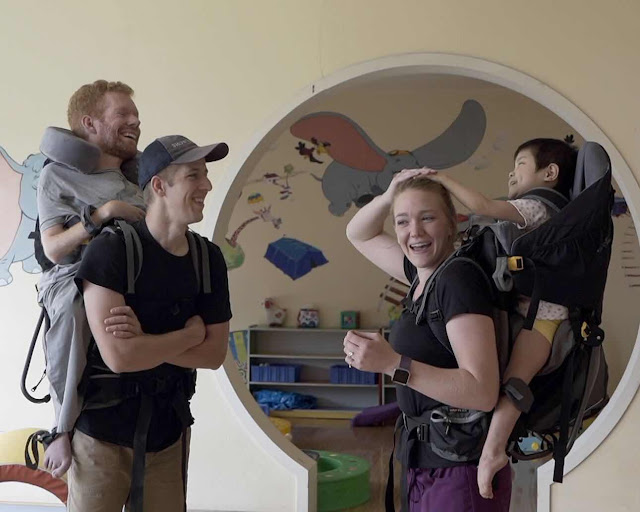
We took two to donate. The staff would bring a child into the room to meet me, and one of the guys would get me set up in my backpack while the child watched. If the child responded well, we’d pull out the extra backpack. We’ve been working with Deuter to develop an adapted design. When we get the first order in this summer we’re sending 10 to the care centres, with a plan to send more.


BLOOM: What was the greatest joy of the trip?

Kevan Chandler:
Being with the kids was the greatest joy, and getting to experience it with my friends. You can imagine the heart of these guys to care for me like they do, so I can travel with them. We saw everything from the care centres to the Great Wall (see photo above) and the Shaolin temple.

BLOOM: Isn’t there a lot of stigma towards disability in China?

Kevan Chandler:
Yes. People with disabilities are hidden away by their families or the system. You don’t see a lot of people with disabilities. We saw one lady in a wheelchair in the market, and otherwise never saw anyone with disabilities in our three weeks there.

Something I was surprised by was that when we would walk through the market or the city, people—especially of the older generation—would stop and give us the thumbs up and shake the hand of whoever was carrying me. They seemed to have a lot of respect and appreciation for what the guys were doing.

We knew there would be a language and some cultural barriers. But we hoped that the spectacle of one guy carrying around another guy would be a visual that would inspire and encourage people.

BLOOM: How often do your friends switch off with carrying you?

Kevan Chandkler:
We try to do a 45-minute switch, that way no one gets completely worn out. Something really neat was that we had other people, outside of our team, carry me as well. At the care centres, a couple of the workers were big guys who said they’d like to help out, so they took turns when we were in the market. Our translator, who didn’t come to carry, also carried me as well. We had only brought three carriers, so it was cool to incorporate more people.

BLOOM: You have a non-profit called We Carry Kevan. What is the mission?

Kevan Chandler:
Our mission is to redefine accessibility as a cooperative effort—people helping people, and getting involved with each other’s lives. Right now our main focus is implementing the backpack, and encouraging people who can, to use it. It will be available this summer and is a one-size that fits up to 70 lbs.

BLOOM: What does it cost?

Kevan Chandler:
It’s US$375. It’s completely adjustable and versatile for different sizes and needs. For the past two years we’ve been developing it with Deuter. We‘ll work with a family to customize it to each individual. Managing that, and with my book coming out, has been a full-time job.

BLOOM: What makes your travel unique is the participation of really close friends. How can that work for kids who don’t have friends?

Kevan Chandler:
I talked to my mom about it recently, and she said when I was diagnosed she and my dad decided they would raise us as normal as possible (my sister also has spinal muscular atrophy). They knew that would take a lot more work, but they wanted us to be involved in the able-bodied community.

What they ended up doing was that we were out in the world, and we also invited the world in. That introduced that idea of community. It normalized for our community the idea that my sister and I, we had needs, and people could help out. It taught us not just to ask, but to invite people into that. It also taught our immediate community how to respond. As I got older, it became more my responsibility. It’s going to be uncomfortable, but you have to put yourself out there. It’s worth a try. Everyone may not get it. But the people who do get it are going to be awesome.


You can follow Kevan at We Carry Kevan. The group is working on organizing international shipping for its adapted backpacks. If you have any questions, please e-mail at wecarrykevan@gmail.com. The photo below was taken at one of the care centres in China where kids got to try out the adapted backpack. Check out Kevan's Ted Talk.

Thursday, April 25, 2019

A front pack takes Louise where she wants to go

By Louise Kinross

Louise Sertsis never saw herself as an entrepreneur. But that was before she was diagnosed with multiple sclerosis, and began using a wheelchair.

It bothered her that to carry a purse or bag she had to hang it on the back of her wheelchair, out of sight, and ask her husband—or a friend or stranger—to pass it to her.

“I felt very dependent on others,” says the Whitby, Ont. resident. “It gave me the idea of redesigning a knapsack that attaches to the front of the user, to promote independence and safety and the feeling that I can do this myself.”

For the last couple of years, Louise has developed prototypes of what she calls the Handi Pac, which is two bags in one, separated by magnets. She started a business, called Advanced Freedom. Next month, she's launching a Kickstarter campaign to fund production of the first 300 bags.

One part of the Handi Pac sits on your lap and is attached with a waistband secured behind your back with magnets, Louise says. “You’d put anything you’d normally carry in a purse on a daily basis in it”—like a wallet, keys, tablet, phone and sunglasses. “It’s attached to you, so there’s no concern about the bag falling off when you go over a bump. That’s what used to happen, when I placed my purse on my lap. And because the bag is attached, someone can’t take it from you.”

The second part is worn from your knee to the top of your foot. It carries 15 lbs—the equivalent of a carry-on bag at the airport—and is the largest wheelchair bag on the market, Louise says. It attaches to the users’ calves with a magnetic system. “It’s great if you’re travelling, or going to school or going to the gym.” 


The pack is made of water-resistant, durable cordura nylon. The large bag sits on your feet, so if carrying a heavy load, you may need to take a break.

Louise says she knew nothing about business—she studied science and psychology at school. “I had to learn everything from the ground up. I’m a sole proprietor.”

Online, she made a chance contact with a manufacturer of traditional backpacks that are sold in stores like MEC. “When I told him about my idea, he thought it was amazing,” she says. “I was missing the business side, and he mentored me. He’s made all of my prototypes.” 

The current design is sized for an adult, but Louise says a child-sized version is in the future.

Louise says the first time she tried a prototype she “jumped for joy. I was ecstatic because it worked so well for me that I knew it could help a lot of people. It was so gratifying to see my solution in physical form.”

Louise plans to sell her bags internationally, and finds herself on social media at all times of the day and night, answering questions from prospective customers. 


Check out this video of Louise demonstrating how to use the Handi Pac. You can find more information on her website, or follow her on Facebook.


Wednesday, July 18, 2018

One family, one sporty Whistler vacation

By Louise Kinross

Carol Eastwood wanted to go on a family trip with her husband and two sons. “I have a 27-year-old son and a 20-year-old son who uses a wheelchair, and I wanted all of us to go on a trip where no one would be left out,” she says.

Carol’s son Ian Steadman, 20, like the rest of the family, is a sports fanatic. He studies sports management at Niagara College, plays sledge hockey with the Halton-Peel Cruisers, swims competitively with the Milton Mighty Tritons, and loves wheelchair basketball and nordic skiing.

In 2010, Ian and his mom were in Whistler, B.C. to watch the Paralympics and Ian rented an alpine sit-ski for the day from Whistler Adaptive Sports Program. “I fell in love with Whistler then,” Ian says.

Carol heard that Whistler Adaptive had summer programs and decided to organize a week’s long family trip around them.

Last month they flew to Vancouver and rented a van to drive up to Whistler, where they stayed in an accessible condo in the upper village. It had a paved, accessible path down to the village.

The family was able to rent all of their regular and adapted equipment—for hiking, biking and kayaking—through Whistler Adaptive. “We wanted to do these sports because we could do them together,” Carol says. “If we couldn’t do something together, we didn’t want to do it. 
The program also provided wonderful volunteers who were experts in each adapted sport and knowledgeable about the area as well. 

They began with hiking. The family met Whistler Adaptive at a sports complex where they picked up a trail rider they were renting for Ian (see photo below). It’s like a chair on one wheel with metal attachments at the back and front that can be pushed and pulled by volunteers. Think “chariot!” Carol says. Two volunteers were provided, but Ian’s brother John decided he’d like to help and push.

“I enjoyed the experience of being on the mountains and the trails, especially since it’s something I might never have been able to do,” Ian says. “It was a reclining chair and I held onto the sides for support. The volunteer knew all about the history of Whistler and the mountains and of a train wreck there.”

On another day, the family went kayaking. They met the folks from Whistler Adaptive at Alta Lake. “There was an accessible path down to the dock, where a kayak volunteer and all of our kayaks and protective rain gear were ready to go,” Carol says. Ian used a tandem kayak with the volunteer and the family spent about two hours exploring the lake.

“Because I wasn’t supporting Ian, I could really relax and enjoy the activity,” Carol explains. “That’s the thing about this trip—we could all enjoy the activities.”

Next, the family took an accessible gondola up Blackcomb mountain. “You just wheel in, like an elevator,” Carol says.

At the top, Ian and his brother John decided to take the Peak 2 Peak gondola with a glass floor across to another mountain. “My mom doesn’t like heights,” Ian explains.

Ian’s favourite activity was biking. The family was outfitted with bikes at a bike shop, including a hand bike for Ian.

“On our first day, Daniel, a director at Whistler Adaptive, took us out and showed me how to use it,” Ian says. “It had gears as well as a speed-control assist machine that I could turn on for certain hills.”

“I saw how fast he was going on it, and I was having conniption fits,” Carol says. “I thought you were going to wipe out, but you never did. It was great to see my two boys doing an activity together at the one who has got the ability’s speed and level.”

The brothers liked it so much that they went out on their own the following day. “I haven’t been on a bike in a while and it was nice to experience something just with my brother,” Ian says. “It was intense. We went round the lake six or seven times.”

Renting adapted equipment is a bit more expensive than regular equipment, Carol says. “I think the hand bike was about $45 and our bikes were $20 each.”

After a day of activity the family went back to their condo to shower and head out for dinner. They strolled along a paved path from their condo to the village, where the restaurants, hotels and boutiques were accessible. “Everyone seemed to be comfortable dealing with wheelchairs,” Carol said.

Ian hopes to apply to volunteer or work at Whistler Adaptive next summer. “He was so pumped at the opportunities for having a disability yet working in the field of sports—whether abled or disabled,” Carol says. “They were integrated.”

Carol says booking a trip before the high-season in July made it more affordable. She was also able to get her Air Canada air ticket covered by going as Ian’s attendant.


Friday, March 2, 2018

It's time for the Paralympics. Where's the buzz?

By Louise Kinross

This morning this story popped up in my Google alerts: Why do Americans ignore the Paralympics?

My first thought was 'What Paralympics?'

I was surprised to read that the Paralympics in South Korea begin March 9. I hadn't heard anything about it here in Toronto.

I messaged my husband, who is an editor at The Globe and Mail: "Did you know the Paralympics start next week in South Korea?"

"I did not know," was his reply.

I was totally caught up in the excitement of the PyeongChang Olympics, and was surprised I hadn't heard about the Paralympics. 

Boston Globe reporter David Scharfenberg, in the article above, describes the disinterest of Americans in the Paralympics this way: "More so than in Europe or Japan, the media landscape in the Unite States reflects an obsession with youth, sex, and money—or, rather, a certain brand of unblemished youth, a certain kind of stylized sex, and a certain type of unabashed capitalism. And the Paralympics just don't fit the formula. They cannot be easily turned into the sexy, profitable entertainment at the center of American life."

In contrast, Scharfenberg notes that hundreds of journalists from the United Kingdom, Germany and Japan flocked to the 2016 Paralympics in Rio de Janeiro, and the London games in 2012 were packed.

The full schedule of the PyeongChang Paralympics will be available here soon, the official website says. But the actual event starts a week today. Isn't that leaving it a little late?

Last week, The Toronto Star ran this piece about how Canada is sending 55 athletes next week, its largest contingent. CBC also has a story about it. But I don't see much, if any, coverage on individual athletes. Think about the stories we read about athletes leading up to the PyeongChang Olympics?

The 2018 Paralympics trailer, above on Youtube, has only 9,000 views. Yet Scharfenberg says that the games are the world's third-largest sporting event.

I couldn't find a Canadian video for this year's Paralympics. Please advise if there is one. I did find this U.S. one, with less than 400 views! 

Scharfenberg interviewed Rosemarie Garland-Thomsom, a professor of English and bioethics at Emory University who specializes in disability studies about the American disinterest in the Paralympics. I read her excellent book called Staring: How We Look. She points to the deep discomfort in American culture with the disabled body.

Canadians like to think their values are somewhat different from Americans. I'm not sure if they are in this respect.

Monday, February 26, 2018

Doctors' disbelief is a common response to rare disease

By Louise Kinross

Laura Howson-Strong is an occupational therapist at Holland Bloorview who has worked with children with disabilities at two ends of the spectrum: as preschoolers readying for kindergarten at our nursery schools, and as teens preparing for transition to adulthood.

At a Schwartz Rounds last year, Laura shared what it was like to work with our families given her personal experience with rare disease. As a child, Laura had pain that oscillated between her stomach, her chest and her joints. Doctors told her parents she was attention-seeking and “making it up,” she says.

As a young adult her symptoms got worse. She was diagnosed with conversion disorder, “where the physical symptoms are real, but are caused by a reaction to stress or psychological trauma.” It took 11 years, several misdiagnoses and a lot of her own research, before she learned she had a rare connective tissue disease called Ehlers Danlos syndrome. Three years later she was diagnosed with a second condition, mast cell activation syndrome, an immune disease.

“When I heard about the Schwartz Rounds on health-care workers who are also health-care users, it spoke to me,” she says. “I thought: ‘Why don’t I tell people about my diseases and experiences? Why am I hiding, so to speak?’” 

“I realized I was keeping quiet because I had a lot of shame and doubt. In the past, I wasn’t supposed to speak about my symptoms, because they were something I was ‘doing’ to myself. But then I learned this was still happening to others. In 2018, children are still given mental illness diagnoses or going undiagnosed when their bodies are failing them. My story isn't uncommon.”

BLOOM interviewed Laura to learn more about how her personal experiences have informed her work.

BLOOM: What is your current job here?


Laura Howson-Strong: I’m an occupational therapist in experience-based employment programs like Youth@Work, Ready to Work and VolunteerAble. A large focus of my job is helping clients and families identify and build the skilled needed for transition to adulthood. It could be learning about job tasks that you can do and like; speaking to new people; ways to market yourself; and thinking about how you learn and how to ask for accommodations.

I’ve also worked in early learning with children with disabilities from birth to six.

Over time, I’ve heard so many similarities in the goal areas of these two populations. Things like: ‘How do I make friends?’; ‘How do I speak up to ask for help?’; ‘What can I do and what do I enjoy doing?’

BLOOM: What’s the greatest joy of your work with teens?

Laura Howson-Strong: I love being able to be part of successes and solutions. In some cases I’m able to see youth and their families throughout their young adulthood, so I’m able to see the change and the progress over time.

BLOOM: Why is Rare Disease Day on Feb. 28 important?


Laura Howson-Strong:
First and foremost, there aren't enough of us to represent ourselves, and many rare diseases go undiagnosed. So we need allies. We need people and communities and organizations to spread the word to bring awareness to these diseases, and to have decision-makers better understand their impact. We need help to advocate for increased funding, knowledge, research, treatment, and possibly cures. I’ve learned that the majority of the rare diseases out there don’t have cures.


For me, I worry that in light of the incredible medical advances going on, a cure for my disease may exist in a cure for another disease. But it might never come to fruition for me, because the right people aren't aware that my disease exists.

Rare Disease day is also an opportunity to celebrate our journeys and uniqueness and beauty and strength. We’re not made to fit moulds, and that should be recognized and honoured.

It's also important because we need to end the unnecessarily complex and sometimes damaging diagnostic processes people experience. Mental illness diagnoses should not be a common step of your medical pathway to getting a rare disease diagnosis.

Right now, denial of symptoms, of services, and of the support we so desperately need within the healthcare system, is a common thread in many of our stories.

BLOOM: What is your diagnosis and how does it affect you on a daily basis?

Laura Howson-Strong: My primary diagnosis is Ehlers Danlos syndrome (EDS). EDS is varied, individual and multi-systemic. It’s a genetic connective tissue disorder with symptoms that range from mild to debilitating. Many of our symptoms have diagnoses of their own.

It affects me daily, all day, every day. The main issues I deal with are chronic pain, joint dislocations, fatigue, gastrointestinal problems and nerve damage.

BLOOM: How do you manage?

Laura Howson-Strong: Daily medications. A lot of them. I also use braces. Some constantly and others at different times of the day. I have ankle-foot orthoses, a neck brace, hip braces, finger and wrist braces. I use a cane for difficult days, long distances and bad weather. 

It's different for each person with EDS, but I manage pain and fatigue through medications, joint injections and positioning—the way I move my body, the way I sit and the way I reposition myself. I set up my days to have a variety of movement and rest activities. I’ve tried a lot of rehab and therapies, and I’ve stuck with swimming therapy and physiotherapy. I’m going to a private specialty EDS clinic in Ohio this year to pay for medical services.

BLOOM: Is there not one in Toronto?

Laura Howson-Strong: Luckily, a new rare disease clinic opened through the University Health Network last year, and I'm on a long wait list for it. At this time, it's a diagnostic clinic only. I look forward to eventually connecting with doctors familiar with EDS through this clinic.

I'll be paying thousands of dollars to go for treatment in Ohio to address loose joints in my neck that dislocate easily. It will likely include Botox, bracing and therapy done by a doctor.


BLOOM: What is your hope for the trip?

Laura Howson-Strong: Pain reduction, better treatment of the symptoms, more EDS-specific knowledge and validation of my symptoms.

BLOOM: You also have an immune disorder. How does that affect you?


Laura Howson-Strong: I have an overactive response to allergens, but it's difficult to determine what allergens because the response is not consistent. It could be clothes, food, the environment or my own heat and sweat. I get symptoms of anaphylaxis such as rashes, swelling, throat closure and difficulty breathing. I take medication to decrease the response, rest, and sometimes go to the hospital. Mast cell activation syndrome can be connected to EDS, but the connection isn't fully understood.

BLOOM: How does having a rare disease add value to your work?

Laura Howson-Strong: I was an occupational therapist first, and a patient second. When I was at school, I had no diagnosis.

When I entered the health-care system as an occupational therapist, I was shocked at how much I struggled to navigate and to speak up. I was educated in health care, yet I became lost and overwhelmed.

When I was diagnosed with conversion disorder, I was shut down by doctors. They would say ‘the basis of this is psychological or psychiatric, and I don’t have the services.’ They refused to refer me on to specialty clinics for the physical symptoms I had.

I lived a few years of my life thinking I was causing this myself. I began to hide the symptoms, the pain, and I just didn’t talk about it. This interview is going to be the first time that many of my friends and family hear that I was diagnosed with a rare disorder, let alone conversion disorder.

One way my experience influences my work is that I really think about how we value the voices of youth. How do we include them in decision-making, and in appropriately understanding their treatment plan and being part of their plan?

I think we're trying hard to do that as an organization, but I still think we have a ways to go to make sure children have their voices and concerns heard during appointments, and have opportunities to get their questions answered in the health system overall.


BLOOM: How do your own experiences with pain and disability inform your work?

Laura Howson-Strong: As a patient, I was so surprised to learn how much the medical system expects of patients and caregivers: to be a system navigator, a doctor liaison, an organizer, a nutritionist, a therapist, a record-keeper. I learned it’s exhausting and sometimes almost impossible.

Today I can better see how much pressure we put on parents to do everything—to keep connected, to be a parent, to be a therapist, to be a doctor, to manage all the appointments, to manage all of the paperwork.

When is there time for parents to self-reflect, network, participate in self-care, or just have fun?

It makes me look at what I expect from families in sessions, and to cut down on the number of recommendations and goals I have. When I set goals with families now, they have to work into their everyday lives and be important in the here and now.

BLOOM: What’s the difference between what’s ideal and what’s doable?

Laura Howson-Strong: We have a tendency within the medical model to want to fix problems, so we give lots of recommendations. We give them with good intentions, but we don’t understand how much it might take for the family to do just one of those things within the day.


With rare diseases and disabilities, you see a lot of different doctors and therapists. You’re given a whole bunch of goals and treatment plans from each one, and the amount of work combined is often overwhelming.

I’m very aware of the guilt clients and parents can have when they don’t accomplish what they were supposed to do. Am I doing everything possible? Should I be doing more?

BLOOM: How have your thoughts about disability evolved?

Laura Howson-Strong: For the last decade I’ve had a firsthand look at how deep the roots of stigma around disability are—the ways people judge those with visible and invisible disabilities.


My disability is primarily invisible. I’m still getting used to being yelled at by strangers for parking in the accessible parking spot. Or trying to figure out what to say to people when they ask: ‘Does your husband regret marrying you?’

I’ve had the experience of crossing the street in downtown Toronto and falling, and I was surrounded by 15 people, and not a single person stopped to help me up. I had to call out ‘Are you kidding me?  have an invisible disability and I need someone’s help.’

I thought I had an understanding of the stigma of disability. But until I became disabled more visibly, I had no idea.

It makes me consider how I build the skills clients and families will need in the health-care system, and in bigger-picture society. Things like advocacy, decision-making, speaking up and resilience.

BLOOM: Do you have any personal advice for youth who feel stigmatized?

Laura Howson-Strong: Trust yourself. Trust your instincts and keep trying. Remember that it’s okay to not be okay sometimes.

Remember that you're not alone. Growing up thinking 'Am I sick, am I not sick?' and then on the other side, having two rare diseases, I've often thought 'Oh gosh. I'm so alone.' But it's important to remember that even if people aren't going through the same thing, there are so many commonalities, so many ways we can come together as a community and group to support each other emotionally.


One of the best things for me is saying 'It is what it is.' I can't control the outcomes, but I can control how I react to it.

We can’t do the health system alone. We need to reach out for help.

BLOOM: How can you find support when your condition is rare?

Laura Howson-Strong: Consider looking up online support groups and communities for disability and rare disease. You could also ask for help from other people in your life, like family, friends, teachers or your doctors or clinicians. There are great youth mentors here at Holland Bloorview. They may not have the same rare disease diagnosis, but they do have firsthand experiences of disability within the health system and the community.

BLOOM: What could we do as an organization to better support families affected by rare disease?


Laura Howson-Strong: At a basic level I wish there was more acknowledgement of rare disease, and access to services. In the health-care system, having a rare disease can restrict your access to clinics, because we don’t fit into the clinic criteria or share the same diagnoses as typical patients. I’d like to see a Holland Bloorview support group or information night for families affected by rare disease.

BLOOM: I would imagine we have hundreds, if not more, families living with rare disease. Jennifer Brea’s film Unrest is creating a lot of buzz about people with rare, chronic illness who are dismissed as being stressed out or mentally ill. What was it like for you to watch that film?

Laura Howson-Strong: Because I haven’t spoken out about my journey through mental illness to rare disease, it was really interesting and validating to hear my own experiences through someone else’s words and thoughts. It really made me feel like I’m not alone in this process, even if the end result is not the same diagnosis. There’s still so much support and love and community that we can give and provide to one another.

BLOOM: There’s a scene in the film Unrest where Jennifer Brea’s husband talks about how their life can feel quite normal and good when they’re on their own. But when they go out into the world, people are constantly reminding them that they aren’t able to do things that their peers are doing.

Laura Howson-Strong: One of the hardest things for me is when people look in and feel sorry for me. Or feel my life could be better. Or feel this can only be a negative thing in your life. Having a rare disorder absolutely turns your life upside down, and things that you wanted, or had planned for, don’t always turn out the way you hoped.


But for every difficult memory I have of my health or the health system, I can think of incredibly positive or funny experiences. Some of my greatest assets have been developed because of my rare disease—like my strength and self-determination, to the point of stubbornness, and my ability to problem-solve. I wouldn’t be the person I am today without the difficulties and challenges I’ve faced.

My disease is progressive. Knowing I may not look the same way in five or 10 years impacts my goals, and what I truly want to spend my time doing. What ultimately matters is I have a family and friends who I love, and I do things in my day that are important and meaningful to me.

Thursday, February 22, 2018

Sadie opened my eyes to reading bias: Audiobooks don't count

By Emily Urquhart

Last week, I encouraged my daughter, Sadie, 7, to cheat at school.

At least she saw it that way.

I’d suggested that during independent reading period she might occasionally listen to an audiobook rather than sight read.

Sadie has low vision but is not a braille reader, so she uses devices like a dome magnifier, an iPad, or a closed-circuit television (CCTV) to read regular-sized print. Sometimes, if the font is oversized (and no, large-print won’t cut it) she can hold a book inches from her face and make out the letters. Digesting her schoolwork aurally can provide a much needed break from this constant visual work-out. Besides, reading is reading, right?


Not according to everyone. My daughter isn’t the first person to suggest that listening is cheating. Adults say this all the time, incorrectly understanding listening to be a passive activity and by proxy suggesting audiobook fans are doing less “work” to achieve the same goal as sight readers.

First, I’d argue that reading is pleasure, enlightenment and access, not work. Second, as a folklorist, I know that stories were oral before they were written. We’ve been literate for 6,000 years, which is a long time, but only a fraction of our evolutionary history. The act of reading partly relies on brain circuits that originally evolved about 150,000 years ago to process language. So sight-reading is actually piggybacking on the pathways used for oral comprehension. This makes sense when you consider that humans have been telling stories since time immemorial, but the novel wasn’t popularized until around the 18th century.

What I wanted to know was how the sight-reading purists had infiltrated my daughter’s belief system when audiobooks and reading-out-loud have been an integral part of our life since before she could speak. My hunch is that it was an inadvertent side-effect of learning in a sighted classroom.

My daughter's sight-reading education is based on a rewards system, meaning that when she reaches a milestone (i.e. 50 books read) she can choose a prize. She does not receive rewards for audiobooks. This has set her up to value sight-reading over audio-reading. It’s also shaping her reading self-concept as she ranks herself against her sighted peers, despite working double-time to view the words in their home reading textbooks. All children compare their reading achievements and kids with disabilities are not immune to this practice.

This means that my daughter sees herself as an average reader despite the fact that she has listened to the entire Harry Potter series five times; that her favourite book is L.M. Montgomery’s emotionally mature, The Story Girl, and that last weekend she listened to Madeleine L’Engle’s, A Wrinkle in Time, on Saturday and on Sunday began listening to Mary Pope Osborne’s kid-friendly interpretation of The Odyssey—arguably the best way to digest this 3,000-year-old oral epic.

I’m proud of these achievements. But I worried. Could Sadie be forming an early reliance on audio when print will also be part of her education experience? I posed this question to University of Virginia psychology professor Daniel T. Willingham, author of Raising Kids who Read: What parents and teachers can do.

First, Willingham explained that there are two components of reading—decoding and comprehension. As my daughter memorizes letters, words and sounds and pairs them together to form sentences, she is decoding. What she brings to the table is her existing knowledge of the world—from the narrative flow of a story to the basics of science, math, history, literature and culture. And this feeds comprehension.

“When it comes to comprehension, for most adults, reading and listening are on par,” Willingham said. But, he pointed out, at my daughter’s stage, reading and listening are serving different functions. Listening to audiobooks helps build knowledge, which is integral to reading comprehension, while the visual act of decoding is a practiced way of becoming proficient at sight reading.

Back when Sadie began the process of learning to read, I asked her vision teacher what would come first for my daughter—reading or mastering her arsenal of vision tools. She’d let the question hover in the air for a moment so that I could find my own answer.

We were sitting together at a child-sized table as I learned how to use one of my daughter’s complex classroom visual aids. It’s a laptop that doubles as a table-top magnifier, connects to the smart board, and has an adjustable arm that you can point at the blackboard to have the image appear on your screen. As I tinkered, the answer came to me.

“She’ll learn to read and use her tools at the same time,” I’d said. “Because the two are inseparable for her.” The teacher nodded. I’d got the right answer.

Learning to decode is an important part of the overall process for a low-vision child who will be a visual learner, so I’ve relaxed my stance on the reading chart. As Willingham told me, “Once you know the notes, you can play music however you like.”

I did consider making an audiobook checklist with the aim of Sadie learning to weigh listening and sight reading in the same way. Then, I remembered an early summer evening when my husband and our two kids began a long road trip and we’d coasted into the night on the melody of Jim Dale’s voice recounting Harry Potter’s first year at Hogwarts. Four hours later, tear-stained and exhilarated, we’d pulled into the driveway of our holiday rental home.

Sadie, wide-eyed and rapt with attention in the back seat, couldn’t bear to have the story interrupted, and, truthfully, neither could her parents. So we left the motor running for a little while longer just to find out what happened next.

Looking back on that night, I realized that my daughter didn’t need a prize chart. She already knew the most important thing about reading: No matter what format, the story is the reward.

Emily Urquhart is a Canadian writer and folklorist and author of Beyond the Pale, a memoir about raising a child with albinism. We interviewed her about the book when it launched in 2015.