Showing posts with label travel. Show all posts

Monday, May 27, 2019

'We Carry Kevan' aims to inspire a new model of inclusive travel

By Louise Kinross

Kevan Chandler paid a visit to Holland Bloorview last week on a tour to promote his new book We Carry Kevan: Six friends. Three countries. No wheelchair.

We’ve interviewed Kevan twice. Once about his 2016 trip to Europe with friends who carried him in a modified backpack, and once as he planned a similar trip last year to China, where he visited care centres that support orphans with disabilities. Kevan lives in Fort Wayne, Indiana, has spinal muscular atrophy, and weighs about 65 lbs. It was awesome to meet Kevan in person.

BLOOM: What is the purpose of your new book?

Kevan Chandler:
The new book chronicles our adventures in Europe and then China, and everything building up to that, with a little bit of autobiographical information about my childhood. It’s a travel memoir of our journey so far, and within that it gives a lot of insights on my perspective about disability and our friendships and how that all ties together.

BLOOM: What message do you hope readers take away?

Kevan Chandler:
I think for folks with disabilities, it’s an encouragement to see someone with a disability living a full life, and in such a way that people can read it and say ‘Oh, yea it is possible. I can do that, too, in my own way. Our story is about how we figured out how to do things. We’re not telling people how, but saying you can figure it out with the people around you.

For the able-bodied community, the book is an insight into a world they may not be familiar with, and an encouragement to plug into that world. It’s an ice-breaker.

BLOOM: We spoke with you before you went to China. Now that you’ve actually been there, what was the greatest challenge?

Kevan Chandler
: There were a lot of challenges. We went to three cities and we had three very dynamically different experiences. Going into each city, we’d get settled, fall in love with the place and have to leave. We spent most of our time in care centres for orphans with disabilities—really getting to know the children and staff and very quickly building some life-long relationships. It was surprising how you can be somewhere for only four to five days and feel homesick for that when you leave.

BLOOM: I guess you were immersed in the children’s lives.

Kevan Chandler:
To see that 24-7 life of caring and loving for these kids, and being in that community, yes, we were immersed. And there was a physical toll as well. The first city we were in was a village in the middle of nowhere. The conditions were more difficult there. The other care centres were a bit more Western—spectacular, clean and well-equipped.

BLOOM: What did you do there?

Kevan Chandler:
We rolled around on the floor and played with them and held them and cuddled them and talked with them. They loved having us there. Most of the nannies and caregivers are women, so it took a little time for them to get used to a group of guys.

There was a language barrier and a lot of the children were non-verbal, so there wasn’t a lot of communicating with words. At first the guys brought me in and set me in my backpack with the kids, but the kids didn’t know what to think of the backpack. I decided it was better to lay me on the floor with them: ‘I’m here, I look like you.’ We talked with them and made noises and rolled around.

BLOOM: Did you take any of your backpacks with you?

Kevan Chandler:
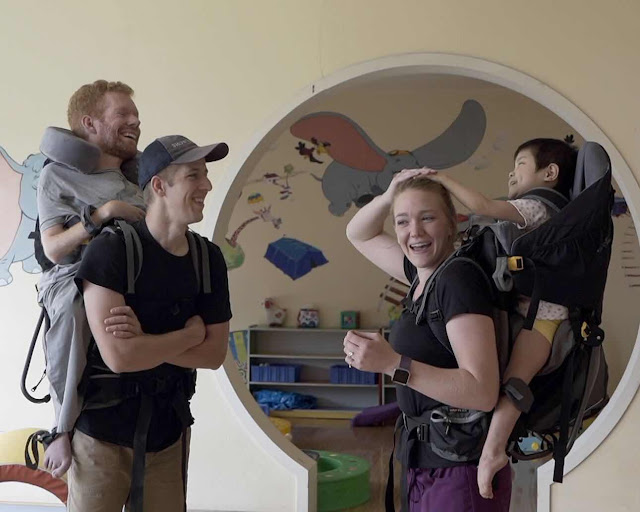
We took two to donate. The staff would bring a child into the room to meet me, and one of the guys would get me set up in my backpack while the child watched. If the child responded well, we’d pull out the extra backpack. We’ve been working with Deuter to develop an adapted design. When we get the first order in this summer we’re sending 10 to the care centres, with a plan to send more.


BLOOM: What was the greatest joy of the trip?

Kevan Chandler:
Being with the kids was the greatest joy, and getting to experience it with my friends. You can imagine the heart of these guys to care for me like they do, so I can travel with them. We saw everything from the care centres to the Great Wall (see photo above) and the Shaolin temple.

BLOOM: Isn’t there a lot of stigma towards disability in China?

Kevan Chandler:
Yes. People with disabilities are hidden away by their families or the system. You don’t see a lot of people with disabilities. We saw one lady in a wheelchair in the market, and otherwise never saw anyone with disabilities in our three weeks there.

Something I was surprised by was that when we would walk through the market or the city, people—especially of the older generation—would stop and give us the thumbs up and shake the hand of whoever was carrying me. They seemed to have a lot of respect and appreciation for what the guys were doing.

We knew there would be a language and some cultural barriers. But we hoped that the spectacle of one guy carrying around another guy would be a visual that would inspire and encourage people.

BLOOM: How often do your friends switch off with carrying you?

Kevan Chandkler:
We try to do a 45-minute switch, that way no one gets completely worn out. Something really neat was that we had other people, outside of our team, carry me as well. At the care centres, a couple of the workers were big guys who said they’d like to help out, so they took turns when we were in the market. Our translator, who didn’t come to carry, also carried me as well. We had only brought three carriers, so it was cool to incorporate more people.

BLOOM: You have a non-profit called We Carry Kevan. What is the mission?

Kevan Chandler:
Our mission is to redefine accessibility as a cooperative effort—people helping people, and getting involved with each other’s lives. Right now our main focus is implementing the backpack, and encouraging people who can, to use it. It will be available this summer and is a one-size that fits up to 70 lbs.

BLOOM: What does it cost?

Kevan Chandler:
It’s US$375. It’s completely adjustable and versatile for different sizes and needs. For the past two years we’ve been developing it with Deuter. We‘ll work with a family to customize it to each individual. Managing that, and with my book coming out, has been a full-time job.

BLOOM: What makes your travel unique is the participation of really close friends. How can that work for kids who don’t have friends?

Kevan Chandler:
I talked to my mom about it recently, and she said when I was diagnosed she and my dad decided they would raise us as normal as possible (my sister also has spinal muscular atrophy). They knew that would take a lot more work, but they wanted us to be involved in the able-bodied community.

What they ended up doing was that we were out in the world, and we also invited the world in. That introduced that idea of community. It normalized for our community the idea that my sister and I, we had needs, and people could help out. It taught us not just to ask, but to invite people into that. It also taught our immediate community how to respond. As I got older, it became more my responsibility. It’s going to be uncomfortable, but you have to put yourself out there. It’s worth a try. Everyone may not get it. But the people who do get it are going to be awesome.


You can follow Kevan at We Carry Kevan. The group is working on organizing international shipping for its adapted backpacks. If you have any questions, please e-mail at wecarrykevan@gmail.com. The photo below was taken at one of the care centres in China where kids got to try out the adapted backpack. Check out Kevan's Ted Talk.

Wednesday, July 18, 2018

One family, one sporty Whistler vacation

By Louise Kinross

Carol Eastwood wanted to go on a family trip with her husband and two sons. “I have a 27-year-old son and a 20-year-old son who uses a wheelchair, and I wanted all of us to go on a trip where no one would be left out,” she says.

Carol’s son Ian Steadman, 20, like the rest of the family, is a sports fanatic. He studies sports management at Niagara College, plays sledge hockey with the Halton-Peel Cruisers, swims competitively with the Milton Mighty Tritons, and loves wheelchair basketball and nordic skiing.

In 2010, Ian and his mom were in Whistler, B.C. to watch the Paralympics and Ian rented an alpine sit-ski for the day from Whistler Adaptive Sports Program. “I fell in love with Whistler then,” Ian says.

Carol heard that Whistler Adaptive had summer programs and decided to organize a week’s long family trip around them.

Last month they flew to Vancouver and rented a van to drive up to Whistler, where they stayed in an accessible condo in the upper village. It had a paved, accessible path down to the village.

The family was able to rent all of their regular and adapted equipment—for hiking, biking and kayaking—through Whistler Adaptive. “We wanted to do these sports because we could do them together,” Carol says. “If we couldn’t do something together, we didn’t want to do it. 
The program also provided wonderful volunteers who were experts in each adapted sport and knowledgeable about the area as well. 

They began with hiking. The family met Whistler Adaptive at a sports complex where they picked up a trail rider they were renting for Ian (see photo below). It’s like a chair on one wheel with metal attachments at the back and front that can be pushed and pulled by volunteers. Think “chariot!” Carol says. Two volunteers were provided, but Ian’s brother John decided he’d like to help and push.

“I enjoyed the experience of being on the mountains and the trails, especially since it’s something I might never have been able to do,” Ian says. “It was a reclining chair and I held onto the sides for support. The volunteer knew all about the history of Whistler and the mountains and of a train wreck there.”

On another day, the family went kayaking. They met the folks from Whistler Adaptive at Alta Lake. “There was an accessible path down to the dock, where a kayak volunteer and all of our kayaks and protective rain gear were ready to go,” Carol says. Ian used a tandem kayak with the volunteer and the family spent about two hours exploring the lake.

“Because I wasn’t supporting Ian, I could really relax and enjoy the activity,” Carol explains. “That’s the thing about this trip—we could all enjoy the activities.”

Next, the family took an accessible gondola up Blackcomb mountain. “You just wheel in, like an elevator,” Carol says.

At the top, Ian and his brother John decided to take the Peak 2 Peak gondola with a glass floor across to another mountain. “My mom doesn’t like heights,” Ian explains.

Ian’s favourite activity was biking. The family was outfitted with bikes at a bike shop, including a hand bike for Ian.

“On our first day, Daniel, a director at Whistler Adaptive, took us out and showed me how to use it,” Ian says. “It had gears as well as a speed-control assist machine that I could turn on for certain hills.”

“I saw how fast he was going on it, and I was having conniption fits,” Carol says. “I thought you were going to wipe out, but you never did. It was great to see my two boys doing an activity together at the one who has got the ability’s speed and level.”

The brothers liked it so much that they went out on their own the following day. “I haven’t been on a bike in a while and it was nice to experience something just with my brother,” Ian says. “It was intense. We went round the lake six or seven times.”

Renting adapted equipment is a bit more expensive than regular equipment, Carol says. “I think the hand bike was about $45 and our bikes were $20 each.”

After a day of activity the family went back to their condo to shower and head out for dinner. They strolled along a paved path from their condo to the village, where the restaurants, hotels and boutiques were accessible. “Everyone seemed to be comfortable dealing with wheelchairs,” Carol said.

Ian hopes to apply to volunteer or work at Whistler Adaptive next summer. “He was so pumped at the opportunities for having a disability yet working in the field of sports—whether abled or disabled,” Carol says. “They were integrated.”

Carol says booking a trip before the high-season in July made it more affordable. She was also able to get her Air Canada air ticket covered by going as Ian’s attendant.


Tuesday, February 6, 2018

Carrying friend in backpack, next stop China

By Louise Kinross

In 2016 we told you about Kevan Chandler's trip to Europe with friends who carried him in a modified backpack when places wouldn't accommodate his wheelchair. Kevan, who lives in Fort Wayne, Indiana, has spinal muscular atrophy and weighs about 65 lbs. Sitting in an adapted child carrier worn by his friends, Kevan and the group hopped over stiles in the British countryside, climbed up 600 rock steps to an Irish monastery, and checked out the underground cemetery in Paris. 


Since then, Kevan and his friends have released a film of their European travels and started a non-profit group to promote accessible travel. Kevan now has his sights set on a trip to China in 2019. We did this interview by e-mail.

BLOOM: Why did you decide on China as your next tour?

Kevan Chandler: Even while we were in Europe, the guys and I talked about visiting China. One of our guys has a niece and nephew who were adopted from China, and he'd gone with the family to get them. So we had that connection and perspective, plus we had interactions with numerous Chinese tourists while in France, which helped to prompt the conversation.

It's an old, magical, and exciting place to explore, and like anywhere in the world, it's also a place where we could maybe be an encouragement in regards to disabilities. Then, last year, a great door opened for us to connect with an organization called Show Hope that serves orphans with disabilities there, which really solidified the idea to go.

BLOOM: Will you be using the same backpack and also taking your wheelchair?

Kevan Chandler: We have a newly developed backpack, along the same lines as the original, but more professionally done. We'll be using that, and like our last trip, we won’ be taking my wheelchair.

BLOOM: Are you travelling with the same friends who carried you through Europe?

Kevan Chandler: We will have the same film crew, and two of the four carriers. The other two guys just had other stuff going on. So, we've added two other carriers, who are friends of mine from Fort Wayne. We will also have a translator with us and a project manager, who will keep us on track.

BLOOM: You plan to visit a series of care centres for children with health issues and disabilities supported by Show Hope. Why?

Kevan Chandler:
Yeah, we are really excited for the opportunity! I'm reminded of what Jesus said about kids, and I can't help but see the Kingdom of God in these little ones and the folks working with them. So much need, so much vulnerability, and so much love to redeem it all. Who wouldn't want to be part of that? Our hope is to be encouragers of the good work that's already being done among the kids and care staff there. We can't wait to spend time with them, play, share our story, hear their stories, and also take some backpacks like mine for the staff to use with the kids.

BLOOM: Do you know what percentage of these children are adopted? 

Kevan Chandler: I'm not really qualified to answer this. And at the same time, we as a team are more focused on the current circumstances of these kids and meeting them in that, with the bit we can do to help. It's important to be faithful with what's in front of you to do, right?

BLOOM: Where will you be staying on the trip? 

Kevan Chandler: We plan to do some exploring around both countrysides and cities, but the Care Centers of Show Hope will be kind of like our hubs that we come back to and spend most of our time.

BLOOM: Are you anticipating any challenges in China that you didn’t experience in Europe?

Kevan Chandler: Well, there is the language barrier! Haha! There is that, but also a pretty extreme difference in culture that we will need to navigate. These are all things we dealt with in Europe, especially France and Wales, but China just takes it all to the next level, so we will have a translator traveling with us to be of assistance.

BLOOM: Are there particular places or historic sites you’re eager to see?

Kevan Chandler: Yeah, we are excited to visit the Shaolin Temple and the Great Wall, for starters!

BLOOM: I think you raised about $35,000 US to cover the cost of your Europe trip. How many weeks will you be in China and what will the total cost be? Is there a link to your funding page?


Kevan Chandler: Yes, and we were pleased to end up on a similar budget for this trip to China. With travel included, we will be gone about three weeks, like with Europe. This trip is budgeted at $40,000US, which makes sense because it's farther and our team is a bit larger (nine of us vs. the seven that went to Europe). We just launched our GoFundMe page this week, and since we're now a 501(c)3, any donations are tax deductible.

BLOOM: I notice you are taking a translator. Do any of you speak Chinese?

Kevan Chandler: Nope. That's why we have the translator, a really cool friend of ours from China who lives nowadays in British Columbia.

BLOOM: What messages about disability do you hope people take when they see you on your trips?

Kevan Chandler:
I think it's bigger than just disability. We are all broken in some way or another, and we're all looking for some relief. So, when folks see a guy carrying another guy whose brokenness is so clear, I hope they see themselves.

What I love most when I travel is when walls come down and people just start sharing honestly about their own lives and experiences. It's a stark expression of what we all feel and desire inside, so we act as a kind of ice-breaker for people to look inward and dig deep. My hope is that that winds them up at a place of peace, whether they are encouraged or challenged, because both—if received—end up at the same place.

BLOOM: You said you’ve started a non-profit called We Carry Kevan since your Europe trip. Do you sell backpacks like the one you use? What does the non-profit do?

Kevan Chandler: We did start a nonprofit! We are working with Deuter to develop a backpack like mine for mass-production. Our hope is to have them available in the Spring of 2019. In the meantime, we are customizing a few backpacks ourselves here and there, and we are also taking time to tour, speak, and spend time with people.

Our mission statement says it best: ‘Believing in the inherent value of all people, We Carry Kevan mobilizes individuals with disabilities by redefining accessibility as a cooperative effort.’ That job of redefining involves a lot of examples lived out and a lot of conversations had, and it's been amazing to see those opportunities come with the nonprofit these past few years.

BLOOM: Do you know of any other people with disabilities who were inspired by your Europe trip to try to do something similar? I’m imagining that the backpack option only works for people who are very light?

Kevan Chandler: It's been wonderful these past few years to see, hear from, and meet folks, both disabled and able-bodied, who are inspired by our adventure. And the backpack was just our way of doing things. It will work for some people and not for others.

But the the backpack isn't the be-all and end-all. It's a tool to exercise the deeper idea, which is that accessibility comes with courage and creativity and people working together. So it's been awesome to see people getting that and acting on it in their own way. It's been a joy to come alongside them in their adventures.

BLOOM: Are you still working as a sound editor producing podcasts?


Kevan Chandler: No, actually! Just recently, I stepped out of that career to give We Carry Kevan my full attention.

BLOOM: What are your thoughts on the new treatment Spinraza for people with spinal muscular atrophy? Is this something you are interested in pursuing?


Kevan Chandler:
I'm excited to see its positive effects on my sister as she participates, and my hope is that it does provide relief and strength for folks with SMA who go that route. I am personally not involved at this time.

Friday, November 24, 2017

Young carers and other pieces of disability news

Photo by CBC News

By Louise Kinross

Youth who help care for a disabled or ill brother or sister were in the spotlight this week at the Young Carers Forum in Toronto, organized by The Change Foundation, an Ontario health think tank.

Alyssa Van Wynen, 21, centre above, spoke to CBC about her experience supporting her older sister Tiffany, left, who suffered a traumatic brain injury in a car accident. “With my sister, she lost out on a lot of stuff, so there’s that huge guilt factor, too,” she says in this eye-opening interview. “Because I am younger than her, I’m getting all these opportunities and stuff that she didn’t have the chance to experience.”

The Change Foundation says as many as one-third of people between the ages of 15 to 24 in Ontario act as caregivers to a family member. You can watch some of their stories here.

Two Toronto programs for siblings of children with disabilities are the Young Carers Program through Toronto Hospice, and a Sibling Support Program at Extend-A-Family.

In other news, check out this interview with Microsoft’s Chief Accessibility Officer Jenny Lay-Flurrie, who is deaf, on AXSChat, where Twitter users discuss accessibility in business.

Microsoft has its own profile on Jenny.

The London, U.K. travel company Accomable, for people who need accessibility, has been bought by Air BnB. That should mean more and better accessibility features in Air BnB listings.

Two new books caught my eye today. The first is Academic Ableism: Disability and Higher Education. That’s it, I thought! Academic ableism. That’s the concept I’ve been trying to articulate. How the culture of academia excludes people with disabilities, especially intellectual disabilities.

Here’s a short passage: “Disability has always been construed as the inverse or opposite of higher education. Or, let me put it differently: higher education has needed to create a series of versions of 'lower education' to justify its work and to ground its exceptionalism, and the physical gates and steps that we find on campuses trace a long history of exclusion.”

The book looks at how universities have helped define, study and devalue disability, but never recognized disability as a source of knowledge.

University of Michigan Press describes it thus: “The ethic of higher education encourages students and teachers alike to accentuate ability, valorize perfection, and stigmatize anything that hints at intellectual, mental, or physical weakness, even as we gesture toward the value of diversity and innovation.” Author Jay Dolmage is associate professor of English at the University of Waterloo.

The book come out Dec. 27.

The other book that intrigued me is A Feminist Ethnography of Secure Wards for Women with Learning Disabilities: Locked Away.

Author Rebecca Fish writes: “This book is an ethnography of locked wards for women with learning disabilities. It represents just a small part of my life the year of my fieldwork...These women had been removed, sometimes a great distance, from their families and friends, and compelled to lead a restricted life under surveillance and control.” Rebecca is a researcher with the Centre for Disability Research at the University of Lancaster in the U.K.

Finally, CanChild is looking for feedback on a new knowledge hub based on its F-words in childhood disability. Check it out and click on the top right to do an evaluation.

Monday, September 11, 2017

Hotel helps kids with autism feel at home

By Louise Kinross

A small Newfoundland coastal town is home to Canada’s first autism-friendly hotel.

Hotel Port aux Basques offers a fully-equipped sensory room (above), bedrooms with extra security features for kids who wander, a visual kids menu and a social story with pictures and text that parents can share with children in advance so they know what to expect.

Owner Cathy Lomond says the idea came from local teacher Joan Chaisson. “She’d organized a group of parents and one of their biggest concerns was how difficult it is to travel with children with autism and special needs.”

Cathy offered the group—called Autism Involves Me—a spare room and the group raised money to furnish a sensory and quieting room.

“There’s a blue swing called a crow’s nest that holds a child cocoon-like, a peapod-shaped boat they can climb in and rock, little hand grips if they want to climb the wall, or bouncy bags if they want to blow off steam,” Cathy says. The room has special mats and a seaside mural painted by a local artist.

Recently, a family arrived for dinner after a seven-hour drive across Newfoundland. Their autistic daughter was distraught.

“The child was very emotional and screaming and it would have been impossible for them to eat in the restaurant,” Cathy recalls. “But by going into the sensory room first, the child relaxed into a quiet mode. The mother couldn’t say enough about what it meant to be able to go and enjoy their dinner.”

The hotel also has four autism-friendly bedrooms. The doors are equipped with high door chains for children who wander. Inside, the TV and pictures are mounted to the walls and there are locks on drawers if parents want to keep appliances like a coffee maker out of reach. The adapted rooms are priced on par with regular rooms and Cathy says they plan to increase them to 14.

“Before people come, we send them questions about how we can help with their specific needs,” Cathy says. For example, “if you need to go into our kitchen to prepare your child’s meal, you can do that. It’s all about satisfying people’s needs. We want to do the warm and fuzzy things that people remember when they travel.”

After creating the sensory room and adapted bedrooms, Cathy brought in an expert to educate front-line staff about autism.

“When our sports complex heard we were doing the training, they asked if they could send eight of their people down, because they wanted to adapt some of their classes for children with autism. So we did two trainings.”

Port aux Basques has been designated an autism-friendly community because a grocery store, hairdresser and other services have followed the hotel’s lead.

Cathy, who first worked at the hotel as a teenager, bought the property 19 years ago. Joan, the teacher who spearheaded the project to adapt the hotel, once taught Cathy's sister Sherry, who has Down syndrome.

Cathy now chairs Newfoundland’s tourism quality assurance board. “When our inspectors go to do inspections, they will be asking ‘Do you want information on how to be autism-friendly?’
 Cathy says adapting bedrooms is not expensive.

“It’s nothing new, because we’ve made things wheelchair accessible and accessible for vision impairment. This is the next step, given the growing number of children who have autism.”

Success “is all about the little things,” Cathy says.

Tuesday, July 19, 2016

How to travel Europe by piggyback

By Louise Kinross 

In April we told you about Kevan Chandler, who was planning a summer trip across Europe with friends who would carry him on their backs when places didn't accommodate his chair. 

The itinerary included hopping over stiles in the British countryside, climbing up 600 rock steps to an Irish monastery, and checking out the underground cemetery in Paris.

Kevan and his friends raised over $26,000 to fund their adventure, and purchased a child carrier modified for Kevan's size. Kevan, who lives in Fort Wayne, Indiana, has spinal muscular atrophy. He updated us in this e-mail interview.

BLOOM: How did the trip go overall?

Kevan Chandler: Oh, it was awesome! Things went smoother than we could've imagined, but it was also balanced with enough challenges and 'wrenches' to keep us on our toes.

BLOOM: What was your favourite part of the trip?

Kevan Chandler: There were so many unbelievable parts to the trip, and I had really special moments with each of the guys who carried me. On one of my favourite days, a few of us went out walking through the fields and woods outside Westerham, in England. 

Our host, Mike, led the way and even carried me for a bit. The countryside was beautiful and it was exactly the sight that I'd seen a thousand times in films or from my van on the highway, and always dreamed of exploring myself. So, this was an especially precious experience to me.

BLOOM: Did you run into any problems while being carried?

Kevan Chandler: The gates at the subway were a bit thin, so we had to watch my knees. And we had to be careful at doorways. When we'd hop a fence in the countryside, the guys had to remember they were a bit top-heavy. There were challenges every day, whether we were in the city or out in the country or staying home. 

Some of them we saw coming, some caught us by surprise, but we just crossed each bridge as we came to them. That was one of the things I considered in choosing the group that came, not that we'd have everything figured out beforehand but that we could be creative and work together to figure things out on the spot.

BLOOM: How did the pack that you were using hold up? Was it comfortable for you and your friend?

Kevan Chandler: The pack worked great. We made more modifications as we went along, but it was a good, sturdy apparatus and did its job well.

BLOOM: What advice would you give others with disability who might want to consider this kind of trip with friends?

Kevan Chandler: It all depends on the person, as to what my advice would be. Generally, I'd say to seriously consider yourself and your team, and decide together how to go about the adventure. A backpack worked for me, but it may be something else for another person. You have to decide first what you want to do, and then go about deciding how you want to do it. Don't be afraid to think outside the box, and if you try something and it's not right, don't be afraid to say no and try something else.

BLOOM: Did anything surprise you about the trip?

Kevan Chandler: Everything surprised me about the trip! I made plans and sorted out details, but emotionally and spiritually, I tried very had to go in with no expectations, just see what happens and enjoy the ride. It was definitely a trip in which you had to roll with the punches, go with the flow, but I think that's the best way to have an experience like this.

BLOOM: How did people respond to you and your situation? Did you meet any other travellers with disabilities?

Kevan Chandler: People were inspired, whether they spoke to us or just watched us from a distance. I think what we were doing was so obvious, they didn't need to know the details to be encouraged by it. I loved being on the subway and seeing someone on the other end of the car glancing at us and seeing a smile come across their face. We made their day without a word, maybe impacted their life more than we know. 

And sure, we had some people who just looked at us with confusion, or they saw us and went on with their day unaffected, but who knows how or if that image stayed with them. We didn't meet any other travellers, per say, who were disabled, but one of our hosts in England had multiple sclerosis, and we did see others in passing who also had various disabilities.

BLOOM: What did your friends who went with you say about the trip? Is it something they'd do again?

Kevan Chandler: They loved it! It was funny to me, because they'd thank me over and over for bringing them on the trip. They were physically carrying me, but they saw it as me taking them to Europe, simply because I invited them. This just shows how great they are and how humble. I think they're all up for another trip.

BLOOM: Did you film the trip so that you can turn it into a documentary? 

Kevan Chandler: Yes, we had a film crew of two and they are now working to whittle that 300-some hours of footage down to a 45-minute documentary. We anticipate a spring 2017 release.

BLOOM: Is the film your next project or are you involved in something else?

Kevan Chandler: I'm pretty hands off with the film. I trust those guys completely with it. For the next few months, I'll be speaking some around the country, and writing a memoir-type novel about the trip. Also, we are working with a few other disabled folks and their families to help them have more freedom to travel as well.


Thursday, April 21, 2016

Flight ban is discriminatory says Toronto mom


By Louise Kinross

Yesterday, Kara Melissa Sharp and her family arrived at Toronto's Pearson airport at lunch time for a flight to Hong Kong at 3:30 p.m.

Almost 24 hours later, the family is still waiting at the airport.

Cathay Pacific won't allow them to board a plane to Hong Kong with a special car seat for their son Sebastian, who has cerebral palsy and seizures.

The Convaid seat, which Sebastian used on a WestJet flight to Florida last year, was approved by Cathay Pacific in December when Kara booked the flight.

Yesterday the airline informed the family that they don't allow car seats onboard for kids over 36 months. Sebastian is seven.

"I say disability discrimination," Kara says. "He can't travel without it."

Sebastian is unable to sit up on his own and can't eat or be fed through his stomach feeding tube without this supportive seat. The family also need the seat in order to rent a car in Australia, their ultimate destination.

At 3 in the morning, the family was denied boarding on a second flight. According to Kara, Cathay Pacific offered to have a five-point harness shipped on a flight from Hong Kong to Toronto for Sebastian.

But the family would need to wait to travel at 1:45 tomorrow morning. And Kara says the airline's harness "does not safely accommodate Sebastian's needs."


The fiasco calls to mind an incident last year when a disabled man was forced to crawl off an airplane after passengers disembarked and staff forgot to bring him a wheelchair. Ironically, the man, D'Arcee Neal, was returning from a talk he'd just given on accessible transportation for people with disabilities. In this related news item, the National Disability Rights Network says they got over 27,500 similar complaints about inaccessibility in 2014.

Kara notes that Sebastian is exhausted because he only got four hours of sleep last night. Lack of sleep is a trigger for seizures in children with epilepsy. 

According to the safety information on the seat (see below), it is certified for use in cars and aircraft when used with the harness.


Tuesday, April 5, 2016

Disabled man to see Europe riding on friends' backs

By Louise Kinross

Kevan Chandler (above centre) is used to being carried by friends when spaces don't fit his wheelchair.

So why would a trip across Europe be any different?

Kevan, who has spinal muscular atrophy, plans on hopping over stiles in the British countryside, climbing up 600 steps of rock to an Irish monastery, and checking out the underground cemetery in Paris. On a website for the latter, it specifically says: “The catacombs are not accessible for persons with reduced mobility.”

Kevan doesn't walk, but that's okay. His friends will carry him on their backs in a child carrier modified for his size. The three-week trip begins this month and the group has already raised over $26,000 to fund their adventure. BLOOM interviewed Kevan, who lives in Fort Wayne, Indiana, by e-mail to learn more.

BLOOM: What’s been most challenging about growing up with spinal muscular atrophy?

Kevan Chandler: My greatest challenge growing up has been the stuff in my own heart. I believe the Lord gave me a sturdy heart to handle this life, the good and the bad of it. But I'm also not perfect, and I struggle with storms of frustration and doubt surrounding my disabilities. Everyone is broken, to some extent, so I think we all ask those questions of ‘What if?’ I call them reminders; reminders of my brokenness. And none of us like being reminded of how broken we are.

So, there's the small stuff, like when I drop a spoon or my neck let's out a small spasm. ‘You can't escape,’ they say in those nano-seconds, like sticky notes from brokenness strewn around the living room of life. Then there's the big stuff. I lost a friend to suicide a few years ago, and ridiculous as it may seem, a great battle within me was, ‘Could I have stopped him if I wasn't... like this?’

Questions of value and identity come into play, and these circumstances cloud my understanding of the truth, which is that my identity and value, my everything, is found in something—someone—far bigger than me or my disability. The Apostle Paul talks about our adoption as sons and daughters of God, and he refers to it as ‘the redemption of our bodies (Romans 8).’

Whatever is going on in this crazy little body of mine, I can hold fast to the assurance that the One who created me loves me more than I could ever imagine and it's that love that makes me who I am, not a disease or what I can and can't do. It's a beautiful, life-giving realization, but man is it hard to remember, and embrace for some reason! Fickle hearts. Fickle hearts.

BLOOM: Have your views on disability changed or evolved as you've grown up?

Kevan Chandler: A friend used to say, ‘Your parents forgot to tell you you were handicapped.’

My sister is disabled too, and our parents raised us to take on the world without a second thought. With that said, my overall view of disabilities has remained the same, which is that it's my reality, it's part of my situation, but it doesn't dictate my situation.

I don't ask, ‘What can I do?’ but ‘How can I do?’ Of course, as I've gotten older, the finer details have been shaped, as with anyone's perspective as they mature. The value of life (mine and others) has more weight, the question of ‘How’ becomes more intricate, and in many ways the stakes get higher on adventuring.

It was a huge blessing (and still is) to have my older sister going through life alongside me with many of the same challenges. We have an older brother, too, who is not disabled but has been a great 
encourager and help over the years. 

BLOOM: What is your job as a sound editor?

Kevan Chandler: The official title I prescribe to is Post Production Sound Editor. What this means is someone else records the material and then they send it to me and I clean it up. I do this mostly for podcasts. So, a podcast host will record a two-hour interview with a guest. They'll then send it to me online and ask me to turn it into two 30-minute episodes. I take out coughs and stutters and then I decide what content stays or goes to make it fit into the necessary timeframe. I do all of this freelance from home.

I do have a second job, which is writing novels and self-publishing (for now). So, I'll write a book and then do reading events or speaking tours to promote it.

BLOOM: Many kids with disabilities struggle to make friendships. It looks like you have great, close friends. Has it always been easy for you to make friends?

Kevan Chandler: Yes! Ha ha! My sister has always said I have a Tom Sawyer personality, very inclusive and magnetic. Mind you, this is just who I am, it's all I've ever known, so I don't really see it happening. I just love having people around, living life to the fullest and bringing folks into that experience.

I definitely see the struggle, though, and it goes back to your first question, really. I've been rejected and ignored, and it hurts like the dickens, but you gotta keep going. I promise, there are people who know how to love and are kind and will see past your imperfections, no matter how glaring they are. Part of this, though, is that you need to see past imperfections too—both yours and theirs. And I know that's hard. Really hard. But it's that heart issue, again, and it just needs to be dealt with. I promise, facing those insecurities and issues of pride and bitterness or self-pity, when you come out on the other side of it all, it'll be amazing!

BLOOM: Can you explain what the tagline for your trip means: ‘There's no 'I' in Kevan’

Kevan Chandler: When the idea of We Carry Kevan came together, the team and I wanted to make the message very clear that we couldn't do this venture on our own. We wanted it to be a community experience, and more than people just giving money, we wanted people to get involved in the story. I spell my name differently and have to correct folks all the time, to the point that it's a joke among my friends. So we took that joke and employed the old mantra ‘There is no ‘I’ in team’ and there you go!

BLOOM: Who got the idea for going backpacking and making it possible for you to go too?

Kevan Chandler: My friends have always carried me around when my chair couldn't go places, like upstairs to apartments or whatnot. So the idea of being without my wheelchair was nothing new. They just pick me up in their arms and go. But a few years ago, my friend Tom Troyer wanted to go ‘urban spelunking’ (exploring the sewer system), and he wanted me to go, but he was going to need both arms free for balance and climbing. So we came up with the backpack idea. It was the innovation and determination of Tom, really, that made it happen. I was just along for the ride.

BLOOM: You have four friends going with you—are these people you knew for a long time, or people you've met more recently?

Kevan Chandler:
Tom, who had the sewer idea, is going with me, as well as Philip Keller, who was part of the sewer experience as well. Luke Thompson is joining us to film the experience, and I've known him for just as long. I've known all three for maybe four or five years, at least, through the North Carolina music scene. And I've known Ben Duvall for about three years, though he’s been my primary caregiver for the past two years, so we've gotten really close in that time.

BLOOM: Is it correct you're going to England, France and an island off Ireland?

Kevan Chandler: Yes, we will spend a week in France, then a week in England, with a short skip over to Scotland, and finally a week in Ireland with a visit to Skellig Michael.

BLOOM: What are some of the places where you'll be carried?

Kevan Chandler: We are planning to see some of the catacombs in Paris, and a great deal of the English countryside. In Ireland, I will be completely without my wheelchair, so I will be carried for all of that week.

BLOOM: Did you have a special backpack made that the others can wear on their back and carry you in?

Kevan Chandler: We settled on a pack from Deuter, called the Kid Carrier III. It's designed for toddlers up to 48 lbs, so we've made the purchase and are currently working on modifications to make it more comfortable and practical for both myself and the carrier. I weigh 65 lbs.

BLOOM: Are you also taking your wheelchair with you or are you ditching the wheelchair?

Kevan Chandler: I will have my wheelchair available for France and England, as some of those areas will be accessible. But we’ll then leave my chair in England while we go to Ireland and retrieve it on our way home.

BLOOM: You've raised over $26,000 of your goal of $35,000. Will that cover the cost of the trip for all of you—or what exactly does that cover?

Kevan Chandler: Yeah, we've been blown away by the financial support that's come in! The $35,000 will go toward a great many things. Plane tickets, the backpack, some hotels, transportation while we're there, plus a stipend for each of us as we are taking time off work. We are also using it for promotional travel before and after the trip, and the production of the film and book we plan to release afterward.

BLOOM: Were donors primarily people you knew already or people who read about your story?


Kevan Chandler: It's been a mix of family, friends, friends of friends, and complete strangers. Now that we've experienced some media coverage, the pull of strangers has been much greater. And they haven't only given money, but they've also contacted us to talk or offer us places to stay. Some offer us dinner if we'll be in their area, and some just want to meet us and hang out while we're there.

BLOOM: What happens after the trip?

Kevan Chandler: We hope to release a documentary film about the trip, as well as a book, and tour these things to tell our story. And we've heard from a lot of folks from other countries that we may visit later as well. We have some other big, long-term plans in mind for the We Carry Kevan brand, bouncing around, but these are the concrete plans for now. Ultimately, we just want to keep spreading the word, getting people involved, and telling this story of brotherly love and self-sacrifice.


To learn more, visit the We Carry Kevan website and blog.


Tuesday, January 12, 2016

A son's disability gives this dad a deadline for adventure

By Louise Kinross

Yesterday I heard a fabulous podcast on The New Family, a Canadian blog by Brandie Weikle that shares unique stories about all the different ways a family can come together and live. 

The New Family has dug up some incredible stories that include raising children with disabilities. 

Yesterday's podcast Seizing The Day With Your Family was about one dad's pursuit of world travel when he learned his son's degenerative condition meant he would lose skills over time.

That dad is David Knapp-Fisher of Victoria, B.C. 

When David learned his son Tristan had Duchenne muscular dystrophy, he vowed to take him around the world before Tristan lost the ability to walk, which doctors predicted would happen in five years.

Coming up with the money was no small feat, and included moving with his wife and son into a 400-square foot bachelor apartment to save on rent and eating lots of Kraft dinner.

When Tristan was eight the family had saved enough to go on a month-long whirlwind to Europe, visiting seven countries. One of the most beautiful anecdotes David tells is getting to the Notre Dame Cathedral in Paris and realizing there was no elevator! He carried Tristan, on his shoulders, up 387 steps so he could see the gargoyles at the top. 

Two weeks after returning home, Tristan had a fall and never walked again. 


David says he's made "amazing life experiences" his family's top priority over material things. 

This interview certainly gave me a lot to think about, and act upon.

Learn more about David's story in this Ted Talk

Monday, May 25, 2015

How to rock Miami Beach in a power wheelchair

By Louise Kinross

In February, Maria Tassou did something she’d never done before.

She flew to Miami Beach with a friend to hang out at the ocean.

Maria, who is a Toronto real-estate lease administrator, had never travelled without her family.

That’s because Maria has Arthrogryposis, a condition that causes stiff joints and weak muscles. She can’t propel herself over distances in a manual wheelchair or carry luggage. The places she’d travelled to in Europe with her family hadn’t been accessible enough to bring her power chair, so she relied on her parents to help her navigate in her manual chair.

This year, Maria planned a trip to Miami with her friend Michelle, who also uses a power wheelchair, knowing she could count on better accessibility. Michelle also had lots experience travelling on her own in the United States.

BLOOM asked Maria how she planned for the trip and what she’d recommend to parents travelling with children with disabilities.

BLOOM: What were some of the barriers you’d faced travelling?

Maria Tassou: I can’t push anywhere long distance in my manual chair and lifting bags was challenging. I had a suitcase with two wheels but it was difficult for me to manage it with my power chair. So I wouldn’t have been able to leave my condo alone and get to the airport with my suitcase. Now you can get luggage with wheels galore, and that’s really helped. I bought a suitcase with four wheels that spin and it’s easy for me to manage it from my power chair.

BLOOM: Did you have any problems with flying?

Maria Tassou: Because my knees don’t bend nearly as much as someone else’s, I have to have extra leg room and the ability to sit forward in the plane so that I can change my posture during the flight. Even though I’d fill out forms asking for bulkhead or window seating, I often didn’t get it. In one case, when I was on a charter flight with my family, the seating was so cramped that I couldn’t move for nine hours. By the end of the flight I could hardly handle the physical pain I was in. My Dad tried to help me but he couldn’t get me out of my seat. Two grounds people had to come and someone took my legs and someone took my arms and they lifted me up and over the seat. That made me nervous about flying on my own.

BLOOM: How did you solve the seating issue on this trip?

Maria Tassou: My friend had experience flying on a number of airlines and had had the best experience with Air Canada. She said ‘It's worth paying a little more if need be to fly with them because they know how to treat you and your chair right.’ Since I was travelling with someone who wasn’t able-bodied, I wanted to make sure everything went as smoothly as possible. I contacted Air Canada about getting elite seats, where there’s a little bit more room. Typically people pay a small fee for these seats, but I’d read that sometimes they’ll provide them to people with disabilities. Air Canada gave us those seats and we didn’t have to pay for them. They were great and made a big difference for me.

BLOOM: Did you have any issues with checking your power chair?

Maria Tassou: One thing we liked about Air Canada was their policy that you can keep your power chair while you’re in the airport right up until you get to the door of the plane. On some airlines they take your chair an hour or two before the flight and give you an old-style manual chair to sit in which is hard to push. With Air Canada, the grounds people who are going to put the wheelchair in cargo meet you at the door to the plane and ask what the vulnerable areas of the chair are. People with disabilities are boarded first and they bring the flight chair to you so you can transfer in privacy.

BLOOM: How did you make sure that the Miami area you were staying in was going to meet your needs?

Maria Tassou: You can find out a lot online, and then you have to phone to be sure. I did a Google search for ‘wheelchair accessible Miami.’ For example, there’s a website called Oyster.com where they often put ‘best accessible places to stay’ for a given city. also I found out that every bus in Miami is accessible and there were a fair number of wheelchair cabs.

BLOOM: What about your hotel?

Maria Tassou: Most hotel websites have filters so you can ask for a ‘wheelchair accessible’ room. But you have to phone to clarify exactly what they mean by ‘wheelchair accessible’ and what you want. We wanted a roll-in shower, not a bathtub, and luckily the hotel was very clear on its website, and with their images, that they had a roll-in shower.

BLOOM: Were there any other issues with your hotel room?

Maria Tassou: I had called to confirm we were getting a fully accessible room that included the balcony. We felt if we’re going to do this, we’re going to do it right, and we wanted to sit on the balcony and enjoy the ocean. When we got there, we realized there was a step onto the balcony. I told them ‘We paid a lot of money to come here on the understanding that the balcony was accessible and, to their credit, they dug high and low and found some very sturdy ramps for us.

BLOOM: What was it like navigating the beach outside your hotel?

Maria Tassou: There was a great pathway behind our hotel that went for a long, long stretch before you had to get back to the sidewalk of the street. I had googled ‘Miami Beach accessibility’ and found a
Miami Beach government site showed where you could find mesh mats. These are mesh pathways with runners on the beach so that you can travel on the sand with your chair and not get stuck. On the same website, when I scrolled down, I was surprised to find that they also had motorized beach wheelchairs that they loan for free to people with disabilities.

BLOOM: What kind of chair is that?

Maria Tassou: It’s a basic power chair with really big flat wheels that can travel on sand—like a little dune buggy. It’s amazing because the mesh mat only goes so far on the beach. The ocean rescue staff told us: ‘We only loan them to people with disabilities so that they can experience the same things everyone else does walking along the water line.’ The beach chairs were a fun adventure that we don’t get to experience here in Toronto.

BLOOM: What was it like to be away with a friend rather than your family?

Maria Tassou: It was freedom. I’m an independent person and when I’m at home I do everything myself, so it’s weird to have to rely on people when I travel with my manual chair. Being somewhere else and really enjoying it with my friend gave me confidence that I can travel with anyone.

BLOOM: What advice would you give parents who want to travel with their kids with disabilities?

Maria Tassou: The key thing is to plan. I found reading online, phoning and asking as many questions as you can ahead of time helped make our trip smooth. If you're told something is ‘accessible,’ ask what that really means. Don't take it for granted that their definition is what you need.

BLOOM: Any other recommendations?

Maria Tassou: When it comes to access and accommodations 'you get what you pay for.' By no means would I say overspend, but where a price differences isn't significant and is something within budget, experience has shown me that in terms of accessibility, treatment and so on, you'll be glad you spent that little bit extra.

Tuesday, September 18, 2012

First class to no class?


Watch the video (click above) and judge for yourself whether this teenager was behaving in a way that would make him a "flight risk" sitting in first class with his parents on an American Airlines plane. To make matters worse, when the family was rebooked on a United Airlines flight, they found themselves seated in the back row of the plane with two empty rows of seats in front of them. For the protection of the other passengers? From first class to no class?

Tuesday, March 20, 2012

The upside of going downhill part 2!


This piece is written by a member of Holland Bloorview's family advisory committee. Thank you to our FAC!

Before children, my husband and I took yearly ski vacations. We looked forward to getting away and enjoying the great outdoors. We travelled near and far. We flew and we drove. We’d go anywhere where there was snow. We lived for these vacations. We liked the sport, the sights, the food and the culture. We eventually took our ski vacations in Italy because it was cheaper to ski in Italy than to ski in Western Canada. What a great lifestyle.

Then we had kids. Screeching halt to skiing! Then we found out that one of our children had cerebral palsy. We thought our ski days were over.

Not so.

Our children’s nursery school teacher told me about a sit ski that allows people with physical disabilities to get out on the hills. Maybe one door for a certain type of vacation had closed, but another door had opened.

We went to the Toronto Ski and Snowboard show and asked reps from different resorts if they had an adapted ski program. We also asked if their childcare program could care for a child with disabilities. We had to think of logistics: Could we push a wheelchair from the parking lot, hotel or gondola to the daycare centre or wherever else we needed to go? Because a wheelchair doesn’t go through snow.

The responses from the resorts were varied. We concentrated on those with a good daycare program because we knew that our kids (then three years old) would not want to spend the whole day outdoors. We found out which places would offer us a one-on-one worker for our son. Some places you have to pay for the worker and some places you don’t.

The first year, we went to Silver Star in British Columbia. The kids enjoyed the daycare while my husband and I went skiing.

The next year, we went to Sun Peaks (also in BC) and our able-bodied daughter took a ski lesson while our son (the one with CP) was happy to be pulled around in the toboggan.

We found that we were treated better by the airlines when we flew with a wheelchair than when we were travelling with a stroller. In addition to boarding the plane first, they quite often had someone meet us at the gate when we arrived at our destination to offer assistance and escort us to the next gate or baggage claim area. You, of course, have to show the airline personnel how to release the wheelchair brakes! We also didn’t put a lot of “stuff” on the chair such as bags, knapsacks etc.

When we were at Sun Peaks it was at the same time as the Canadian Association for Disabled Skiing Festival and the Para-Alpine Canadian Championships. There were skiers from all over the world with different disabilities: blind skiers, sit skiers, amputees. It was inspirational to watch these athletes compete. They didn’t let their disability stop them from enjoying the sport so we tried to learn how we could do a family ski vacation too.

The Sun Peaks adapted ski program took our son out for a couple of runs in their sit ski. A sit ski sort of looks like the sled used for dog sledding. It was an exciting and emotional experience to ski with our son for the first time because what we thought wasn’t possible was possible after all! The adapted ski people were so kind to us that we decided to continue taking family ski vacations.

On the Internet we found out that Vermont has an adapted ski program -- Vermont Adaptive at Pico Mountain. We started going to Killington Mountain for March Break. The Friendly Penguin Daycare supplies us with a one-on-one worker for our son at no extra charge. The first worker happened to be a nurse. There was also a doctor who had recently graduated working in the daycare. They don’t guarantee this type of worker but all the workers we’ve had in the past three years have been excellent. The daycare said that they will take kids up to the age of 13 even though it's aimed at children who are five and under. They will supply a worker unless the child has behavioural issues. The parent has to give any necessary medications. Our son required diapering and help with feeding. We let the daycare know in advance what kind of help we needed and they did their best to accommodate us. The more information you share with the daycare, the better your child’s experience will be. Information such as what your child likes to eat or play will make for a better vacation for all.

Vermont Adaptive has a pediatric-size sit ski. Considering how much one of these things costs, I was amazed that they had one. Since we ski at Killington, we pay a small fee for Vermont Adaptive to bring the sit ski from Pico to Killington. We book the sit ski sessions in advance through Vermont Adaptive. It costs more if you book the same program through the resort.

Vermont Adaptive sends one or two volunteers to take our son out for as many runs as he'll tolerate. We learned that our son gets cold quickly in the sit ski, even though he normally runs hot, so we put on his regular cold weather gear and then a blanket on top of everything at the beginning of the session. You need to have two people to lift the sit ski onto the chair lift. So my husband helped the Vermont Adaptive volunteer lift the chair. I don’t know if the ski lift operator would get involved. Bring your own helmet unless you don’t mind your child wearing a loaner helmet worn by many other people.

In our son’s case, the sit ski is held from behind (like a dog sled) and is controlled by an able-bodied skier. We went down the regular ski runs so you have to watch out for other skiers.

Our son is verbal but not always able to express himself well. But we know that he enjoys skiing by the smile on his face. We hope that if you dream of a family ski vacation, you too will find a way to make it happen. Good luck and happy skiing!

Tuesday, February 21, 2012

The upside of going downhill


The upside of going downhill
By Ijeoma Ross

We happened upon skiing almost by accident. Four years ago we had a bad case of cabin fever. Canadian winters are hard with a child in a wheelchair. Going down south or on a cruise was too expensive. Cruising online we happened across Maine Handicapped Skiing (now Maine Adaptive Sports and Recreation) based at Sunday River Ski Resort.

We couldn’t believe that our son Deane could go skiing at Maine Adaptive for free (the group offers free lessons to children and adults with physical disabilities). Deane, who has cerebral palsy and uses a wheelchair, would be taught to ski by volunteers. And we could ski with him. We booked five afternoons and over March Break drove to Sunday River.

The team at Maine Adaptive was amazing. They have an occupation therapist and equipment “doctor” on site who assessed Deane’s strengths and abilities and adjusted and adapted equipment for him. Their building is slopeside so the skiers can get fitted and go right on to the hill.

It is a busy place with volunteers and skiers of all abilities coming and going. Deane and his “team” made up primarily of his father (Mark) and a good friend (Ali), who is a keen skier, were immediately welcomed. Because of their experience, expertise and friendliness, we will be going back for our fourth year in March.

For the first two years, Deane skied in a slider – the front of a walker on skis with arm rests for him to help support his weight while on his own skis. A volunteer would control his speed and direction from behind using straps attached to the slider.

The volunteers were more than willing to teach Mark and Ali how to control the slider. By the end of the second year, the volunteers were there primarily in a teaching role.

Other family members and friends could ski down the hill with Deane - as long as we stayed out of the way!

This past year we switched to a sit ski because Deane had the beginnings of hip dysplagia. Deane was more than happy with the move. Because the sit ski is more stable it can go faster and Deane loves speed. Now I’m working to keep up with him.

For the past two winters, we have also been skiing with the Canadian Association of Disabled Skiing (CADS) at Brimacomb Ski Hill outside of Oshawa.

There are provincial branches of CADS across the country with different ski hills running programs. In total CADS has 1,130 skiers assisted by 1,900 volunteers to participate in recreational and competitive snow skiing and snowboarding.

At Brimacomb, a team of dedicated volunteers take 30 skiers out on the hills for one of three 1.5 hour lessons each Sunday for eight weeks during January and February. All equipment is provided by CADS.

It is a tight-knit group of instructors, volunteers, family members all there to help the skiers get the most out of their time on the hill.

All of the instructors and volunteers must be trained on all of the equipment from sit skis to harnesses for blind skiers and three-track outriggers for leg amputees. Family members are encouraged to take the training so they understand the process. The cost is $110 for participants and $35 for volunteers to cover the insurance.

It was at Brimacomb that Deane first moved into a sit ski. Mark and Ali were trained to drive (holding on to the back bar on the sit ski) and tether (holding a strap while skiing behind as an anchor). In our first year, I found it difficult to keep up with the speed of sit ski.

This year, I have learned to tether and have loved being a crucial part of Deane’s skiing.

There are not many activities that both Deane and his sister Rayne, who is not disabled, can do together. Skiing is one of them. It has become an integral part of our family’s recreation.

On the iPad Deane uses to communicate, he will readily tell you that he likes the chair lifts, the sit ski and going fast. What we thought was just a rash idea to cure cabin fever has become a way of life for all of us.