Showing posts with label feeding tubes. Show all posts

Thursday, April 11, 2019

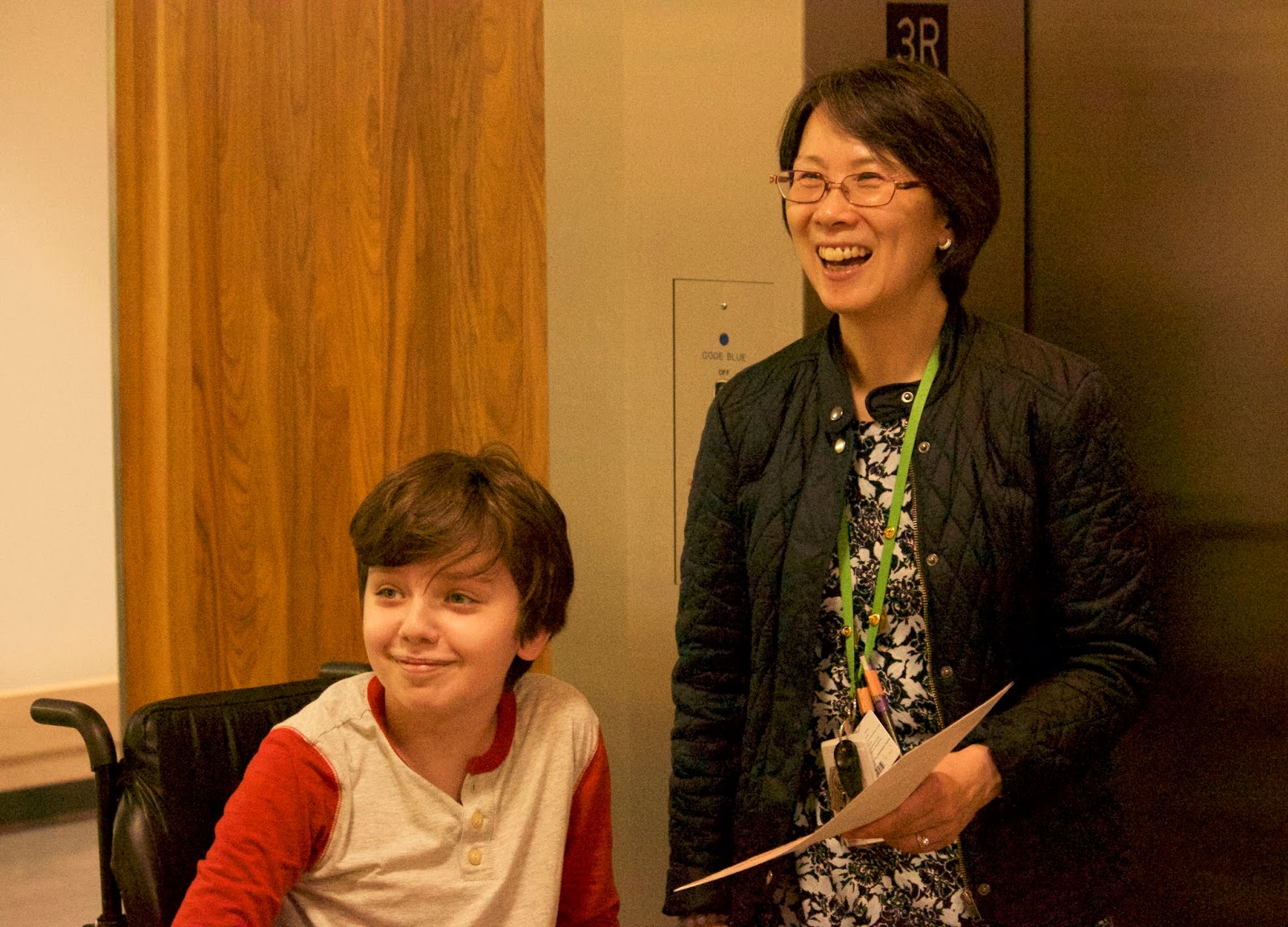
Pushing a tube down your nose hurts. Lorry knows firsthand

By Louise Kinross

Lorry Chen has a passion for promoting access to healthy food. “I wanted to solve world hunger,” she recalls of her time in dietetic school at Western University. For 28 years, she’s been a clinical dietitian at Holland Bloorview, initially working at our Bloorview site. She now works with our brain injury and orthopedic and developmental units, as well as in an outpatient nutrition clinic. We spoke about how she chose her career, and an instrumental preceptor at the Hospital for Sick Children who had Lorry put in her own nasogastric feeding (NG) tube, so that she’d understand what it felt like for patients.

BLOOM: How did you get into this field?

Lorry Chen:
We emigrated as a family from Hong Kong when I was 12. Our aunt sponsored us. My parents wanted to come to Canada to have a better life for their children. At that time, in Hong Kong we were required to speak Cantonese or Mandarin. I had no English. Before we boarded the plane my aunt told us 'You need two phrases: Excuse me and thank you. That way you’ll be able to get out of your seat to go to the bathroom.'

Throughout school, English was my weakest subject. My guidance counsellors in both elementary and high school said I don’t think you should aim for university. Luckily, I hung around with great people, and all of my friends were aiming for university and said I should try for it. I was the first one of my siblings to go. I initially took science.

That was when I wanted to solve world hunger. I loved nutrition and thought I could go into the lab and make a super plant. That’s all good in theory, but there were two problems. One, I had a black thumb. And two, undergrad experiments often involved animal models, and I have a phobia about rats and mice. At about this time I met my future husband and he said ‘You’re interested in nutrition, why don’t you look into dietitian school?’

BLOOM: How did you move from your training to working with children?

Lorry Chen:
After a four-year degree, you have to apply for an internship, or you can’t become a registered dietitian. I did my internship at SickKids and I loved it.

BLOOM: Why?

Lorry Chen:
I learned so much. The dietitians there were so dynamic. My first clinical rotation was in cystic fibrosis. I had two lovely patients who made me reindeer and Santa magnets when they were doing crafts. I was at SickKids when they discovered the cystic fibrosis gene. Talk about being in the epicentre of discovery! And that spawned my passion for research.

BLOOM: What did you do after SickKids?

Lorry Chen:
The internship was for a year. After that I got married and then I typed and hand-delivered
resumés to all of the hospitals in Toronto. I had to take the bus everywhere. I applied to North York General and a friend of mine said Bloorview is just down the street, you can walk there from North York. So I dropped off my resumé and voila—I got an interview and the HR person hired me right after. I’ve been here ever since. 

BLOOM: What is a typical day like?

Lorry Chen:
It’s changed so much from 1990 to now. In 1990, I might have one or two patients who were on g-tubes. There were no NG tubes. Now, at any time, I will have five to 10 patients who are on g-tubes or NG tubes. The complexity of our children has increased. Most of my patients have a tube through their nose.

BLOOM: I’ve heard that those nose tubes are extremely painful to put in.

Lorry Chen:
When I was doing my cystic fibrosis rotation at SickKids, the dietitian felt we needed to experience what it was like to place one, so that we could have empathy.

BLOOM: That is so smart! Did you put them in for each other, or on yourself?

Lorry Chen:
We did it ourselves. It was so hard. I thought I was going to gag and throw up in front of my preceptor and everyone else. That’s why I can relate to an adolescent who needs an NG tube. I’ve put one in myself. Also, before I recommend any kind of feed, I taste it myself and I have my students taste it.

BLOOM: So feeds kids would get by tube?

Lorry Chen:
Yes, because sometimes you burp, and then you will taste it. I want to be able to tell them if it’s not the most pleasant taste.

BLOOM: What’s the greatest joy of your job?

Lorry Chen:
Taking the NG tubes out! Last week I had two come out. It was the best week ever. The patients and the parents were over the moon. It was a gold-star day.

BLOOM: Besides your work with tube feeding, what other type of work do you do?

Lorry Chen:
We’re big on the clinical practice guidelines on bone health. Often I’m asked to make sure if a patient is at risk—especially if they have a spinal-cord injury—that they have appropriate calcium and vitamin D intake. Another part of the job is working with children who are too skinny or too heavy.

BLOOM: I was on a panel at a Food Summit on Monday, and it was for food centre staff who work with people who can’t afford to eat at all, or to eat well. It got me thinking about our families, who are often strapped financially with all of the extra costs of raising a child with a disability. Is that an issue for inpatient families you work with?

Lorry Chen:
Oh yes. Patricia Rebia, the clinical assistant in our nutrition clinic, and I have been chatting about applying to the No Boundaries fund to provide tools to families about how to eat nutritiously on a very tight budget.

BLOOM: Perhaps we could also develop a partnership with a food centre locally, or with our foundation. What is the greatest challenge of your work?

Lorry Chen:
When you work, and put in your best intentions with a client, but things aren’t going the way you envisioned. For example, if a child has a huge food aversion and he’s not eating.

BLOOM: When my son was an inpatient here, he went on a hunger strike. He was in a body cast and was taking so many meds and was in pain. So he refused to eat.

Lorry Chen:
Literally, there are clients that go on hunger strikes. Luckily we can give them an NG tube that provides nutrition, but we want a happy balance with oral intake. Sodexo as a group have been very responsive to some of the food requests we’ve made. Sometimes I’ve brought in some of my kids’ toys from home, if a child responds well to positive reinforcement with toys.

One thing I do communicate with caregivers, when a child won’t eat, is that ‘He’s the captain of the ship. We’re just passengers. We have to let him lead.’ Choosing whether to eat is one of the only things children have control of in hospital.

BLOOM: That’s right. What emotions come with the job?

Lorry Chen:
The two extremes. Wonderful joy—when I got to take out two NG tubes last week, I was dancing down the hallway. Stress
when you’re grappling with what can I do to help a child, because the things you’re trying aren’t working. 

BLOOM: How do you manage stress?

Lorry Chen:
I’m an exercise fiend. I’m at the gym at 5:30 in the morning. My husband and I go. He kicks me out of bed. We go to a cycle-fit class. Then I take a shower and come to work. On the weekend I do yoga. Exercise, absolutely, is my stress relief.

BLOOM: What kind of qualities does someone need in your role?

Lorry Chen:
As dietitians, we tend to be very precise—sometimes too precise. I’ve learned that a little flexibility is a good thing. Sometimes, when there’s an emergency, you have to come up with a solution that may not be ideal, or might have flaws to it, but you do the best you can with a solution, while mitigating all the risks.

BLOOM: You must be good at explaining things.

Lorry Chen:
The car is a great analogy for the body. Everyone knows how a car works, so they understand that food is like fuel for your body. When kids say they don’t like breakfast, I tell them to think about how their engine has been idling all night, and when you put your foot on the gas, but the tank is empty, you stall. I tell them breakfast can be different things to different people. It could just be a glass of milk, or a piece of toast.

BLOOM: If you could change something in children’s rehab, what would it be?

Lorry Chen:
Always the resources available to our families. Here I think we’re well supported, but in the community, I often find that there’s not enough. I wish there was a barometer that I could use to assess how much support a family needs, and then be able to give it to them.

BLOOM: If you had to give yourself advice on your first day, but from where you stand now, what would you say?

Lorry Chen:
Two words: patience and flexibility.

Sunday, February 8, 2015

A doll like me

By Louise Kinross

This is Katie Hebert with her doll with a stomach feeding tube and brother Nathan. "We heated up a skewer and used it to melt a hole in the doll's stomach and then just placed the tube as usual," says mom Kyla. "The kids thought the 'operation' was so cool."

Katie has suspected mitochondrial disease and her family in Texas has adapted her dolls to be like her. I received Katie's photos, and many from other families, after our story about Melissa Shang and her petition to have American Girl release a doll with a disability. We'll share more pictures in the BLOOM print magazine later this month. And...I am interviewing Melissa and her older sister Eva tomorrow about their campaign to see kids with disabilities represented in dolls and books and media.

Below is a picture of Katie with a monkey with a g-tube made for her by Tubie Friends, a non-profit that adapts toys free of charge so that they have medical equipment or features like their owners. "They do all kinds of modifications, feeding tubes and traches and ports and even heart-surgery scars," Kyla says.

And below that is Katie with an American Girl doll who has a wheelchair, glasses and a sock-monkey hat like her.


Tuesday, June 26, 2012

Mom backs real blended food for tube-fed tot


By Jennifer Han

My twins Andrew and Eleanor were 28-week preemies. Andrew came home from the hospital with three stomach surgeries under his belt and significant brain damage. The brain damage caused cerebral palsy and epilepsy, which put him at risk of aspirating and made feeding difficult.

At 21 months he had a fourth surgery to place a G-tube to ensure he was getting nutrition safely and in hopes of boosting his calories.

Andrew, I was told, could no longer eat real food. Instead, his diet would be a formula that was described as nutritionally complete, but which I discovered is made up of 53 per cent corn syrup.

The G-tube solved the problem of getting formula into Andrew, but it exacerbated his reflux and vomiting. Andrew spit up every ounce, retched, lost weight, never slept and stopped smiling. Instead of producing stools, he had green diarrhea once or twice a week. He was on the brink of total dehydration and doctors suggested more surgery: a J-tube, nissen-fundoplication or GJ-tube, but with the caveat that they might not work.

Then, while scouring the Internet for stories about children with severe reflux, I came across something called the blenderized diet.

In this diet, vegetables, fruits, grains and meats are blended in a super high-speed blender until they become liquid, then fed through the g-tube.

Families out in the blogosphere said that real food had a calming effect on their children’s stomachs and as a result, stayed down.

I had no idea that real food was a possibility with a G-tube!

This diet – which was never presented to us as an option by our medical team – has given us our boy back.

The blenderized diet isn’t new or radical. Feeding tubes have been around for decades and patients were once fed mostly blenderized food. In the 1970s commercial formula was introduced; hospitals embraced the convenience and never looked back.

I told our doctor and nutritionist that before we did any more surgery, I was going to try the blenderized diet. They weren’t happy. They said they had never had a patient go this route and that formula was best. With some reluctance, our medical team agreed to a trial.

The first week of the diet, Andrew did not spit up once. By day four, he was completely off formula and having nice bowel movements one to three times a day. He went from taking multiple 10- to 15-minute catnaps a day to a single one-to-three hour nap. He started sleeping 10 to 11 hours straight through the night with no feedings.

At his weigh-in two weeks after the start of the diet, he had lost a few ounces. I was disappointed, but knew that as the body adjusts from a mostly-sugar diet to real food, this was common.

Ever since, Andrew’s been gaining weight!

He may spit up once a week or so but it’s usually if he’s overtired or constipated.

Now that Andrew’s body is responding in a healthy way to real food, it’s clear that formula didn’t agree with him. We are bewildered and beyond pleased at how amazingly fast, drastic and profound the change has been. Not only is the blenderized diet treating Andrew’s severe reflux but it’s made him happier and healthier and prevented further surgery.

We know this diet isn’t for all children with severe GI problems. However, I believe medical staff should present it as a treatment option along with standard surgeries.

While the blenderized diet is a foreign idea to most North American hospitals,
there are a few – like Children’s Hospital of Philadelphia and Cincinnati Children’s – that recommend it. In fact, in a 2010 study by Cincinnati Children’s Hospital, 75 to 100 per cent of 33 children with failed nissen fundoplications who trialed the blenderized diet showed an immediate reduction of 50 per cent or more in reflux and vomiting.

For Andrew and our family, the blenderized diet has been life-saving.

Before beginning any change in your child’s diet, run it by your medical team, as it’s important that you have a supportive doctor and dietician to guide you.

Blenderized diet resources

Homemade Blended Formula Handbook by Marsha Dunn Klein

Ainsley Rae blog: great practical tips from a mom

Blended Food Resource Group

Facebook group for the blenderized diet

Andrew’s first blenderized recipe

This one comes out to about 34 calories per ounce. His Elecare formula is 30 calories per ounce. In the other recipes I’ve come up with, ratios for protein/grains/oils/veggies/fruits stay the same. I just swap different foods each time. His blends tend to be between 30 to 40 calories per ounce.

3 cups of roast chicken 700 calories
1 cup orange juice 100 calories
1 cup soy milk 100 calories
2 slices of whole wheat bread 200 calories
1 cup blueberries 70 calories
1/2 cup broccoli 40 calories
1 cup spinach 60 calories
1 tablespoon of olive oil 120 calories
1/3 cup apple sauce 60 calories
1/2 cup peas 60 calories
1/2 banana 50 calories
1 container pureed pear 45 calories

Total Calories: 1645

Read about Andrew and Eleanor and the latest edition to the Han family at The Early Birdies.

Friday, September 30, 2011

Under the 'hero's' cape


Two days ago Jennifer Johannesen brought me a copy of her book. It was a shiny paperback called No Ordinary Boy, about her life with son Owen, who had multiple disabilities and died almost a year ago at age 12.

Today, my copy's cover springs open, the pages are dog-eared and there are traces of food and bath water dispersed throughout.

No Ordinary Boy explores themes that will resonate with parents of children with severe disabilities and educate professionals and those who have never lived this reality.

It will enable readers to understand how parents can experience their child as magical, yet struggle with a crushing hopelessness when years of rehab efforts don't yield results and therapists (and a 'you can do it!' culture) don't let up.

"What if I know we'll never get there," she writes of efforts to find a communication system that works for Owen. "What if I'm certain? Who would I dare tell? Who would listen? And who would dare agree? Are we all supposed to die trying? And why do we always have to be working on something? Is 'hope' the only thing that matters?"

We hear about the herculean efforts Jennifer goes to to feed Owen, who is at risk of aspiration, orally: "Food and thickened fluid had to be given slowly and methodically. At the last assessment before I finally threw in the towel, the instruction was to feed 1/4 teaspoon of food every 30 seconds. I calculated how long it would take to feed Owen his recommended calories and fluids: about five hours a day."

Elaborate, drawn-out feeding sessions rule the day, to the point that Jennifer's younger toddler Angus protests when he sees the equipment come out. "...at that moment, I felt helpless," she writes. "And hopeless. I was frustrated that I couldn't provide for either of my children properly."

There are years of relentless attemps to get Owen -- who is profoundly deaf, unable to use his hands and struggles with uncontrolled movement -- to express himself.

"The discussions always went around and around. I was offered options at every turn but they felt futile. I knew what I was up against. Every year, a new suggestion, a new hope.

When Owen was three: "He can use a voice-output device to communicate."

But he can't hear.

When Owen was four: "He needs to first learn cause-and-effect; learn how to use switches."

Yes, learn. Goals, checklists, spreadsheets, Time of Day/Number of Opportunities/Number of Successes. The expensive adapted toys. The battery-interrupter to adapt regular toys. The computer arranged through the Assistive Devices Program specifically for Owen's training...We tried. We really did.

When Owen was five: "It's okay if he can't hear. He just needs to know that if he pushes the button, someone will respond."

But his caregivers can't hear. I hire only deaf people. They're the only ones who sign well enough. They're the only ones who can offer consistent language input.

When Owen was six: "Then we'll attach a light signal to the switch, so they can see when he wants something."

But Owen can't see it. His head is always craned around, his chair always tilted back.

When Owen was seven. "Then we'll attach a buzzer, so he can feel when he's pushed the button."

It was enough to drive a sane woman mad.

One of the most moving and insightful parts of the book -- to me -- is a letter Jennifer writes to a trusted speech therapist, explaining why she's given up on augmentative communication. "My apparent abandonment of AAC has nothing to do with my acceptance of Owen himself -- it's more about my exhaustion and what I'm seeing as futility," she says. "I do wish he could communicate and I wish I could give that to him -- but at what cost?"

Jennifer connects the goal-setting of rehab professionals to a workplace phenomenon called Fake Work. "Fake, because it creates the illusion of productivity when the activities actually don't contribute to the production of anything real or meaningful....Institutions and therapists like disabled kids and their families to be working on stuff, to be improving, to have goals and accomplishments. To be all they can be! This persistent striving can create an environment where Fake Work is prevalent and even encouraged."

It's painful -- and somewhat humorous -- to read the lengths to which this parent goes to have her son participate (I'm sure our readers will relate). At one of Owen's birthdays, Jennifer hooks up a hairdryer to a switch box so he can 'blow' out his candles by hitting the switch with his foot. Only things don't go as planned!

There are so many places in this book where I said: "Yes. She gets it. She had the same feelings, the same thoughts."

An example is when she visits a segregated school for Owen, the only schooling option she's given.  "I can't describe exactly what was wrong or why throughout the whole tour I was holding back tears" she writes. "...Beyond the buzz, I sensed an environment devoid of connection, authenticity and learning. The place looked like a school but it didn't feel like one; it felt like a facility in which employees looked after disabled kids, more institutional and soulless than any other place Owen and I had been."

And although I've known Jennifer for at least eight years, I wondered: "Why didn't I know?"

To therapists (and I assume even other parents, like me) "I would always wear my shining-hero cape," she writes.

We get the sense that putting on this front of supermom who 'has it all together' is expected of us -- by professionals, family, friends. Certainly we, as parents, don't want people to interpret our lives as tragic. "There's nowhere to go with the reality of hopelessness," Jennifer told me this morning.

Jennifer covers all the bases in her book. She talks about the impact of a child's disability on marriage.

We hear about how she spent her nights ensuring Owen had the continual pressure his body needed to calm itself. "I found a way to keep him tucked into a ball without having to sit up: spooning." This allowed Owen some sleep, but not his mother, who was occupied in a psueudo-game of Twister that left her with chronic pain.

There are surgeries, a baclofen pump implanted to reduce spasticity that's recalled, a meeting with Holland Bloorview's bioethicist about decision-making for someone so vulnerable and dependent.

When Jennifer and her husband choose not to pursue deep-brain stimulation, which is held out as a way of calming Owen's uncontrolled movements, Jennifer feels a sense of exhiliration. "There was nothing left to hold out for, no more straws at which to grasp, no more hope for improvement, no theories to explore, no further experiments, no more trials. Finally, Owen was free to just be."

At the end of the day No Ordinary Boy is a love story --- to Owen, and to brother Angus, to whom the book is dedicated, and to all of us families out here struggling to run what feels like a parenting marathon.

It is candid, thoughtful, philosophical, important. Jennifer weaves her narrative around excerpts from hospital and rehab reports that juxtapose Owen's 'clinical' picture with that of his mother's lens.

You can buy No Ordinary Boy at http://noordinaryboy.com/buy/ or borrow it from Holland Bloorview's library (416-425-6220, ext. 3713).

Wednesday, October 20, 2010

A shattered trust


I'm grateful to one of our readers for sharing the following story.

A shattered trust

When my daughter was discharged from the NICU her neonatologist encouraged us to keep in touch. “We love to get photos” she said. We did keep in touch, but lately I don’t want to send photos.

I worry that in sharing photos with our medical professionals they’ll assume we’re okay and feel they don't have to worry about us. This makes me sad, because it would take such a load off my shoulders if I felt some doctor or nurse – anyone – would worry about something for me, instead of minimizing or ignoring my concerns.

My daughter is chronically sick, which means we need to get in to be seen quickly, but we have ongoing problems with clinic staff and doctors who don't return calls and pages. Nurses frequently dismiss my concerns about my daughter’s health. One doctor failed to respond to two pages, an e-mail from another doctor and a message I left on his voicemail. Instead of saying “I'm sorry I didn't call you back,” the doctor suggested there was a misunderstanding.

When people make mistakes and I ask for change, explanations or at least acknowledgment of what happened, I get yelled at. Both doctors most central to my daughter's care have yelled at me and though she has more specialists and sub-specialists than I care to count, there is not one I feel I can truly trust.

For almost a year I’ve made over 30 calls and worked with six hospital departments to find a way to better handle my daughter’s g-tube changes. My daughter is petrified of the procedure. Her hips are strapped down but I have to hold her arms while she screams, twists her upper body and turns bright red. The first time it happened I had flashbacks to when I had to restrain her for procedures in the NICU. So I've spent months trying to come up with an alternative. I’ve asked for sedation, but been given conflicting information about whether it's safe. I've asked for a child-life specialist to provide support. I've sat outside the procedure room, listening to my daughter (with my husband) scream inside. I've asked if the ‘comfort kit’ is in the room with them, only to be told it’s sitting behind me in the waiting room. I’ve asked if I can take the kit to the room and been told "No." We’ve left in a g-tube that should be changed every six months for 15 months because we can't find a solution to managing our daughter’s pain and anxiety.

I'm also reluctant to share photos with doctors who I feel made decisions for us and not with us. When my daughter was on a ventilator in hospital we asked to have a discussion about how aggressive her care would be. The doctor said “We'll come back and talk to you,” but no one came back.

This is not the life I imagined for my family. Truly, it is not something I could have imagined.

Our daughter is three, but is on her fourth case manager. My typical child has one doctor, who has never yelled at me, never brushed aside my concerns, and never failed to return my calls.

I'm a high-school teacher. As we prepared for the new school year, my colleagues and I discussed how to best meet the needs of our students and their families. We talked about being our best in our most challenging situations. Our administrators encouraged us to come to them with our problems so that we could work together to solve them.

This quote from Colin Powell was shared: “The day soldiers stop bringing you their problems is the day you have stopped leading them. They have either lost confidence that you can help or concluded you do not care.”

These words speak to where I sit now with our medical professionals. I hesitate to ask for help because I’ve become more disillusioned with each failure. Our professionals don't work together to solve problems and give conflicting information. And because actions speak louder than words, increasingly I’m convinced that the bigger problem is that they don't care.