Showing posts with label friendship. Show all posts

Monday, May 27, 2019

'We Carry Kevan' aims to inspire a new model of inclusive travel

By Louise Kinross

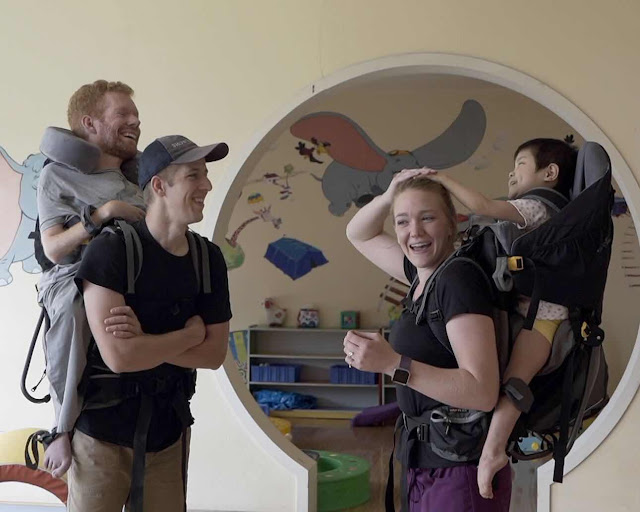
Kevan Chandler paid a visit to Holland Bloorview last week on a tour to promote his new book We Carry Kevan: Six friends. Three countries. No wheelchair.

We’ve interviewed Kevan twice. Once about his 2016 trip to Europe with friends who carried him in a modified backpack, and once as he planned a similar trip last year to China, where he visited care centres that support orphans with disabilities. Kevan lives in Fort Wayne, Indiana, has spinal muscular atrophy, and weighs about 65 lbs. It was awesome to meet Kevan in person.

BLOOM: What is the purpose of your new book?

Kevan Chandler:
The new book chronicles our adventures in Europe and then China, and everything building up to that, with a little bit of autobiographical information about my childhood. It’s a travel memoir of our journey so far, and within that it gives a lot of insights on my perspective about disability and our friendships and how that all ties together.

BLOOM: What message do you hope readers take away?

Kevan Chandler:
I think for folks with disabilities, it’s an encouragement to see someone with a disability living a full life, and in such a way that people can read it and say ‘Oh, yea it is possible. I can do that, too, in my own way. Our story is about how we figured out how to do things. We’re not telling people how, but saying you can figure it out with the people around you.

For the able-bodied community, the book is an insight into a world they may not be familiar with, and an encouragement to plug into that world. It’s an ice-breaker.

BLOOM: We spoke with you before you went to China. Now that you’ve actually been there, what was the greatest challenge?

Kevan Chandler
: There were a lot of challenges. We went to three cities and we had three very dynamically different experiences. Going into each city, we’d get settled, fall in love with the place and have to leave. We spent most of our time in care centres for orphans with disabilities—really getting to know the children and staff and very quickly building some life-long relationships. It was surprising how you can be somewhere for only four to five days and feel homesick for that when you leave.

BLOOM: I guess you were immersed in the children’s lives.

Kevan Chandler:
To see that 24-7 life of caring and loving for these kids, and being in that community, yes, we were immersed. And there was a physical toll as well. The first city we were in was a village in the middle of nowhere. The conditions were more difficult there. The other care centres were a bit more Western—spectacular, clean and well-equipped.

BLOOM: What did you do there?

Kevan Chandler:
We rolled around on the floor and played with them and held them and cuddled them and talked with them. They loved having us there. Most of the nannies and caregivers are women, so it took a little time for them to get used to a group of guys.

There was a language barrier and a lot of the children were non-verbal, so there wasn’t a lot of communicating with words. At first the guys brought me in and set me in my backpack with the kids, but the kids didn’t know what to think of the backpack. I decided it was better to lay me on the floor with them: ‘I’m here, I look like you.’ We talked with them and made noises and rolled around.

BLOOM: Did you take any of your backpacks with you?

Kevan Chandler:
We took two to donate. The staff would bring a child into the room to meet me, and one of the guys would get me set up in my backpack while the child watched. If the child responded well, we’d pull out the extra backpack. We’ve been working with Deuter to develop an adapted design. When we get the first order in this summer we’re sending 10 to the care centres, with a plan to send more.


BLOOM: What was the greatest joy of the trip?

Kevan Chandler:
Being with the kids was the greatest joy, and getting to experience it with my friends. You can imagine the heart of these guys to care for me like they do, so I can travel with them. We saw everything from the care centres to the Great Wall (see photo above) and the Shaolin temple.

BLOOM: Isn’t there a lot of stigma towards disability in China?

Kevan Chandler:
Yes. People with disabilities are hidden away by their families or the system. You don’t see a lot of people with disabilities. We saw one lady in a wheelchair in the market, and otherwise never saw anyone with disabilities in our three weeks there.

Something I was surprised by was that when we would walk through the market or the city, people—especially of the older generation—would stop and give us the thumbs up and shake the hand of whoever was carrying me. They seemed to have a lot of respect and appreciation for what the guys were doing.

We knew there would be a language and some cultural barriers. But we hoped that the spectacle of one guy carrying around another guy would be a visual that would inspire and encourage people.

BLOOM: How often do your friends switch off with carrying you?

Kevan Chandkler:
We try to do a 45-minute switch, that way no one gets completely worn out. Something really neat was that we had other people, outside of our team, carry me as well. At the care centres, a couple of the workers were big guys who said they’d like to help out, so they took turns when we were in the market. Our translator, who didn’t come to carry, also carried me as well. We had only brought three carriers, so it was cool to incorporate more people.

BLOOM: You have a non-profit called We Carry Kevan. What is the mission?

Kevan Chandler:
Our mission is to redefine accessibility as a cooperative effort—people helping people, and getting involved with each other’s lives. Right now our main focus is implementing the backpack, and encouraging people who can, to use it. It will be available this summer and is a one-size that fits up to 70 lbs.

BLOOM: What does it cost?

Kevan Chandler:
It’s US$375. It’s completely adjustable and versatile for different sizes and needs. For the past two years we’ve been developing it with Deuter. We‘ll work with a family to customize it to each individual. Managing that, and with my book coming out, has been a full-time job.

BLOOM: What makes your travel unique is the participation of really close friends. How can that work for kids who don’t have friends?

Kevan Chandler:
I talked to my mom about it recently, and she said when I was diagnosed she and my dad decided they would raise us as normal as possible (my sister also has spinal muscular atrophy). They knew that would take a lot more work, but they wanted us to be involved in the able-bodied community.

What they ended up doing was that we were out in the world, and we also invited the world in. That introduced that idea of community. It normalized for our community the idea that my sister and I, we had needs, and people could help out. It taught us not just to ask, but to invite people into that. It also taught our immediate community how to respond. As I got older, it became more my responsibility. It’s going to be uncomfortable, but you have to put yourself out there. It’s worth a try. Everyone may not get it. But the people who do get it are going to be awesome.


You can follow Kevan at We Carry Kevan. The group is working on organizing international shipping for its adapted backpacks. If you have any questions, please e-mail at wecarrykevan@gmail.com. The photo below was taken at one of the care centres in China where kids got to try out the adapted backpack. Check out Kevan's Ted Talk.

Friday, September 8, 2017

This mom broke the social isolation of autism

By Louise Kinross

Charlie Castro is a happy, social 7-year-old who loves elevators, math and reading. But his autism makes it impossible to filter out the everyday noises of modern life.

“He’ll be having a great time, and then he gets a blast of an overhead announcement or a cell phone rings, and he has a meltdown,” says Charlie’s mom Karen. “We have to remove him and he misses out on the fun—again and again and again.”

Four years ago, “I couldn’t stand the isolation Charlie was experiencing,” Karen says.

So she started Play Dates, a Scarborough, Ont. support group for parents of children with autism and other physical and developmental disabilities.

She invited parents from the Holland Bloorview nursery school Charlie attended. In the early days, the group would arrange a trip to the zoo or island or a play date at someone’s home.

“We had this moment where there were six of us sitting in one of the mom’s homes and we realized, for the very first time, that we were relaxed,” Karen recalls. “Our children hadn’t changed, but for the first time I’d let my spine settle into a chair, and I wasn’t jumping up to apologize or correct Charlie or pull him off something.”

This feeling of comfort was a surprise, because parents didn’t experience it when they took their kids to parks or regular children’s programs. In mainstream settings, “they’re worried about whether their child will be judged, or they’ll be judged,” Karen explains. “It’s painful and traumatic when you don’t feel there’s anywhere you can go with your child where you’re welcome and your child is safe.”

Karen, a self-described dreamer, has parlayed her Play Dates ideas into a weekly, protected drop-in for the group at a double gym at the East Scarborough Boys and Girls Club (jumpy castle, balls and ride-on toys included); a series of five summer soccer lessons where each child had a one-on-one volunteer; professional guest speakers for parents; and birthday and holiday parties at family homes. They even have hair-cutting parties so that when one child wants to take a break, another can jump in the chair.

Saturday drop-ins draw 14 to 20 parents and up to 40 children, and over 200 people follow Play Dates on Facebook. One family drives in from Milton. Brothers and sisters are always welcome. Most parents are moms, but some dads participate. Most events are free.

The East Scarborough Boys and Girls Club hired a part-time disability studies student to help manage the Saturday group. “I don’t ask anything from people,” Karen says. “You don’t have to bring lasagna, and you don’t have to do any preparation. It’s come when you can.”

Many of the participants are immigrant families whose kids have hit a service wall, Karen says. “When English is a second language, things happen so much more slowly for them. It’s shocking. I could tell you stories that would curl your hair. I’ve learned a tremendous amount about heroism from some of the obstacles these families face.”

Karen says Play Dates helps parents see they’re not alone, and educates them on services that are available to their kids.

“This is an opportunity for people to talk, to share information, and for the kids to just be together and to be who they are. I hope other parents will consider doing this.”


Wednesday, June 1, 2016

QuickFlix: Can support workers be friends, too?


Holland Bloorview family leader Donna Cappelli discusses whether paid support workers can be considered friends of her son Julian, 15, who has high needs that make friendships with peers challenging.


QuickFlix is a series of short BLOOM clips about parenting, disability and health. Don't forget to check out our A Family Like Mine videos.

Monday, March 7, 2016

Mailbag: A reader responds to a post on disability, friendship

By Louise Kinross

A couple of weeks ago Meriah Main, a nurse in Vancouver, responded to a piece I wrote on friendship and youth with disabilities in the Huffington Post about four years ago (it generated over 650 comments, but the comments are no longer visible on the website). I wanted to share her response and our correspondence as I think it will interest you. Meriah is pictured above (centre) with her husband Gabe and their roommate Ariel. Thanks for letting us share this Meriah! Louise

Meriah Main, Vancouver:

I’m about to criticize your article. And I’m not a parent who fears your child will “give less” to my child than another typical child. I’m not a parent at all.

I’m a 30-year-old woman, and the only person I know who has true, genuine friendships with individuals my age with cognitive disabilities. And your article irritated me.

For the simple reason that these friendships I mention above, have grated on me and worn me down over the years and I’ve come to the belief that it’s a high expectation to think your child will have friends.

I wasn’t always so jaded.

Let me tell you who I am and how I came to be me.

I was always fascinated by the kids with disabilities at school: “Why does Jane bite herself?” “How does Billy say Hi?” I came by this never-ending curiosity genuinely.

I had parents approach me in elementary school and say “Thank you for being so-and-so’s friend! She talks about you all the time.” And, sure that was nice…but the true reward for me at that young age was spending time with people who interested me and who I had fun with.

By the time I was 12, I had been connected, by my school, to a magical, wonderful place. It was a project put on by the local park board that aimed to foster relationships between youth with disabilities and youth without disabilities. It was an amazing time.

From the age of 12 until I was 23, I put my heart and soul into this program. The set up was: 10 youth with disabilities, 10 youth without disabilities, three amazing staff. Every day in summer, and every Saturday during the year, we would all get together and do fun stuff.

During the years I was a part of this group, I met many, many great friends.

I made friends with a girl my age there. She is non-verbal and has challenging behaviour and communicates very differently (sitting in the middle of the road and biting herself might be how she would say “I don’t want to leave yet” for example).

I found her adorable and fascinating and funny and I learned not only how to communicate with her, but to read her mind. And she learned the same of me.

Over the years, she and I have spent plenty of unpaid time together. I have also been paid to support her periodically.

In fact today, at age 30, I remain friends with her in addition to many other close friends from that program—some with disabilities, some without.

So what’s my point? This all sounds great to you I suppose. This is what you’re talking about!

This program lived and breathed disability rights, inclusion philosophy, people-first language.

But I must say, I was the only person from the hundreds of typical youth I met there that actually branched out and became friends with any of the youth with disabilities.

Everyone had a good time. But developing friends in the true sense of the word. No. Only myself.

During the 10 years I was involved in that, I also worked in various settings supporting people with disabilities in the community. My job was to “facilitate community inclusion and build relationships.”

It was impossible.

I was their friend more than anyone in the community. Yes I was being paid but the blatant reality was that the support staff were the closest things these people had to friends and creating them in the community was impossible. Believe me, I tried.

In addition to these two endeavours, I also spent time living in an inclusive house hold where myself, two friends and the girl I spoke of above lived together as roommates.

My typical friends tired quickly of her sounds, behaviour, waking up at the crack of dawn excitedly. It was like having a little kid around.

And the truth is. It is.

What I describe above is my life as a friend and advocate of friendship between individuals with disabilities and typical kids/ teens.

It doesn’t really work because as we grow up and become adults, our interests and priorities change.

I’ve let go of friendships with typical people because our life paths began to go in different directions.

I’m married now and I’m much less interested in talking with my 21-year-old co-workers who want to talk dating.

My friends with kids bore me going on and on about their child’s potty training.

And my non-verbal friend who bites herself when she’s upset is draining on me. It feels like baby sitting on top of my already chaotic life

This isn’t to say that I dump friends when they bore me but the reality is friends come and go and people who don’t share anything in common with their peers aren’t likely to offer stimulating friendships.

I have two questions for you.

Do you have friends with cognitive disabilities that you take time out of your week to go spend time with?

Second, do you think you would have friends with cognitive disabilities if you never had a child with a disability yourself?

It was fun for me when I was young and curious and part of an activist group. But when you become a teenager and your world is dating and talking about life, when you become an adult with a million responsibilities, these friendships become irrelevant.

It’s hard work to maintain even my most fruitful friendships in life, let alone ones where conversation isn’t stimulating and we share nothing in common.

I do maintain these friendships, mostly in the form of paid respite (with occasional unpaid stuff), but I do not expect that this should be typical. I’ve never even seen it occur except for with myself and it’s become a lot of work.

And a quick add on, which is in response to something you say in your article: Why, if families of people with cognitive disabilities can have rewarding relationships with these individuals, why can't others?

Simply put. Family is family.

Family is a different relationship than friendship. And to some extent family carries obligation that friendship does not.

Louise Kinross, Toronto:

I really appreciate your writing.

I think your first question is a good one—do I have significant friends with cognitive disabilities?

I work in a children's rehab hospital, so I have acquaintances with many people with physical and developmental disabilities. My closest friends are parents who have children with disabilities. Because of my role here, some adults with cognitive disabilities have “friended” me on Facebook. I have gone with my son to a L'Arche arts program for adults with intellectual disabilities and participated. I do not have a “best friend” with a cognitive disability. During my school years (because I'm an ancient 52) children with disabilities were not in our schools, they were segregated.

I think that first question is a fair and good one. And I don't know if it will change in the future. At some point I hope my son—now 21—will move into some kind of independent, supported living and I would imagine that will be with roommates with disabilities, so perhaps I will have the opportunity to get to know adults with intellectual disabilities more deeply. My son was mainstreamed for most of his high school years.

Your second question—would I have had friends with cognitive disabilities if I didn't have my son with disability?—I think is irrelevant in the sense that I want to live in a world where we are always making more people who are marginalized—for any reason—feel included and part of the mainstream. Just because I didn't have exposure until my son was born to people with disabilities doesn't mean that I want that to be the status quo in the future for people growing up.

I do accept that because of the degree of a person's disability—especially if they can't speak like my son, and use sign language which is not generally understood—that there are massive obstacles to having what would be considered true friendships.

I accept that but I don't just stop there and say it's impossible. And given what you've written to me, even though at some points you say “it's impossible,” you are also telling me that you continue in some ways to have relationships with people with disabilities.

I will keep in touch and I do value you writing to me, and your honesty, very much.

Meriah Main, Vancouver:


Thanks for your response. I was honest with you because we don't know one another. It was easier to say to you, than parents I know. I responded with frustration because it's something I've heard from parents over and over.

Additionally, “facilitating friendships” is a goal of the community inclusion movement and through my experiences, I’ve become frustrated with this philosophy and I've come to believe that the focus must be shifted in order to achieve this.

I believe the shift must be in two essential areas: creating opportunities for friendship and redefining friendship.

If more inclusive and communal space is created, I believe these communities can provide friendship for individuals with disabilities. Even then, I don't think friendship will look exactly the same as it does between two people without disabilities, but I don't think that matters.

“At some point I hope my son—now 21—will move into some kind of independent living and I would imagine that will be with roommates with disabilities, so perhaps I will have the opportunity to get to know adults with intellectual disabilities more deeply. My son was mainstreamed for most of his high school years.

This point supports my message which is essentially that, unless people enter our lives on a natural basis AND it becomes somewhat “easy” to be in touch on a regular and ongoing basis, a friendship is unlikely.

Creating more stimulating inclusive spaces (youth groups, places adults can go during the week and communal living like L'Arche communities) is the true answer I think.

My husband has a physical disability. We rent our upstairs to Ariel, an individual with a cognitive disability. As both my husband and Ariel need support, they share some of support, which saves both parties money and makes for a great, mutually beneficial friendship.

"Your second question—would I have had friends with cognitive disabilities if I didn't have my son with disability I think is irrelevant in the sense that I want to live in a world where we are always making more people who are marginalized—for any reason—feel included and part of the mainstream. Just because I didn't have exposure until my son was born to people with cognitive disabilities doesn't mean that I want that to be the status quo in the future for people growing up."

I share your perspective. I don't think we should all just settle with the current state of things. Pushing for change is how the world becomes a more aware and accepting place. The reason I asked that question was to say: How can we expect people who have not been touched by cognitive disability to care or to try to make friendships?

Again, I think the answer is creating more inclusive situations...And ones that are mutually beneficial. This way, people gain exposure.

“I accept that but I don't just stop there and say it's impossible. And given what you've written to me, even though at some points you say ‘it's impossible,’ you are also telling me that you continue in some ways to have relationships with people with disabilities.”

Totally—we should never stop fighting and hoping for a better future.

And, yes I have these friendships—but I don't find them inherently mutually beneficial in the same contexts I do my typical friends.

This is why I think that deciding to redefine our, frankly, ableist idea of friendship will, in turn, create more friendship for people with disabilities.

Ableist because the friendships I hear people wanting for their children, and the friendships it was my job to form—were friendships that look just like the ones you and I may have.

The redefinition in my mind means both seeing the interactions that happen within structured communities (schools, day programs, group homes) and embracing that many friendships come in the form of paid staff.

If we can accept these two things, we can create more inclusive spaces and celebrate and support the true friendships that exist between paid staff and the people they support.

And you're right. Not impossible.

After I sent the email I remembered two other people I know (both people who are paid support for individuals I know who take significant unpaid time out to maintain friendships with the people they support).

Paid support people are actually some of the truest forms of friendship I've seen. My husband just made a fantastic point and said “Who cares if they're paid? They aren't paid to be friends.” They are paid support and within this natural, mutually beneficial situation, a relationship is often formed. This doesn't mean that every support staff is a friend, but I think that if a relationship is formed, it shouldn't be undermined. I believe it is just as valuable.

Even if they disappear after they quit.

Friendships come and go for everyone. I think that because individuals with cognitive disabilities live in different circumstances, their friendships exist within different circumstances.

Anyway, thanks for listening. This is stuff I have thought long and hard about.

At one point in my life it was my goal to create inclusive spaces like I describe above but life has gotten busy. It's still something I certainly hope for in the future.

I would love my friends with cognitive disabilities to have more enriching daily lives and bigger social circles into their adulthood. This said, I do think parents (and others with the passion and energy) must put their energy into community.

Louise Kinross, Toronto:

Thanks so much for your detailed response. I’m particularly interested in your thoughts re paid staff. Right now my son is doing a planning process through our government, and I know that one of their goals is that over time the person have more interaction with people who are not “paid.”

Perhaps this is a misguided approach.

Meriah Main, Vancouver:

We can chat about the paid friend thing anytime.

As you said—it’s not impossible but I think it's a set up for disappointment for families to set out in the community looking for meaningful unpaid relationships in the contexts we're looking in.

Thursday, December 3, 2015

We need disability rights, not days

By Louise Kinross

Today is International Day of Persons with Disabilities.

I’m not a fan of awareness days.

I know they’re unlikely to prompt us to unearth the unconscious biases we hold toward marginalized groups.

These are unstated stereotypes we pick up as children, as if by osmosis, and which get passed down from generation to generation.

They explain why a French study in 2012 found that adults who say they accept children with disabilities carry a negative bias towards them that only shows up in implicit association testing, which gets at our thinking at an automatic, unconscious level.

The theme of disability day this year is “Inclusion matters.”

Last month I read this brilliant Time essay about inclusion and race by author Annie Murphy Paul: The Yale controversy is really about belonging.

It's about how Yale University's intercultural affairs council asked students not to wear costumes at Halloween that mocked a culture or ethnicity. When a staff member pushed back, saying “if you don’t like a costume someone is wearing, look away,” minority students protested.

“I never thought about my race,” writes Annie of her time as a white student at Yale in the early 1990s. “I never had to. Nor do I remember thinking much about the fact that almost all of the servers at the [Freshman Holiday Feast] were black, or that none of my professors were.”

What was really at stake in the costume uproar, she writes, was whether students of colour felt they belonged.

In fact, studies show that a sense of belonging is critical to learning, says Annie, whose book Brilliant: The New Science of Smart will be published in 2017.

“We humans are social beings, wired for membership in a group,” she writes. “Mental resources devoted to monitoring one’s environment for cues of rejection, to fending off suspicions that one doesn’t belong, are mental resources that can’t be allocated to understanding and remembering academic content.”

Bingo! I thought. It so perfectly applies to inclusion and disability. For students with disabilities who are mainstreamed, but in name only, or educated separately from peers, how do feelings of not fitting in interfere with the ability to learn?

That made me recall a Holland Bloorview review of 56 studies that show children with disabilities have fewer friends and smaller social networks than their peers.

Last week University of California scientists reported on how loneliness changes white blood cells, making them less able to fight infection and explaining why socially isolated adults are 14 per cent more likely to die early than peers.

Research groups in different countries are studying friendship, or the lack of it, in disabled children, young adults and even seniors.

But here’s the problem. I keep reading that they want to define what friendship “means” to children or people with disabilities.

I think that’s completely backwards. Because I think friendship means the same thing to all human beings. 

People with disabilities don’t have fewer friends because they have a different concept or understanding of friendship. Yes, there may be significant communication and physical barriers. But the main reason they have fewer friends is because of those unconscious stereotypes our culture continues to root in children’s minds, the ones that say: “disability is less and difference is not okay.”

Why don’t we instead study children who stigmatize others? Why don’t we study how stereotypes, about race or disability, influence friendship patterns? Why don’t we study the behaviour of people in privileged positions who exclude? Why haven't we figured out how to make people recognize their own deeply held prejudices, much less to change them? In effect, why is all of the research focused on the marginalized group, rather than the marginalizers?

“Simply put, my existence is not valued,” wrote William J. Peace last week. Bill is a visiting professor at Syracuse University who was paralyzed at age 18 and writes at Bad Cripple about life in a wheelchair.

“First and foremost bipedal people observe all the things I cannot do. Bipeds are wary of the handicapped. We are different. Our identity is spoiled. Stigma abounds. Wheelchair use is always framed as being bad. I am wheelchair bound. Oh, the tragedy! Let’s not upset the handicapped. Let’s treat them as special. Special equals segregation. Society does not want nor value wheelchair lifts on buses. Let’s create ‘special’ transportation in the form of substandard para-transit."

Bill was writing about assisted suicide legislation, and how it puts people with disability at risk. “I do not suffer any more or less than the typical biped,” he writes, yet a doctor offered "to end my suffering by forgoing life-saving antibiotics.”

Last month, young adult author John Green (The Fault in Our Stars) posted an interesting vlog (the video equivalent of a blog) in which he discusses his mental illness. 

It takes a while for him to get into the topic, but be patient.

“I find it difficult to talk about my own experiences with chronic illness because the central way we imagine sickness as a thing that we must ‘conquer’ and then put behind us doesn’t really apply to chronic illness,” he says. “Like when you go to the store to get a card for a sick friend, you go to the “Get well soon” section. For people living with chronic illness, it isn’t a question of ‘getting well soon.’"

In children’s rehab, there's a language of "potential" that also assumes the child gets "better" or changes in some fundamental way. 
 
Jennifer 
Johannesen refers to the “tyranny” of chasing her son's potential in a fascinating piece in the December issue of Brainstorm, a newsletter about ethics, neuroscience and society.

“Our therapists were creative and energetic,” she writes. “Together we heroically embarked on a years-long journey to help Owen ‘reach his full potential.’” It didn’t seem to matter, she writes, that Owen, who had severe, multiple disabilities, wasn’t meeting any of the goals set for him, or that she was feeling increasingly futile.

It seems to me that “potential” is an onerous burden we place on children and people with disabilities in a way we don’t their peers. No one is walking around questioning whether I have achieved my potential, or lamenting the ways in which I haven’t (and I’m sure there are many, please don’t point them out). There is something about “potential” that works against seeing a person’s value as inherent and unchangeable. Am I more worthy if I reach my “potential?” Who decides what my “potential” is?

A reader on Jennifer's Facebook page posted this comment on her piece: "Hmmmm, interesting perspective. I often write letters advocating for services/accommodations/interventions using 'to maximize his potential.'"

"We had to play up potential all the time, to get services, equipment and funding," Jennifer wrote.

"I agree that referring to maximizing 'potential' is necessary in advocacy," I responded. "Why? Because in our culture, potential means 'value.' It has currency. Children can be denied therapies because it's thought they have no ability to 'progress.' It's all an interesting reflection of our culture no?"

Potential is always focused on something in the future, some way in which we’re going to become ‘new and improved’ versions of the human beings we are now.

It doesn't look at how systems, environments and attitudes today privilege some and disable others.

"Despite 40 years of progressive legislation designed to empower people with a disability and make our lived environment barrier free most people are uncomfortable in the presence of those with an obvious disability," Bill writes. "Moms pull their kids away from me in the supermarket and tell their children 'watch out for the wheelchair.' Handicapped seating is often substandard and in the worst location in various auditoriums nation wide. It is never easy to navigate restaurant aisles. Purchasing a ticket to a sporting event requires multiple phone calls so a given venue can provide disabled patrons special service. Not a day goes by when I am not made aware of my disability. The people I know with a disability are equally aware. We know a cultural divide exists between those with and those without a disability."

Sometimes the hidden stereotypes we carry about disability come tumbling out in the most unlikely of places.

This week the president of America’s largest teachers’ union apologized for referring to students with disabilities as “chronically tarded” in a speech she gave at a Campaign for America’s Future gala.

Her excuse? She meant to say “chronically tardy” but inadvertently said “tarded” as in “retarded.” 

Tuesday, November 17, 2015

What do disabled youth say about friendship?

By Louise Kinross

Youth with disabilities tend to have fewer friends and smaller social networks than their peers. And studies find that typical youth are more open to having a friend who has a physical disability than one with an intellectual disability.

Most of the research about friendship for people with intellectual disabilities is based on the perspectives of caregivers and support workers.

That’s why a three-year University of Toronto study called Voices of Youth is so innovative.

The project asks youth with intellectual disabilities aged 13 to 24 what friendship and community means to them.

“Friendship is very important for a happy life,” says David Conforti, a 25-year-old with an intellectual disability who’s a project consultant on the study. “I find it difficult to find new friends my age. We all need to feel connected to other people, that way we feel more safe and comfortable in our communities and lives.”

The Voices of Youth research involves three in-person interviews, including one in the community and one where participants are asked to invite a friend who will join them in an activity. A videographer is part of the research team.

“We’re videotaping to get less of an interview and more of an experience format,” says Shauna Eisen, an occupational therapist coordinating the study. “We want to make sure we catch a lot of different subtleties that we might miss in written answers. We also want to make the research accessible for people who might have difficulty communicating verbally.”

The research aims to get a youth perspective on “what friendship looks like and what some of the challenges may be,” Shauna says. “We also want to explore the definition of community, which is seen as vital for a balanced quality of life. Community engagement might be seen by some as physically engaging with neighbours or being part of different groups, or it might be an online presence.”

Researchers are working with three project consultants who have intellectual disabilities and three community organizations that work with people with intellectual disabilities (see photo of the team above).

One of these is Hand Over Hand, a non-profit in York Region that pairs volunteers without disabilities with youth with disabilities for monthly social events and activities. “I’ve seen the difference this peer-driven social experience makes from the individual’s perspective and from feedback from families,” says Shauna, who is a volunteer. “I’ve seen how much personality, how many skills and abilities are brought to light with this type of opportunity.”

Voices of Youth is wrapping up its second year and will eventually produce a video that incorporates what participants had to say about friendship and their experiences.

The research, a partnership with McMaster University, is supported by the Social Sciences and Humanities Council of Canada.

Participants are still being recruited. To get involved, e-mail Shauna at voices.ofyouth@utoronto.ca.

Wednesday, September 30, 2015

A radical idea: Be friends, make movies, respect disability

By Louise Kinross

Zeno Mountain Farm in Vermont has an unusual mission: create lifelong friendships by bringing together diverse people to make films and plays or do sports or music.

Last week 30 of these friends were in New York City for the premiere of their new film: Becoming Bulletproof.

It’s a documentary about the remaking of a 1920 Western, with a twist: its actors include people with Down syndrome and cerebral palsy as well as those without disabilities. The director and producer are award-winning filmmakers, but no one is paid to work here. And no one pays to attend. Participants come back every year. “The goal is to have these friendships last forever,” it says on the Zeno Mountain website.

I interviewed Peter Halby, one of two brothers who founded the program. What Peter has created is so radical, and so foreign to mainstream ideas about art, human value and disability, that it made me cry.

BLOOM: Why did you create the farm?

Peter Halby: We did it for our love of community and wanting to build something bigger than ourselves that would bring in a lot of the people we’ve met over the years.

I taught adaptive sports in the Boston area, my wife is an occupational therapist, and my brother is a special-education teacher. We’d worked at camps in the disability community and loved doing this kind of thing and bringing people back year after year.

We started Zeno in 2007 and said ‘Let’s take this to the next level and build a dream facility and create a lifelong network of friends that love getting together each year and having fun.’

Through my work I met wonderful people who happen to have disabilities. What was lacking in a lot of their lives was this sort of community that would be with people through their lives.

We also realized a lot of the creative stuff we all love, like making movies and sports, is enhanced with a diverse cast. It’s more fun and creatively interesting. At its core it’s friends coming back year after year doing fun, interesting things. No one is paid to do it.

Everyone is there for the same reason. We don’t have any hierarchy in our camps—we don’t even like the word ‘camp.’ It’s all about everyone contributing to the highest level of their abilities and being really honest with what people can and can’t do. But there’s no staff and no clients.

BLOOM: Do you have a background in film?

Peter Halby: We’d done musical theatre at other camps and then my brother moved out to Los Angeles, the land of movie making, so we thought we should make a film.

That first year we made a soap opera and pieced together friends in the area who would help with the film and shooting and lighting. It was a creative project we used to bring the gang together. Over the years we got better and better at it—the acting and production. For the last film we did, BulletProof, we got all the costumes from Universal Studies.

Over the years we’ve met friends who are connected with film, sound, costumes, scenes, sets, locations. When we have our movie camp in the spring, we call up everyone we know and say ‘We’re coming in, who has a connection that has a Western set? Or who knows where we can shoot a scene?’

BLOOM: How many camps do you run?

Peter Halby: We have nine camps a year and they run a week to a month long, so that’s over 100 days a year. The film camp is 2 ½ weeks. This year there were 45 of us there.

BLOOM: Can you describe the farm?

Peter Halby: Our home base is in Lincoln, Vermont. It’s a mountaintop farm with acres and acres of trees. But you can also see the Adirondacks and the green mountains of Vermont. There are six cabins in the woods. Four of them are accessible treehouse cabins. We have a big theatre barn—an ’1850s barn that we deconstructed and put back up.

The whole idea when we built the place was to make a magical place where people would want to come back year after year. The way we raised money to do our projects was through our movie premieres. People who loved what we do said whenever you get a facility, let us know and we want to help put it together.

Each cabin was donated by an individual or a foundation. We don’t get any government funding, but we do have a network of 4,000 friends of Zeno and close to 1,000 donors.

BLOOM: What’s the age range of participants?

Peter Halby: The age range is from eight to someone in his 70s. We’re open to any ability, although we don’t have anyone right now who is medically fragile. We have people with cerebral palsy, Down syndrome, autism, traumatic brain injury survivors. The mix of abilities leads to a more interesting dynamic.

BLOOM: Do you have participants who don’t speak?

Peter Halby: Yes, we have people who use assistive devices. One communicates ‘yes’ and ‘no’ with his eyes, and some smile for communication.

We have some people who need two people for their direct care and others who are pretty independent.

BLOOM: Do participants bring support workers?

Peter Halby: No, we would never have anyone bring a paid aid. It would break our philosophy of not paying anyone to come—which applies down to the cooks and nurses. People may come with a sibling, but the sibling wouldn’t necessarily work with the brother or sister or support them.

BLOOM: Where do participants come from?

Peter Halby: All over the country. We meet people through friends of friends. Part of the challenge of getting new people in is that we want to support people for life. They come back year after year. So it’s not open enrollment. We have a wait list and we can maybe have one or two new people at a camp. When someone says they want to come we say ‘We want to meet you.’ It’s a very intimate community. We want to learn about their interests and abilities and passions.

BLOOM: How do you manage to organize nine camps when you need people with very specific skills and everyone volunteers? How is that doable?

Peter Halby: That’s not the hardest part. In fact getting people to come and support us is not what I worry about. We have a huge network and people love it and in the end everyone comes for the same reason across disability: It’s community and family and friendship and fun. We’re on tour right now and there are about 30 of us, a mixed ability group, representing the new movie and we’re having a blast. We had a movie premiere last night in New York and then all went out to dinner. We’re off to LA next week.

BLOOM: What you’re doing is radical. Many youth with disabilities, especially in the high school years, are excluded and isolated.

Peter Halby: It is a radical idea. It’s a human right and a civil rights movement—the last great one in a way. And it’s so simple. It’s sad that it doesn’t exist on a major level. We hope this movie will bring awareness and understanding and acceptance to a higher level in the world.

BLOOM: What impact does your farm have on people?

Peter Halby: It’s life-changing. It’s the biggest community and family in a lot of people’s lives. It changes careers. People get married within the camp community. As an able-bodied person I take for granted the freedoms and liberties I have, and the ways I can keep connected with high school friends or any social network. I can just go out and do it. A lot of the people with disabilities that come here don’t have that human right.

BLOOM: How have your perceptions of disability changed over the years?

Peter Halby: I started working in the field when I was 15 and I’m almost 40 now, so I’ve been in it a long time. I don’t know how I’ve changed. I’ve always been in it and loved it and I love having a really diverse network of friends. I enjoy the different ways it challenges me personally—the ways I communicate with people or the different ways I connect with people. And the physical care that is involved—I enjoy all of that at this friendship level. I’ve been a teacher and I’ve been an aid. When you’re paid you can never get to this level of multi-beneficial communication and relationship. I was ‘the staff’ and that is a wall.

BLOOM: For some people with disabilities their only friends are paid.

Peter Halby: That is so prevalent in this community.

BLOOM: It seems unusual that you started this with your brother and your wives, and you all have the same passion.

Peter Halby: I met my wife at a camp similar to ours, so we came into it from outside. Will, my brother, brought his girlfriend in to the community and they fell in love with it. All of my best friends are involved.

For more than 100 days a year we’re living in the community. It’s not day trips. It’s living together 24/7. You can’t help but get really close and form really strong bonds.

When we’re making a film it’s a full-on creative project with all hands on deck. We run the camps on the premise that there is no wasted time. The one rule is you can’t do nothing. You have to take advantage of this moment, that’s the beauty of what a camp is all about. It’s focused time and energy on whatever the project is and it’s different than regular life.

BLOOM: There must be some challenges.

Peter Halby: As a director I’m constantly worried about people’s safety and making sure people feel supported and feel happy and healthy. And the logistical organizing of what we’re going to do and how we’re going to do it. Who’s going to cook? Who’s going to organize the meds? There’s so much we organize. Someone may get sick and you worry about that. But these are the smaller things compared to the bigger thing of this community.

BLOOM: In some ways our culture is becoming even less accepting of differences. How do you change people’s minds about friendship and disability?

Peter Halby: I think awareness. I think this film will help a lot. It shows everything we’re talking about in a really beautiful, incredibly well-made documentary.

The outside world has a misunderstanding of what disability is. It’s so vast and diverse and no two people are the same, just like in the able-bodied community. But people have an idea of what it is and that it’s a ‘thing’ that needs to be changed.

Even in mainstream media less than 1 per cent of disability is represented, and when you do see it it’s typically an able-bodied person playing somebody. I want a more open world. I want to see people having more diverse friends.

When you give people the time and understanding to get to know people there are ways we can all contribute and matter. That’s what happens at Zeno. Society needs to do more of that: giving people a chance to be respected and matter and have a purpose.

BLOOM: I think our readers will find this fascinating.

Peter Halby: The problem with Zeno is that we’re not an open camp. We want everyone to know about it, but it’s hard when so many people write to say they’d love to send their kid. Our mission is to support the core we have.

Ultimately, I want more camps like Zeno. We need more of these and we want nothing more than to help people start them. We would love to share everything we know and have these pop up.


Tuesday, August 4, 2015

At this camp 'disability didn't matter'

By Jessica Geboers

“Ooh / There is a camp I know/ and it lies on the Rideau / and they call it Merrywood / and you know, they really should.”

These are the opening lines to the Merrywood Song, the anthem of my favourite place on earth­­: Merrywood Easter Seals Camp in Perth, Ontario, for children and youth with disabilities. However, Merrywood was always much more than just a summer camp to me. From the first five days I spend there in the summer of 1997—my first time alone after two summers of family camp at the former Northwood with my parents—this was a place of accessibly, inclusion, friendship and fun. And as cheesy as it may sound, the friends and memories made there really do last a lifetime.

I’m still in touch with Erin, the counsellor who met me at my car on my first day at Merrywood. Not only did she look out for me that session and every session we’ve spent there since, but we’ve stayed in touch over the years through letters and Christmas cards. Nowadays, Facebook helps keep us up to date on the happenings in each other’s lives.

I think it was the summer of 2002 when I didn’t get into Merrywood but instead was offered a place at Camp Lakewood. I was in utter despair over not getting into Merrywood—my 12-year-old life was over as I knew it. But I was happy to be going to camp somewhere. And, as it turned out, this was one of the best things to ever go wrong in my life.

At Lakewood, I met my best friends in the world. Not long after arriving, I met Hanako. She was in the bed next to mine and our first interaction involved her helping me to disentangle my walker from my wheelchair. I’m pretty sure she thought I was quite daft for getting into such a predicament, but it was nice of her to help.

The previous year, Merrywood had acquired a collection of untippable and unsinkable sailboats that could be maneuvered easily from a comfortable seat with a joy stick and single rope operating the sail. Sailing quickly became my favourite activity, pushing swimming to second place. I love the freedom and exhilarating speed when I catch the wind just right.

Lakewood also had these sailboats, and pretty good wind conditions as well. When Hanako and I arrived at the beach for sailing on the second day of camp, it was quickly established that, due to short staffing, we would be sent in a boat together as we were both experienced­ sailors. Darren, an attractive Irish sailing instructor, whom I immediately had a huge crush on to the point of being speechless, had trained Hanako the summer before.

So off we went. The thing about spending two hours in a boat, with little else to do but sail and talk, is that you either come back friends or foes. Luckily for us, we discovered that we had a fair bit in common: in addition to a love for sailing, we had similar tastes in music and books, came from Dutch families and were the oldest of three children. We also had a similar form of cerebral palsy so shared a life view in this respect. We returned with the beginnings of a beautiful friendship. From that point on, Hanako and I did everything together, sailing as often as we could. We were even so bold as to ask Darren to rig an additional boat for us when there weren’t enough spaces.

“Hang” was a two-hour period of down-time we spent in or around the cabins every afternoon. Hanako and I would sit side-by-side on my bed or in our wheelchairs, as we quickly discovered that there was just enough space between our two beds to fit both chairs beside each other. We listened to my countless burnt CDs while singing along shamelessly.

Lakewood was not a bad place. The people and the sailing were great. The cabins had yet to be updated but the six, small, wooden buildings fostered a sense of community and tradition. The only downside was that dead fish from Lake Erie often washed up on the beach, giving the entire camp an unfortunate smell.

Despite my love for Merrywood, I followed Hanako back to Lakewood the next summer. She’d never been to another Easter Seals Camp and, like me, dislikes change. Hating to waste a day, she convinced her father to drop her off at 9 a.m. on arrival day and, after some badgering from me, my family dropped me off soon after.

If I remember correctly, after the required rounds of handing in the money our parents had given us to purchase a new Easter Seals T-shirt, checking in with nurses and assuring the waterfront staff that we were still crazy about sailing, we spent the majority of the morning messing around in arts and crafts while meeting new staff and catching up with those returning.

It was later that afternoon while lounging on my bed with Hanako that we met Katie, who would quickly become our third Musketeer and another of my best friends. When she came in I could tell right away that Katie was another highly independent camper like Hanako and I. Her cerebral palsy wasn’t even noticeable to me at first.

It was quite out of character for me then, and still is now, to make the first move to initiate a friendship, but Katie seemed cool and I felt for her as she nervously sat down next to another cabin mate who was much more severely disabled. She looked uncomfortable so I took a chance and said hi, striking up a conversation.

I later found out that this was Katie’s first time at camp, although her twin brother Kasey had come the year before. She was new to camp life and to being around kids with such a wide spectrum of disabilities. She adjusted quickly though, asking Hanako and I questions whenever coming across something she wasn't familiar with.

After Katie and I hit it off, Hanako asked if I was ditching her for Katie. I assured her that I was doing no such thing; I simply thought she could use a friend and the three of us could hang out together, which we did.


We did everything together, except sailing which Katie found boring unless it involved a water war against her brother. Three can be an awkward number (and I won’t say there weren’t disputes over the years) but we usually sorted it out. Not big on sports in general, we often found ourselves together at the pool diving for rings (although Katie floats a little too well for such activities) having sparkle and paint fights in arts and crafts or doing something (often involving food) in Life Skills.

Hanako, Katie and I were an odd trio but were drawn together by our shared independence and friendship. I saw myself as the glue of our group. In addition to the things I have in common with Hanako, Katie appeals to a lighter and more girlie side of my personality. At 14, and even now to a point, Hanako never cared much about clothes, make-up or hair. On the flipside, Katie, to our slight disappointment, has never had much interest in picking up a Harry Potter book or watching A Walk to Remember on repeat.

Lakewood was closed after that summer and after some fantastic times there I was sad to see it go.

Once home, Katie and I began speaking on the phone almost daily (a habit that would continue until we went to college and upgraded to Skype) and Hanako invited me to stay with her for a couple of weeks in Kitchener-Waterloo. From then on I would visit Hanako after camp each summer and almost every school holiday during the year. Our parents used to take turns driving me back and forth between Bowmanville and Kitchener-Waterloo and when I look back, those two-hour drives were some of my favourite times, often spent singing aloud to our favourite bands (like Switchfoot, Relient K and Coldplay). Although I appreciate the independence it provides, the train ride alone is just not the same.

Off to Merrywood we went the next summer where I proudly introduced them to my favourite place and everyone I knew. Hanako and Katie were happy to admit that this was a nicer place with new, air-conditioned cabin buildings and water on three sides (free from the stench of dead fish). We also enjoyed some additional activities: Hanako and I went white water rafting on the Ottawa River, while the three of us enjoyed beach day and camping in a tent overnight together (Katie, who wasn’t keen on boats at the time, braved the canoes like a champ to partake in these two activities with us).

This continued for the rest of our years at camp, the three of us usually only separating when Hanako and I went sailing. Hanako and I took the summer of 2009 off because we knew we might want to work at Merrywood and were required to take at least one year away to create a bit of separation between camper and staff.

I worked at Merrywood as a cabin counsellor in the summer 2010. It was my first real job and a lot harder than I expected. I was always tired, but it was still the best job in the world. Hanako came for a session to work as a peer support counsellor. Essentially she was an ex-camper hired to act as a role model for campers who might wonder what life is like with a disability as they get older. It was so much fun to be there together again.

Then life and school got in the way, so I had to take four years off from camp.

I missed it very much and was ecstatic about going back this summer to work for a session as a peer support. It was easier this time as I’m older and know better what to expect. Although I can’t help much with the more physical aspects of the job, such as lifting, I love hanging out with the campers and helping them to enjoy Merrywood as I did, while encouraging them, as I have learned from experience, to be the best they can be.

It’s been suggested to me recently that Easter Seals camp does more harm than good by fostering the idea that those with disabilities should be segregated from their able-bodied peers. I however, disagree. As I’ve written before, I think that mingling between abled and disabled people is important for acceptance and understanding between both parties. But that doesn’t mean that it’s not nice, let alone helpful, for children and youth to spend time with others with shared life experiences—even if it’s only for 10 days a year­­—in a place so accessible it could be argued that disability doesn’t matter.

Camp was the only place that I can say this was undoubtedly true.


Monday, July 20, 2015

Love speaks louder

By Emma Ockerman

I've had this conversation 50 times already. I stand on my front porch as my hand just brushes the brass-plated door knob and I turn to speak to a new friend who waits to enter my abode.

It could be called a warning, even.

"Listen," I say gingerly, as if I'm telling them their cat has passed. "Before you come in my house, you should probably know about my brother..."

They nod. They have heard from others before, and their nonchalance allows me to believe that their entrance into my house will be the breakthrough of normalcy I've never had with a friendly introduction.

But then I open the door.

My 15-year-old brother Tristan tends to be a recluse from society in his room, but he always takes the chance to meet me by the door when a new friend is being introduced. One hundred and twenty pounds of ignorant joy in an adult diaper, he holds a red ribbon and a "sippy" that supplies his liquid diet. Tristan's bib is fashioned out of a bandana that gives him a slightly ridiculous cowboy affability.

But he can't help it. I have never expected him to be anything but himself.

Tristan is severely autistic, but it doesn't really cross my mind until a new friend is standing beside me, their eyes shifting from my brother, to the floor, to me.

"What do I do?!" they silently plea and I would tell them if my brother wasn't already staggering towards them
hand outstretched, wet with drool.

"Hi there!" they say, falsely chipper. But Tristan is mute, so he drags them to whatever location in the house he sees fit at the time.

Tristan makes the rules to which everyone must follow.

He drags anyone who obliges to his small red cooler beside the kitchen sink, which holds his "sippies" containing a mixture of Ensure and Lactaid. Tristan coaxes them to open it and give him something to drink.

Anyone who has a heart, or essentially fears what he will do if they don't comply, plucks a "sippy" for Tristan and follows him to his room to enjoy The Little Mermaid on his monument of a television. It may not be polite on my brother's part, but he's not accustomed to his own company.

I am never looking at my brother at this point, but the house guest. My capacity to love a friend lies in their capacity to love my laughable, and maybe only in my eyes, adorable brother. My introductory speech doesn't lessen the shock in their eyes when they soak in Tristan's undeniably mentally challenged face.

But at this point, I have never had a friend deny the hand of my soon-to-be 16-year-old brother. To reject Tristan would not only be rejecting my friendship, but the friendship of a boy whose disorder has blessed him with the inability to hate anyone.

And they probably wouldn't want to face the wrath of me, his big sister, if they did.

Editor's note: About 16 or 17 years ago, I met Tristan and Emma in Michigan with their parents Jude and Steve. In addition to autism, Tristan has Langer-Giedion Syndrome, the same genetic deletion that my son Ben has. We had taken Ben to see a speech therapist in Michigan and had made contact with the Ockermans through a parent support group. All these years later, as Tristan turned 19, I heard from Steve. He told me about this story his daughter Emma wrote when she was in high school. She's now studying journalism at Ohio University. I particularly like the headline she chose.

Friday, July 17, 2015

How I became a sister to my brother with autism

By Melissa Ngo

I was taught that I was the expert. The “go-to” person. As the sister of someone with autism, I was the translator, the teacher, the therapist, the person who explained, the mighty protector and defender. As a child, I assumed these roles without question. For my brother Scott, I wore all of these hats at once.

I was a “good” sister for doing therapy exercises with him. When he couldn't find the words, I spoke for him. I was even the sister who swore and swung at the other kids for calling him names.

One time another student came right up to my face and said “Your brother is a stupid retard.” And the sound of that last word barrelling out of his mouth made me cringe, and I felt the long sear of his disgusting words. I swung and yelled at him and he ran away.

Later that day I went home and wrote down questions about a colourful book that my brother had borrowed from the local library. After all, he needed to work on his comprehension. We read the book together, and it was a nice feeling to read a book with Scott.

Then I told my mom about how that student made me feel terrible. The other child was wrong, she said, and didn't know any better. Scott was lucky to have a big older sister like me, my mom said. But please don't swing at the other kids next time! Right before bed, I thought, “I hope that if the same thing happens tomorrow, it happens to me, rather than Scott.”

All hats were on that day.

While I don't regret those swings, I realized in my teen years that I had to shed some of these roles. While it was great to feel like the expert on my brother—to be the person who wanted to know my brother the best out of everyone in the world—I realized that perhaps not wearing every single hat, one of top of each other, was the best thing for him or me.

Growing up Scott attended programs to improve his deficits in “social skills and communication (imagine being defined by what people say you don't have).” These services were a long drive to Toronto from where we lived in Markham. The people running them didn't seem to genuinely connect with Scott, and there was a strict relationship between the therapist and Scott. They gave him worksheets that were for a young child and he couldn't relate to them. We paid some serious money for these services.

Oddly, what ended up being most beneficial for Scott was right at home! My friends came over and he'd hang out with us, people who were his own age and non-judgmental. And it didn't cost anything!

Scott was happy and he would sit with us and focus on the interaction. My friends would say “Hi Scott. How are you?” and they would wait for his reply. With us, Scott was social, engaged and communicating. Was it magic? Or was the American Psychiatric Association's diagnostic manual, known as the DSM, unable to define every person with autism? With my friends, Scott didn’t need a defender. He didn’t need a therapist. He didn’t need a translator. He didn’t need someone explaining what 
autism really is (and really isn’t).

This was when my friends and I decided to start a high school club called Hand Over Hand. We put posters up around school telling people about different disabilities. We started a social group (free, run by youth volunteers, and very recreational). During university, we continued to work with local organizations and businesses in the community that helped us with the social group.

We started a Pen Pal Program between our members with disabilities and our volunteers to help everyone feel more comfortable when we got together (this also helped with hand writing and computer skills). It's 10 years later, and we've incorporated as a nonprofit organization. We continue to run three programs regularly, and we throw the only accessible music festival for people with disabilities in York Region. Hand Over Hand was founded on friendship and collaboration. Not only do our members work on personal goals, but they build strong connections with the people around them, and feel safe and empowered in their community.

Hand Over Hand sprouted because I realized I didn’t have to be a pathologist, transcriber, or a knight to my brother. I didn't have to wear each and every hat. I just had to be his sister.

And this is not to say that I never wear any of the hats anymore—sometimes I still have to wear a hat or two and that’s okay (in fact, I like to think of the hat I wore at 14 years old when I told the school board that they need to pay attention and step up their game).

I also wear new hats. Today I find myself explaining “neurological differences” rather than autism or translating words like “retard,” so people know why it's offensive.

Over the years, I've seen that while ignorance in the community still exists, there are people who care, people who want to learn and eradicate discrimination. From a young age, I knew I didn’t need anyone’s pity about my brother’s autism diagnosis, because it's a part of him that he shouldn’t have to feel ashamed about. I used to say that Scott is, first and foremost, my brother. But perhaps I could have simply said: I am his sister.


You may also know Melissa Ngo as a family support specialist in Holland Bloorview's Family Resource Centre. Tomorrow (July 18) Hand Over Hand is hosting an amazing, accessible music festival in Thornhill. For more information, e-mail info@handoverhand.ca  


Monday, June 1, 2015

'Making friends' an unexpected rehab gift, parents say

By Louise Kinross

Jimena Ortiz and Ricardo Menendez say one of the greatest gifts of their son Sebastian's inpatient stay at Holland Bloorview was the friends he made.

Because of life-threatening seizures, Sebastian, 16, wasn't able to go out with school friends in the past. "We didn't allow him to go anywhere alone so he missed trips with school," Jimena said on Friday as they were packing up to leave. "He felt like he was alone, and different from the other kids. His self-esteem was very poor."

Sebastian came to Holland Bloorview in March after brain surgery to remove an area thought to be causing his seizures.

"We are so blessed to be here," Jimena said. "He had physio, speech therapy, school, occupational therapy and so many groups where he got to meet other kids: a teen support group, the lunch club, and a cognitive group. The staff helped him work on social skills and looking people in the eye and he's going home with so much confidence. He's made three very good friends. He says he's not alone anymore and he has friends that understand him. The experience in the hospital gave him an attitude of being more understanding of other kids and of their parents."

Sebastian didn't have a seizure for six weeks following his surgery, but did have three shortly before he was discharged. "The big goal was that he be free of seizures but we are generally feeling more optimistic. Sebastian has a hope to be normal: to be able to drive, go to sleepovers and parties and trips with friends."

Jimena says she benefited from getting to know other parents of children who were hospitalized here. "I've made some good friends too. It's been an unbelievable experience to see parents with a pure love for their kids."

Tuesday, April 28, 2015

Expecting death, Gabe prepares for life

By Megan Jones

Luke Terrell tells his friend Gabe Weil’s story like this:

By the time he reached his mid-20s, Gabe (above second from right) thought he only had a few more years to live. Diagnosed with Duchenne muscular dystrophy in his childhood, the St. Louis resident had always been told that he could expect to live until the age of 25—if he was lucky. By 10, he needed a wheelchair for mobility. And when he hit his teens, his physical state had deteriorated so drastically he needed help from a full-time caregiver.

Gabe set large, short-term goals. In December of 2013, he graduated with a degree in psychology from Washington University (where he had met Luke two years before). The accomplishment was bittersweet: getting a degree had been a life goal for Gabe. But at 25, he and his family knew the clock was ticking.

Then, at a doctor’s appointment that same month, everything changed. Sitting in a small medical office, Gabe and his mother, Josephine, watched as the doctor examined Gabe’s feet. The doctor mumbled to himself. He paused. He mumbled again. Josephine asked him to repeat himself.

“I said I don’t think Gabe had Duchenne’s,” the doctor explained.

In the months that followed, many doctors performed countless tests to try to determine a new diagnosis. They never settled on one for certain, but something became clear: Gabe Weil was going to live far longer than expected. In fact, his life-expectancy had doubled, doctors said. Suddenly, he needed to plan for a life he never imagined he’d have.

Today, Gabe, 27, is the main character in
a documentary that Luke, 23 (above photo, second from left), is directing about his friend. The film, named after its subject, captures Gabe’s transition as he reimagines his life from scratch, and tries to set the long-term goals he never thought he’d need. 

***

Luke met Gabe when he began working as his tutor at Washington University in 2011. At the time, both men were completing degrees in psychology. Luke had worked with adults with muscular dystrophy in high school, and teamed up with Gabe on a volunteer basis.

“Initially, I went into the relationship thinking that we wouldn't necessarily have a lot of common ground,” he says.

But that soon changed. One day, after Luke had helped facilitate a test, he asked Gabe how he thought it had gone. “He said, ‘Dude, I don't want to talk about it. Let’s take a shot,’” Luke says.

That broke the ice. 


“I didn’t even think he drank,”  Luke says. “But all of a sudden he became real and relatable to me,” Luke says. “I realized he had interests, passions, hobbies and dreams just like me and all my friends did.” It was small, surprising moments like these that made Luke want to share Gabe’s story through film.

As their friendship grew, Luke noticed many only considered Gabe at a surface level. They saw him as the “disabled guy” who they couldn't relate to. With the documentary, the director hoped to break some of those stereotypes about young adults with disabilities.

“There’s this tendency to see people with obvious physical disabilities and immediately dehumanize them. I’ve seen people talk to Gabe in a baby voice,” Luke says.

But Luke knew him as someone multi-faceted: Gabe was a foodie who loved going to concerts and listening to new bands. “I wanted to show the impact Gabe had had on me. I wanted to show that he is a bright young man.”

So far, they’ve been working on the film for a year. Prior to beginning the documentary, Luke had directed and produced a number of shorts. But this is his first foray into feature film making.

It hasn’t been without its challenges. Gabe’s muscular dystrophy causes him to speak slower and less clearly than most. Occasionally he needs to take breaks to use a breathing machine. Obstacles like these have slowed the filming process at times.

But they’ve also added to the film. Luke explains that since Gabe has to rely on others to do most daily tasks for him, he’s used to having to be a great communicator. Gabe’s patience and his ability to speak so candidly about his wants and needs make him a compelling subject to film.

Making the movie has also been transformative for Gabe. Being filmed and interviewed forced him to reflect on his muscular dystrophy, and the way the condition has affected multiple facets of his life.

“I’ve seen him become much more vocal about his feelings towards others, about how appreciative he is of his life,” Luke says. “I think it’s helped him come to terms with his identity.”

Luke hopes that audiences will get as much out of watching the film as he and his friend have gotten out of making it, and that viewers will find inspiration in Gabe’s unique perspective on life, whether or not they’ve previously spent time around people with disabilities.

The director describes a night, during the filming process, where he and Gabe were out to dinner. Gabe’s right arm had fallen asleep, and Luke was holding it up for him to try to restore feeling. At one point, Luke jokingly brought it down to rest on his shoulder so that Gabe’s arm was around him. Gabe paused, then excitedly told Luke he’d never put his arm around someone before. “This is so cool,” he said. “Can we do this again from time to time? Is that weird?”

“That was such a Gabe moment,” Luke laughs. “He finds the extraordinary in these moments we take for granted. There’s a lot of strength and power in Gabe’s voice.”
GABE is slated for release in fall 2015. Check out the trailer.