Showing posts with label children's rehab. Show all posts

Friday, July 26, 2019

'Foolishness' plays a critical role in rehab

By Louise Kinross

The ‘fool’ in Shakespeare’s plays and the ‘trickster’ in Indigenous stories held an important role in upending the status quo. A Holland Bloorview paper published this week in the Journal of Medical Humanities notes that the foolishness of therapeutic clowns—their emotional vulnerability and willingness to fail—is at the heart of their work with hospitalized children, producing a 
‘joy without demands.’ Clown practices, however, are often seen as ‘secondary to the real work of medical professionals,’ and devalued.

Lead author Julia Gray, a post-doctoral fellow at Holland Bloorview, argues that all clinicians and researchers could benefit from embracing aspects of foolishness in their own work. BLOOM interviewed Julia about the paper, called Seriously Foolish and Foolishly Serious. It looks at how clowning creates a space of vulnerability, surprise and the unknown in which children feel agency, as well as the freedom to express sadness, despair, pain and delight. This
 spontaneous, undirected, flexible practice isn't usually taken seriously in a medical world grounded in science, expert knowledge and quantifiable outcomes.

BLOOM: Why was there a need for this paper?

Julia Gray:
It came out of things I was observing anecdotally about the clowns’ role at Holland Bloorview, and in other hospitals, and reading in academic literature about how clown practice is framed. I was seeing a strange tension between admiration for the clowns and an attempt to legitimize them by framing them as a medical practice. They had to have certain kinds of medical goals, or be supporting the medical goal of other professionals.

As an artist and scholar myself, it seemed such an odd way to try to legitimize what they do. The arts do things that may complement medical goals, but they also do other things: they help us be in the world, they help us feel things, they help us see things differently, and they help us see ourselves differently. Those [experiences] are really important in a health setting, but they tend to be overlooked generally, in practice and in research.

BLOOM: What kind of knowledge has traditionally been valued in children’s rehab?

Julia Gray:
Science tends to be valued, and particular kinds of science—objective research.

BLOOM: So quantitative over qualitative research. You also wrote about “high knowledge.”

Julia Gray:
Yes. It’s quantifiable, an intellectual prowess that is valued, reasoning. It comes out of the Enlightenment, and the roots of scientific method are revolutionary and incredibly important. But when you value that over other ways of being or knowing, it has the potential to exclude people who may have different abilities and strengths.

BLOOM: You wrote about how foolishness is central to the role of the clown. Why is emotional vulnerability, and a willingness to fail, important to hospitalized children?

Julia Gray:
Our rehab practices are continually encouraging them to be independent, and that independence is where strength is, as opposed to being vulnerable. They’re supported to be a certain kind of ‘strong.’ That has implications for how children with disabilities see themselves. Some of them are never going to fit that mould.

Rather than pushing children to fit a particular mould that we understand to be success, we need to think more about what ‘that success’ is? At a philosophical level, it asks us to question what it means to be a human being. Is being independent and self-sufficient valued, above all else? Is it holding down a particular kind of job that makes more money? Or is being playful and joyful enough?

BLOOM: One of your co-authors, Barbara Gibson, is a physiotherapist, which is a more traditional clinical role in children’s rehab. As authors, you note that typically, play in children’s rehab is not an end in itself. It’s always tied to a therapy goal or achieving a developmental milestone. Why is this problematic?

Julia Gray:
I think it comes back to what does it mean to be human? Is it not enough to play? Why do we need to use play to control development and decide what is 'normal' or 'abnormal' play? I sometimes think medical culture gets it backwards. These artistic therapies and practices are seen as a way to fix people, rather than as a way to support kids, so they can be in the world as themselves.

BLOOM: That approach can also take all of the joy out of life. I remember when every interaction I had with my young son had an agenda—I was trying to get something out of him, rather than enjoying the moment. And if I wasn’t successful, I felt like a failure.

Julia Gray:
There’s this pressure to always be better, but we don’t question what better is.

BLOOM: What if better is happier, and has nothing to do with abilities?

Julia Gray:
What if better is chilling out in a bath?

BLOOM: You note in the paper that hospital clowns are often misunderstood. People think they provide simple laughs or positivity, when what they do is actually very sophisticated. You include an example of an interaction between a nine-year-old patient, Daniel, and Helen Donnelly, a co-author, who is a therapeutic clown at Holland Bloorview known as Dr. Flap.

Daniel, who uses a ventilator, accuses Dr. Flap of lying about the death of Jamie Burnett, who was a therapeutic clown at Holland Bloorview. He worked with Dr. Flap until he died of a brain tumour in 2011. Why did you choose that example?

Julia Gray:
I wanted to show how the child drives the boat, and Helen really follows his lead. Helen doesn’t balk at what he’s putting forward, when he challenges her. It’s really brave for a child to challenge an adult, and accuse her of lying. She doesn’t try to take control by saying ‘No, no, I’m a serious adult. I know what’s best.’ She follows his play, and lets him lead. She makes herself very vulnerable. She recognizes the importance of not always talking and being clever and being in control.

BLOOM: You write about how fool-like characters historically played an important role in challenging the status quo. You also share examples of how scientists and research students, here and in other rehab facilities, reacted to learning you were researching clowns. They felt uncomfortable and hesitant. In fact, one colleague said she was afraid that if she encountered the clowns, they might make a fool of her. Can you explain?

Julia Gray:
Our culture really values high intellect, certain kinds of expertise, and being in control, and the clowns do not offer that. They are constantly playing low status. They relish in being ridiculous and weak and failing all over the place.

That kind of exposes the ridiculousness of how seriously people take intellectual control. It has a place, and we have discovered all kinds of amazing things. But even in science, you need creativity, and there’s so much ‘not-knowing.’ It’s ironic that people get nervous around the uncertainty and not-knowing that the clowns bring.

BLOOM: That’s so interesting, because now I think about it, I remember a couple of times I was having a bad day, and I saw the clowns in the hall, and thought: ‘Oh no, I hope they don’t see me. What if they engage me, and I don’t know what to say? What if I don’t understand the characters they’re playing? What if I can’t say anything, or be cool?’

Julia Gray:
People think they need to be funny, and that it’s about wit and intellect. It’s not. It’s about imaginative play, and you don’t have to know anything. You don’t have to know.

BLOOM: How does our focus on science and high intelligence and professional expertise potentially impede creativity and more flexible ways of thinking about disability?

Julia Gray:
When there’s an emphasis on a particular kind of knowledge as being more valued, it delegitimizes another kind of knowledge, which comes from people’s experiences and feelings and emotions and senses. For example, clients are constantly being asked to articulate their goals in rehab, but only in certain ways. We say we’re being client-centred, and doing what the client wants. But we expect them to articulate those goals in a way that fits with a world where independence and productivity are valued.

BLOOM: There was an interesting quote related to that in your paper. 'Rehabilitation functions in tandem with efforts at home, school, and community to secure children’s futures as productive, contributing, autonomous and ‘normal’ adults.' I’ve always said that in mainstream childhood, parents don’t talk to their children about goals. It’s a clinical concept.

Julia Gray:
I never sit down with my able-bodied kids and talk about what their goals are for their own bodies. I tell them to go outside and play. When a parent is trying to get a child to do things that will make them more 'productive,' it shapes the whole relationship. This opens up questions about what the purpose of rehab is? When we value independence and expertise over other ways of being, it influences our practice. Could we support kids to be who they are in a variety of ways?

BLOOM: There’s a brilliant line in your paper that I want to read. ‘There is little room in the serious scientific aspirations of contemporary rehabilitation practice and research for risking failure through creative experimentation, promoting pleasure, supporting alternative ways of being and doing, particularizing care, and/or thinking about people differently.’

I read that, and I thought: That’s why we don’t do more research on really complex populations. For example, we usually study youth with disabilities who are employable in conventional ways. Why don’t we research youth who will live unconventional futures, and who won't be able to do paid work? What do they do? What kind of a good life is possible for those people? I think we don’t go there because we don’t want to enter into a field where we don’t know the answers. We don’t know how things are going to look.

Julia Gray:
And it probably won’t show what we consider productivity to be. We’re more comfortable celebrating certain kinds of successes, but what do we mean by success? We’re in a time where we have to account for every dollar spent, and if there’s money going to help kids be successful in particular ways, we have to account for that. If they’re successful in other ways, you can imagine people saying ‘But how is that going to help the economy?’ All of this is situated in our larger culture and its expectations. Those expectations really limit us, because we don’t critique what we even mean by success or improvement. Why do we need to improve?

BLOOM: Maybe a goal for a child is acceptance, so they feel good about themselves. Your paper resonated with me because I’ve felt a lot of discomfort with how we promote the academic exclusivity, or high intelligence, of our research work. How does that fit with our vision of inclusion?

Julia Gray:
We are heavily academically inclined. We are measuring particular kinds of successes and experiences—largely through marks.

BLOOM: Yet some of our population, due to intellectual disability, can’t be successful in academics. You suggest that all rehab clinicians and researchers can enhance their practice by incorporating foolishness into it. What might that look like?

Julia Gray:
My son used to take violin when he was 6, and one day, after about five sessions, he showed up and said ‘I don’t want to be here,’ even though he was the one who'd asked to take lessons. The teacher said ‘Okay, maybe we don’t need to practise bows and techniques. Why did you decide you wanted to take the violin?’ 


He said he thought it was a cool instrument. She said ‘Let’s take a look at the instrument,’ and that’s what they did for half an hour. They talked about the different parts of it, without playing it. If the teacher had had in her brain ‘I must teach technique and I have these goals,’ she would have pushed him away and he would have been even more annoyed. She knew that her relationship with him, and with music, was more important than holding the bow in the correct way.

BLOOM: One of the messages in your conclusion is that relationships, and activities that spark happiness, in the moment, with children, are as important as clinical outcomes.

Julia Gray:
Therapy and physical function, and relief from pain, are incredibly important, and have a very important place. But it's also important to think about why we focus so much on improving in rehab? What are we improving? What is our understanding of betterment? Why do clinical outcomes take priority over a child being in a good way with a person in a space—being in a good relationship? Isn’t that, really, what life is all about?

BLOOM: What do you hope professionals take from your paper?

Julia Gray:
I appreciate they’re in a tough position. We’re in a culture where the pressure is to be ‘better.’ That, according to the funding, is the point. They need to be able to show particular outcomes to justify their practice. Many feel very torn about existing within that structure that pushes them to practise in particular ways—ways that may sometimes be harmful. I don’t know what the answer is. I think we need to rethink what we value. What is valued as ‘better?’ What is valued as ‘improvement?’

BLOOM: What message do you hope parents take?

Julia Gray:
To recognize that therapy, or betterment, or improvement goals or practices, can be totally overwhelming, and overtake your relationship with your child. Maybe there are ways to resist that by just being. And playing. Being silly, and sitting in the sun. Try to prioritize that, and remember that the parent and child being together is enough—as opposed to the parent being the fixer.

Saturday, June 8, 2019

Busy engineer finds happiness in children's hospital

By Louise Kinross

Emile Benyamin is an engineer who spends his days taking care of robots. His robots extract DNA from human blood and saliva, so it can be studied in research and clinical labs in hospitals. Emile travels across Canada to train scientists on the robots, and troubleshoot when there are problems.

But when BLOOM interviewed Emile, he had come in to Holland Bloorview on a Thursday night to volunteer with young children in our Ronald McDonald Playroom. “Emile is always down at the level of the kids, right in the thick of it all,” says Daniel Scott, who coordinates the playroom. “He’s very eager and hands-on with building or imaginative play.”

Emile's presence meant that the children’s parents could attend a talk about getting their kids, who have disabilities, involved in sports.

On Saturday mornings, Emile, whose three children are grown, drives in to the hospital from Richmond Hill to volunteer with inpatients with the most complex medical problems. Many, like Krystal above, use ventilators to breathe. Last Christmas Emile dressed up as Santa Claus on the unit. We spoke about why he’s so committed.

BLOOM: How did you hear about Holland Bloorview?

Emile Benyamin:
I work in hospitals—even Sunnybrook is one of our customers. I love kids in general and I always wanted to come here to volunteer. I do a lot of work for SickKids hospital. When I applied to volunteer here, I had to get two references, and one was from a PhD I work with at SickKids. I’ve been working at SickKids for more than 10 years, and they know me well. When I joined here, I was so impressed with the hospital and the services for the children. That’s why I love it so much, and I wanted to give more.


BLOOM: What is a typical shift here like for you?

Emile Benyamin:
 My main shift is Saturday morning from 9:25 to 11:45 on the complex continuing care unit. We have a supervisor who runs a program—like art or cooking—and we usually work one on one with the children. Some are able to participate and others aren’t. But we still work with them, and hold their hands. Some of them we don’t know if they feel or hear us, while others hear and understand. If there isn’t a program, we may sit with a child at the bedside and read.

BLOOM: What’s the greatest challenge of the work?

Emile Benyamin:
My focus is on how to make the children happy, how to comfort them, and most importantly, making sure they are safe.

Even though they are not speaking they are communicating a lot. They may smile. When one child is not comfortable, she will shake her head. We know something is bothering her—maybe she needs [her airway] suctioned, or she wants us to change the song we’re playing.

BLOOM: So you learn how to read their communication. You’re a very busy person. How do you make time to volunteer here?

Emile Benyamin:
I don’t go to movies. This work is fun for me. 
Put me somewhere where I can play with kids. It’s my relief. It takes away all of the stress and hassle of thinking about work and problems.

BLOOM: What’s the greatest joy?

Emile Benyamin:
I love the kids so much that I find myself very happy being with them. Because the children are weak or sick, I feel good about doing something good for them. I'm always excited to work with them.


BLOOM: I know this place can be like a ghost town on the weekend. How do the children on the unit benefit from people like you coming in?

Emile Benyamin:
In my opinion, we do a very good program, and the program drives us. I’m just a part of it.

BLOOM: How did you get so committed to volunteering in the first place?

Emile Benyamin:
I volunteer with a seniors’ home close to my house in Richmond Hill. I’ve been doing that for 10 years. I have so many friends there. I had one client who was a very good friend of mine who passed away last year. She was 96 and she had a very sharp memory. She would ask me to sit, so she could tell me stories from when she was four years old. It’s heartbreaking sometimes when I go and I don’t find someone I’ve been seeing for years.

BLOOM: Has anything surprised you about your work at Holland Bloorview?

Emile Benyamin
: Yes. The staff are very well trained and they respect the kids so much. They really care about them.

For example, sometimes we do reading, and one boy’s eyes are usually closed. I was taught to put the book mark exactly where I stop, so that when the next person goes to read, they know where to start. I see a lot of respect in this. I’m trying to learn from the staff.

BLOOM: You mentioned that most of the volunteers are students.

Emile Benyamin:
Yes. I’m the only old guy there. I love to see people of a young age volunteering. The community needs it and the children need it. When we have a new, young volunteer, I keep an eye on them, too.


Emile and Emma at work making chocolate chip cookies that fill the room with fragrance.


Friday, June 7, 2019

'Kindness matters...that is what good care is'

By Louise Kinross

Karen Ward has worked with children with disabilities for over 30 years. I met her 22 years ago, when my son attended a Scarborough nursery school run by Easter Seals (the program is now run by Holland Bloorview). Karen explained how the integrated, play-based program worked. She was so warm and kind and upbeat. Karen hasn’t changed a bit, but she now manages many clinical programs at Holland Bloorview, with a focus on work in the community. We talked about the joys and challenges.

BLOOM: How did you get into this field?

Karen Ward:
I took a bachelor of applied science in child psychology at Guelph University. Do you remember Robert Munsch?

BLOOM: The children’s book author/illustrator?

Karen Ward:
Yes. He was one of my professors. He was fabulous in how he engaged students to engage young children. He was someone who made me understand the importance of early learning and that I wanted to be a part of it. My first role after school was running a daycare program for children with special needs at Variety Village. It was run by Easter Seals, but located at Variety Village.

BLOOM: And later the nursery schools in the community that were run by Easter Seals became Holland Bloorview programs.

Karen Ward:
Yes, in 2003 Joan Ferguson and Sheila Jarvis could see that the children we served in the Easter Seals programs were followed here, and there would be better alignment to have the programs run by Holland Bloorview.

The nursery schools were aligned with participation and inclusion, because they were community programs. I’ve always been interested in community-based education. Whether we have early childhood educators doing play-based intervention with families in their homes, or specialized teams who go into Toronto day cares to provide therapy or help adapt a program, or therapists who support clients who use communication and writing aids at home and in schools.

BLOOM: Why were you interested in children?

Karen Ward:
I came from a really large family where there was a lot of family involvement. I think I saw the amazing potential in young kids. I saw they were this wonderful canvas for what could be, and I wanted to be a part of that.

I remember going for my first job interviews and they were to work with typically developing kids. I thought that might be interesting. But then this opportunity at Variety Village came up and I thought it would mean a huge amount of learning for me. I was fascinated by it.

BLOOM: Was that your first exposure to disability?

Karen Ward
: No. When I was in my teen years I was a swimming instructor and a lifeguard and I had taught children with disabilities before.

BLOOM: What is a typical day like here?

Karen Ward:
You’ve got to be kidding! I’m constantly changing hats. I may get calls from any one of the programs to help them troubleshoot, when we need to make adaptations.

I have amazing teams that run exceptional programs, and I’m honoured to work with them. A typical day is always trying to improve the quality of what we’re doing. One of the big things we’re doing right now is building community capacity.

A lot of my role is making sure I understand politically where we’re going, and who are the internal and external partners we need to be constantly dealing with to push that forward. Now we’ve become part of ambulatory services, we’ve really broadened our scope.

I think early learning, especially, is being recognized as an important enhancement to a lot of programs. For example, when a child under age five comes into our spina bifida clinic, they will see an infant development worker who will help link the parents to supports in the community.

Or if we have a young inpatient here about to be discharged, we will give them information about local services, whether that’s in Toronto or Thunder Bay. People are asking our staff to share their expertise, whether it’s in creating play-based therapies for kids with autism, or making sure literacy and communication are embedded in school curriculums for our clients.

BLOOM: What is the greatest challenge of your job?

Karen Ward:
Making sure that we clearly hear what our clients and families need. They drive our programs of excellence. They make us think differently. They’re at the core of everything we do.

BLOOM: What’s an example?

Karen Ward:
Well, we’ve looked at revisions to the referral criteria for communication and writing aids. Based on the organization's No Boundaries strategic plan and client and community feedback, we worked diligently to streamline the process. We made it more user-friendly, understandable and easier to access. We talked to families, reflected on best practices and what other agencies are doing, and adapted the criteria.

BLOOM: What's the greatest joy?

Karen Ward:
Talking to the parents. No question. Staying connected with the parents over time. I’m known so many clients since they were two or three years old. They’re the ones who have made me change. I’m fascinated by clients and families, and I listen to them.

Then there are the frontline clinicians. I’m in awe of what they do and so respectful of it. I don’t want to be their leader, I want to be their partner. I’m so pleased when we, as a team, make a quality improvement and everybody sees the benefit of it. I’m a real hands-on leader.

BLOOM: What other qualities do you need to be good in your job?

Karen Ward:
You need a tremendous level of awareness and of kindness. You need to figure out how to manage people. You may need to make decisions that don’t always have the full support of everyone. However, you acknowledge that concern, and ask that we all just give it a try. We need to keep trying, and to have a vision of what can be better, even though we might stumble along the way. I’m always telling staff that if something doesn’t work, we will work to make it right.

BLOOM: What emotions come with the job?

Karen Ward:
Tremendous joy, because I absolutely want to be working here. I do have concern about the future of some of our services for our families, based on municipal and provincial politics. I do worry about how some of our families will access some programs. I do get frustrated that we can’t do more, or there isn’t enough time in the day. I’m often concerned about the wellbeing of the staff. They give 150 per cent, and I’m always trying to keep their health and wellbeing in check. I care very much for them.

I love the busyness of my work. I love that it’s never the same day.

BLOOM: Is there anything you do to manage stress?

Karen Ward:
I really love walking. I walk on the boardwalk at the beach. And I have a couple of really good friends, and sisters, that I make sure that I see and spend time with.

BLOOM: If you could change one thing about children’s rehab, what would it be?

Karen Ward:
I think we need to broaden what we do. We’re trying really hard to expand our hours and the diversity of groups that we offer. Our families have such a hard time when our hours are rigid. 

The other thing I think is key to success, and which we haven’t done as well as we could, is to infiltrate the community. We need so much more of our rehab services in core community groups—in camps, sports programs, library programs. We need so much more of us 'out there,' instead of 'in here.' We need to broaden our arms. If we keep rehab within four walls, it will never be as inclusive as we need it to be.

BLOOM: If you could give yourself advice on your first day, from where you sit now, what would it be?

Karen Ward:
Kindness matters so much. I think we need to remember to be kind to everyone—families, staff, each other. That is what good care is.

Because my background is in education, people used to say I’m not a clinician, so how can I manage clinicians? You don’t have to be clinical, you have to have solid core values. Kindness and honesty are two values that are very important to me. I’m very good at acknowledging I don’t know everything. When I need to know about speech, I go to an SLP. If I need to know about occupational therapy, I go to an OT. As a leader, you need to be able to pull from different people to figure things out. Together, we can build remarkable teams and programs for everyone.

Monday, May 13, 2019

For many, Joanna is the face and voice of Holland Bloorview

By Louise Kinross

Joanna Miedzik is an institution at Holland Bloorview. She’s the bright smile that greets you at reception, and the kind voice when you call in with a problem. Joanna has an encyclopedic knowledge of the hospital, its staff and programs. She grew up here as a child receiving services in our spina bifida clinic. Today, parents regularly turn to her for advice on raising their child with a disability. Joanna has worked at Holland Bloorview for 20 years. As a receptionist, she’s our point person for families, staff and visitors who need information or help.

BLOOM: How did you get into this field?

Joanna Miedzik:
I’ve been here all my life. I came to Bloorview when I was nine. My family originally lived in Poland, and then we travelled in Syria for a couple of years and lived in Damascus. Then we moved to Buffalo, where I had a lot of my surgeries at the Shriner’s Hospital. Some friends of my parents told them about the medical treatment I could get here at Bloorview, so my family moved here.

My parents gave up living in their own country in order to give me the opportunity to live in Canada, where there are more opportunities for me to be who I am today.

Bloorview has always been home for me. By working here I felt I could give back to everyone what they gave to me. I’ve had help from almost every department here, and every single person that was with me growing up has had an unbelievable impact on me and who I’ve become.

I always wanted to work with children and be a helper. At one point I wanted to be a social worker, but that didn’t work out for me. There was no question when I was looking for work that this was the only place for me.

BLOOM: What is a typical day on reception like?

Joanna Miedzik:
Very unpredictable! I open up shop in the morning and get reception prepared for the day. We have daily tasks we need to complete. The mornings are pretty hectic. We often have lots of students come in, and they need help in getting themselves settled for their parking.

Then the calls start coming in. There’s a lot of action—people-wise and phone-wise. It’s a big juggling act most of the time.

There’s a lot of multi-tasking, and being a detective to put information together to assist people. We have a lot of enquiries about Holland Bloorview. I have to be on top of it, and figure out who is the best person to help with a particular question. I need to focus on the roles that everyone plays at Holland Bloorview, and how I can redirect people.

BLOOM: Being a former client must be a huge advantage.

Joanna Miedzik:
Yes. To come into this role without that background would be extremely overwhelming. I’ve spent half of my life here. I’m 42 and I started when I was nine. Certain pieces of knowledge come naturally to me, because it was part of my everyday growing up. Sometimes I don’t even realize what I know. When I don’t have an answer, I call around and ask questions of my colleagues to put together the information.

BLOOM: What are the joys of the job?

Joanna Miedzik:
To see everybody with a smile on their face in the morning. To see the children go by on their bicycles on their exercise routine. I love to have conversations with the parents. A lot of parents come to me to chat and vent, and have a human body to listen to them when they’re overwhelmed.

I feel that is very special. I’m able to be on their level and have a conversation that’s not artificial or scripted. I’m giving them my heart and my soul. When I see the pain and the tears I can actually say ‘I’ve been there and I’ve cried, too, and I’ve had my frustrations.’ And we share our stories. I always try to turn their negatives into a positive. I always tell them that that they’re in good hands, and everything that’s possible will be done for their child here.

It’s nice to know I can have true heart conversations with these families. I’ve almost fulfilled my dream of wanting to be a social worker—not on paper, but I get to sit on reception and be that helping hand in a different way.

BLOOM: What are the greatest challenges?

Joanna Miedzik:
I’m the first person that people see, and sometimes I get the brunt of their frustration. Negative energy can surround me, and I have to remember to ground myself and not let it overwhelm me.

BLOOM: I guess whenever anyone—staff, family or visitor—has a problem, they call you!

Joanna Miedzik:
There are so many people who are hurt and frazzled and angry and sad, and sometimes it gets dumped on me. I have to back up and say ‘this is not about me.’ I can’t take it personally.

BLOOM: What qualities does someone need in your role?

Joanna Miedzik:
Patience, empathy and a positive attitude. You have to be good at abstract thinking for problem solving. Sometimes it’s like being a private detective, where you put the puzzle pieces together.

BLOOM: I think you probably have a unique window into hospital life from where you sit.

Joanna Miedzik:
I definitely have a revolving door around me. Some people are waiting for a taxi, or a parent is waiting for their child to get out of therapy. They come to chat. You do hear about their pains and their thoughts and their frustrations and their fears.

You also have the opportunity to share some pretty amazing moments. Like when you build a rapport with a mom over six months. And one day she comes downstairs to your desk, squealing with excitement, to show you her phone and a video of her son taking his first steps. And you cry together and hug. ‘I get it,’ I tell her. ‘I remember when I took my first step. I get it, and I’m thrilled for you.’

Sometimes an inpatient mom comes because she’s upset that her son’s stay has been extended for another six weeks. I tell them that an extension is progression, that the physicians see potential for more improvement.

BLOOM: If you could change one thing about Holland Bloorview, what would it be?

Joanna Miedzik:
It may not be realistic, but my wish for Holland Bloorview is to treat our clients longer. When I finished up here and was thrown into the real world, it was absolutely horrifying. I didn’t receive the help I needed. I was out there and I was lost and we had no support and no follow-ups.

So it would be a dream for Holland Bloorview to take the children they’ve cared for all their life, and not give up on them at the age of 18. Extend the care into early adulthood to ensure clients are psychologically and physically safe, and know their routine, and know the doctors they have to see on a regular basis.

BLOOM: If you could change one thing about children’s rehab, what would it be?

Joanna Miedzik:
I think Holland Bloorview is doing a pretty amazing job as it is. When I was at Bloorview, we didn’t have many of the support groups for kids and siblings, and extra-curricular activities, that you have now. I think Holland Bloorview is heading in the right direction with those groups and sessions.

I’d love to see more help for the parents. And I’d like the opportunities to be for families with all diagnoses, not just for a particular disability. Every disability is valuable, and deserves the same kind of attention.

Friday, March 29, 2019

Nick turns to teens to help raise reporting of concussions

By Louise Kinross

Nick Reed is an occupational therapist who joined Holland Bloorview as a research associate. In almost six short years, he’s become a senior clinician-scientist, co-director of our pediatric concussion centre, and most recently, the Holland Family Chair in acquired brain injury. He’s passionate about bringing an occupational therapy lens to rehab for children with sports and other concussions.

It all began when he followed a youth hockey team for a season as part of a graduate research project. Nick put sensors in the players’ helmets, then tracked the number of times they were hit in the head, and how hard. “That opened my eyes to what research could be,” he says. “There weren’t a lot of occupational therapists working in pediatric concussion. I saw it as an opportunity to carve out a niche.” We spoke about his early days and how he’s grown Holland Bloorview’s concussion centre into an internationally recognized leader.


BLOOM: How did you get into the field?

Nick Reed:
Growing up I played every sport under the sun. I started lacrosse at age five and played through university and Junior A and was drafted into the National Lacrosse League. So sports were big for me, and I always had injuries. I thought I wanted to bring health care and sports together, and that I’d go to med school or physio school.

One night in third year of my undergrad, I went to an information night on physio. But they ended up presenting first on occupational therapy. It blew me away: This idea that a knee isn’t just a knee—it’s a knee on a body on a person in a family in the community. Thinking about this holistic focus on the person and asking the person what they need—not making assumptions—excited me. I took the leap and changed my plans.

BLOOM: What is a typical day like now?

Nick Reed:
A busy one. It’s an exercise in prioritizing across different demands. I’m no longer directly in the clinic but I support our clinics with advice and integration of research. In the early days it was the physicians and me—I was the rehab team. As the clinic grew and we secured more funding and brought on more staff, my role transitioned to focus more on the research, teaching and advising.

BLOOM: One of the clinics it the persistent symptoms clinic.

Nick Reed:
It’s our flagship clinic. It’s a globally funded outpatient clinic for kids who have had concussion symptoms for four weeks or longer. We also have an early care clinic that is fee for service for children with a concussion that’s four weeks or less old. They come in to get diagnosis, consultation and rehab.

While I advise these clinics, the majority of my time is spent growing and directing our research program as a clinician scientist.

BLOOM: Can you tell me about that?

Nick Reed:
It’s quite large. We have about 20 projects, and five or six of them are major grants. The one I’m most excited about now is a Canadian Institutes of Health Research grant. We want to extend our thinking in novel ways about how to raise awareness of concussions and change behaviour in reporting them among youth.

BLOOM: Why is there still a problem with teens pretending they’re okay when they’re not?

Nick Reed:
There are two reasons. The sport culture of never being allowed to be hurt: ‘Just rub some dirt on it and get back out there.’ I had my own concussions, and we didn’t talk about it, we just kept playing. And people didn’t know a lot about concussions—they didn’t know the signs and symptoms.

Eighteen high schools across Canada will be part of a project we’re launching in September. We’ll be getting them to create concussion clubs—to raise awareness of symptoms and what to do, and to provide support to peers who have concussions. Young people will come up with creative and relevant and meaningful ways to educate their peers.

All through this process we’ve had high school students tell us what works and what doesn’t. They’re co-investigators. For example, we created an online portal to support them, and we thought it looked amazing. We took it to a local high school that has a cyber arts program to get their opinions and they didn’t like it at all.

BLOOM: Why?

Nick Reed:
They said the colours and feel were too corporate. So we handed over the reins to them and they came up with a whole new colour scheme, logos and flow. One of our family leaders—Gideon Sheps—linked us to that high school. It goes back to that occupational therapy idea of anyone you sit down with is the expert in their own domain. The real strengths come from the person we engage with—whether it’s clinically, or in this case youth in their high school.

BLOOM: What’s the greatest joy of your job?

Nick Reed:
People. Engaging with people and watching and supporting people do amazing things. Whether that’s working with and learning from my PhD and master’s and undergrad students, watching them develop and grow and become inspired. It’s a dream, a real luxury of academia. You’re able to build relationships over time, over years.

And it’s not as ‘I’m a supervisor,’ but ‘We’re in this together. I’m learning from you as much as you from me.’ Working with people—whether it’s with sports organizations in the community, schools or youth or family members—is what drives me to get up every day. To be part of a team and engage as many people as possible in a meaningful process that will make a difference.

BLOOM: What is the greatest challenge?

Nick Reed:
My role is unique. I’m not just a scientist, or a clinician or an educator. I see myself as all of these things, and we’ve attempted to design our program to integrate all of them. We want to break down the silos. So trying to bring it all together is the greatest challenge. You can’t do meaningful research without the knowledge and experience of sitting down with the families who need it. We’re here to help at every step of the way, be it in our clinics, or through the research and education and support. But these programs fall under different areas in the hospital. So it’s trying to integrate them so we have proper communication and all work together.

BLOOM: What’s the biggest misconception about concussion?

Nick Reed:
There are two ends of the spectrum. One is that continued thinking that ‘it’s not a big deal.’ It is a brain injury and it’s a serious injury if you don’t receive medical attention and diagnosis, so you have the potential to prevent repeated injury.

On the other end of the spectrum is hysteria about concussion. We read a lot in the media about brain disorders like depression and Alzheimer’s, or we hear about a professional athlete with serious issues who has died by suicide. A parent may feel ‘If my child has a concussion, everything will change forever.’

We need to tailor a message to land in the middle. It is an injury you want to get treated, and to have rehab support along the way. But it’s also an injury we can manage, for the most part, for most kids. About 70 per cent of kids will feel well within a month. The probabilities of getting back to what you love to do are extremely high.

BLOOM: What emotions come with the job?

Nick Reed:
Being in academia and health care, there are always challenges with regards to funding, or to sustaining a program. But I’m a very positive person and I’m always optimistic. That’s good for someone in my role. I truly believe if you put good stuff out, that good stuff will come back. And if you co-create with the people who need it, you will do work that matters.

BLOOM: Do you have problems with overworking?

Nick Reed:
I do wear a lot of hats and have a crazy schedule. I think we all do. There was one time two years ago when I got shingles and my body shut down. I had three little kids at home, and I was balancing that with work and my personality of ‘go, go, go.’ I live off adrenaline. I don’t have caffeine, but I get up early, at 5:30.

Three days a week I go to Variety Village. I run the track, do a little bit of weights or play a bit of basketball and swim. I need to be home by 7 to make my kids’ lunches. The other days I tend to get up early and work, either at home or here. Physical activity is a big part of my life. My father had a heart attack at 45, when I was in early high school, and he did his rehab at Variety Village. I really appreciate the opportunity there for my family to be exposed to individuals of all abilities and ethnicities and cultures. I get great questions from my kids, who are seven, five and three.

BLOOM: If you could change one thing about children’s rehab as it applies to concussion, what would it be?

Nick Reed:
It’s what we’re trying to do—really focusing on the child. So having the perspective that what this child needs, and loves to do, really matters. They have an opinion, even if it’s a little guy, and we need to engage the child actively in rehab. I’m really proud that we do that at Holland Bloorview, and not just in concussions. We need to move past a focus just on symptoms like headaches to ‘How do you feel? What do you want to do today? What can I do to help you do the things that make you happy?'

Thursday, March 28, 2019

When parent hopes and rehab truths clash

By Louise Kinross

Sarah Davidson is an occupational therapist at Holland Bloorview. For 14 years she’s worked with children with complex medical needs who are hospitalized here after painful surgeries or life-changing illness or trauma. Of course, that also means working with their parents. She worked with my son when he was an inpatient. We talked about what it’s like to work with families who are under enormous emotional stress.

BLOOM: How did you get into this field?

Sarah Davidson:
I always knew I wanted to work in healthcare. When I finished my undergrad degree, I took four years off and explored different professions. I looked at nursing, medicine and physio and occupational therapy, and OT
was what worked out for me. At the time I worked at SickKids in an administrative role. I’ve always wanted to work with kids and once I finished school I waited to start my first job as an OT at Holland Bloorview so that I could find a job that fit with my interests. 

BLOOM: What is a typical day like now?

Sarah Davidson:
A lot of the OTs start early. We’re here at 7:30 a.m. That way if a child is learning how to get dressed in a different way, we can assess them and try to help them become more independent. We see a lot of inpatients for active therapy, so we book sessions throughout the day. It could be to work on strengthening their arms, being able to sit while they play and finding ways for them to self-feed. Our main goal is to help kids to be as independent as they can be.

Equipment is a big part of what we do—trying out equipment to toilet, or to be able to have a shower or bath. We do a lot of wheelchair prescriptions and prepare families to go home. It could be talking to a family about how to transport their child with a ventilator.

BLOOM: What’s the greatest joy of the job?

Sarah Davidson:
I think, like everyone who works here, we love coming and seeing the children and the families. I love seeing kids make changes and be able to go home with their families, because it’s difficult to be in hospital. I also really love learning about the experiences of the different families I work with and where they come from.

A huge part of my love of this place is the team I work with. I’m surrounded by people who support me and who I can learn from. They’re there when you're not sure what to do, or have a difficult situation. They bring treats. They make you laugh. They know about your life outside of Bloorview, so they know a lot about you as a professional and as a person.

BLOOM: What is the greatest challenge?

Sarah Davidson:
One of the greatest challenges for me is balancing a family’s hope for their child’s recovery with my own understanding of what their recovery will look like. We may know, deep down in our hearts, that a child is not going to do some of the things they did before.

I’m thinking about what the family will need to do to get home. Will they need to change how their home is set up? Or move to a different house? Or make decisions about wheelchairs and equipment that they never anticipated their child needing?

We’re at a place where we’re ready to have these conversations, but families often aren’t ready.

The wheelchair conversation is the hardest. 

BLOOM: I know Barbara Gibson has done research about how our culture places so much value on walking.

Sarah Davidson: Sometimes Holland Bloorview is the parents’ first exposure to disability. Their child may have gone through something traumatic and lost a lot of their abilities. And the parents are still grieving and in crisis. Sometimes needing to make significant decisions that will impact their child’s future is just too much. 

BLOOM: It sounds like it’s an emotional process that you can’t rush. On the other hand, you must feel pressure to make sure they have what they need when they go home.

Sarah Davidson:
The time they’re here isn’t indefinite, and it’s a window during which we can help support them. The fact that they will need to be discharged is a pressure.

What I’ve learned, after being here for so long, is that some families won’t be ready to make those big decisions while they’re inpatients, and that’s okay. Sometimes they need to go home and live their new reality first.

BLOOM: What kind of emotions come up for you around difficult conversations with families?

Sarah Davidson:
Sometimes I get nervous. I can also feel sad when I put myself in the family’s situation—they have to think about things they never thought they would think about.

BLOOM: Do families sometimes lash out at you?

Sarah Davidson:
When the family’s stress level is high, it can be directed onto staff. Parents may say hurtful things. I don’t think families realize that we take their situations home with us. I try not to take things personally, but it can be very difficult at times.

BLOOM: As a parent I didn’t think about how it felt to be on the staff side of hard conversations until I heard a therapist here describe it. Is there anything you do to support yourself?

Sarah Davidson:
We use our team to help deliver a consistent message. That may be during a family team meeting, or by pulling together a smaller team. So the physio and I may meet with the family together. If the physio has been working on walking, having us both there to make suggestions is helpful.

BLOOM: What do you do to manage your own stress?

Sarah Davidson:
I do my best to take my lunches and take advantage of what’s offered at Holland Bloorview. I go swimming at lunch or participate in the weekly mindfulness session. I also participated in the mindful self-compassion group last fall. I go for a walk or come and read in the library. It’s easy to get stuck at your desk working through lunch but when I do, I’m exhausted at the end of the day. Then I’m not really there for my own family.

BLOOM: What qualities are important in your role?

Sarah Davidson:
Being able to listen to what families want and need. Even if you’ve done something a few times with clients with the same diagnosis, every family needs something different. Being patient, and realizing you will have to say the information over and over again, in different ways, for families to hear and understand it. Being able to have empathy and compassion for what they’re going through.

BLOOM: What about creativity?

Sarah Davidson:
That goes with knowing every family is different. Sometimes you’ll plan for a session but it doesn’t go as you thought it would, and you need to think on the spot to try something different. For the older kids, you can negotiate things, because they understand that you’re trying to help them. But for the younger kids, you have to make what they need to do appear fun.

BLOOM: If you could change one thing in children’s rehab, what would it be?

Sarah Davidson
: I think better access to services and resources when families leave here. Our families are fearful and worried about finding community nursing to support kids who have tracheotomies and ventilators. Respite services are limited and families are burning out. Even in a big city like Toronto, the home nursing isn’t there to support families.

Funding is another big area of need. A lot of the equipment is very expensive. We also need better access to therapy services in the community. There’s some, but not always the frequency that is needed.

BLOOM: If you had to give advice to yourself on your first day, from where you stand now, what would you say?

Sarah Davidson:
It’s okay not to know everything. You’ll never know everything, and you’ll continue to learn from your colleagues and from every family you work with. When we’re honest with families that we don’t know everything—that we’re not sure about what the best solution is—it makes it easier to partner with them and get their input.

BLOOM: Because we can’t necessarily ‘solve’ things in a traditional sense for many of the kids and families we work with.

Sarah Davidson:
 Sometimes you can’t change what is. Sometimes you can’t make it better.

BLOOM: If you could change something about our workplace, what would it be?

Sarah Davidson:
Recognizing that staff are under an incredible amount of stress. They’re dealing with an ever-increasing complexity of clients and families, and it’s important to offer supports.

For example, I felt valued that we were allowed to take the eight-week mindful self-compassion course. It was a significant amount of time out of our work week that enabled me to connect with clinicians, not just in my program, but across the organization. I got to hear their stories and learn how to better take care of myself.

Wednesday, February 27, 2019

'I love it if someone needs help and I can help'

By Louise Kinross

If you're a parent staying at Holland Bloorview with your child, chances are you know Berthe Nabico. Berthe has been a housekeeper here for 30 years, and her ready smile and willingness to sit and chat with parents and kids makes the hospital feel more like home. Berthe speaks four languages, which comes in handy for some of our clients, and she's a master seamstress who adapts clothes for children with disabilities and in casts. In Holland Bloorview's accommodations for families, Berthe has sewn playpen mattresses, recovered furniture upholstery and made all kinds of positioning cushions. Her day begins at 6 a.m., when she puts in three to four hours at her sewing machines at home, before coming to her job here. In addition to adapted products, she makes all kinds of bedding, pillows and window coverings at Berta Beds. We spoke about her long history at Holland Bloorview.


BLOOM: How did you get into the field of housekeeping here?

Berthe Nabico: Thirty years ago I came from France. My husband was looking for a job, and somebody told him that Bloorview was hiring. I went with him to apply and we were told 'No, it's not for a man. It's for a lady.' At that time, there were jobs for men and jobs for ladies.

My husband said maybe I should ask about the job for me. I had been cleaning houses and all of the people I worked for loved me, and I loved them, too. But my husband said it's better for you to have a steady job. I thought he's right, so I asked for me. I got an interview with Mrs. Parker, and she asked me a few questions. I didn't have any English then, so I was trying to use sign language.

She said we'll send you a letter if you're not going to get the job, and we'll call you if you have the job. 

When I arrived home my phone was ringing. I took the phone, and it was Mrs. Parker, asking if I wanted to start the next day at 8 a.m., and I said yes. That was April 11, 1989.


BLOOM: What made you stay all these years?

Berthe Nabico: To tell you the truth, when I started, there was a 17-year-old boy who was a patient. The nurses told me 'If you see his door closed, don't go in the room,' so I always respected that. But one day the nurses were at the nursing station and I was cleaning another room and I heard this boy crying. Sobbing. I said 'I don't care what the nurses tell me, I can go inside this room because the boy is crying.'

I opened the door, and the boy's g-tube was wrapped tight around his neck. I screamed and said 'Come here, this boy needs help!' The parents were very happy and said I had saved their son's life. When their son went home, they asked me to go and work at their house every day. I said no, my place is here. 
Something inside me told me 'I think this is the right place for me to be.' 

BLOOM: Wow! What is a typical day like for you now?

Berthe Nabico: I'm working in the accommodations for families. It's a place I love. So many people, when they come, they're in a lot of stress. I let them sit, and every day I'm asking 'How is your son today?' or 'How is your day going?' I encourage them, and when they leave they wrap me [in a hug] and want to stay friends with me. I have many friends from work on my Facebook. 

I clean 10 rooms every day, and also do some cleaning in other areas. In the rooms I make beds and do everything perfect. 


BLOOM: What is the greatest joy of your work?

Berthe Nabico: I love it if someone needs help and I can help, and after I like to see their smile, or they thank me for helping them. 

BLOOM: What is the greatest challenge?

Berthe Nabico: At the end of the day I'm tired. It's very physical work.

BLOOM: What kind of emotions come with the job?

Berthe Nabico: I feel sad when I see suffering, and sometimes I like to teach people how to survive, how to do this better.

I remember one family arrived and the husband came in the room and said 'It's very hot. Do something!' I said 'Okay, I can open the window,' and I did. Half an hour later, he comes back and says 'Now it's cold.' I could see it wasn't him, it was his nerves. So I sit with him, and I touch him, and I say 'Can you say please, or give me a little smile?' A few days after he came to me and [hugged] me and said 'Thank you so much for understanding how we were feeling.' 


It's things like that. We have to see how people are feeling inside, and give them what they need.

I had a family and the first day they came, the mother told me that for two months she was in stress, because she was afraid the room here would be dirty and very ugly. She even brought cleaning supplies. When she arrived, the floor was spotless and everything was clean, and she was so impressed and said 'Everything is perfect.' After that she bought me a coffee and asked if we could be friends.

Sometimes I feel stress, but I calm down. 

BLOOM: Does anything help you manage stress?

Berthe Nabico: It helps me when I'm sewing, especially when I'm doing something new. Sometimes if a child here has a cast and it's very hard to pull on their pants, I will adapt their clothes so the parent can open and close them with Velcro. Creating something like that takes out my stress.

BLOOM: What kind of qualities are important in your job?

Berthe Nabico: You have to be polite, always with your smile. And if you have problems, don't show the people your problems. Make sure you are doing a good job. I'm very picky. 

BLOOM: What have you learned from families?

Berthe Nabico: Everyday I learn with them and they learn with me. Everyone is different. Every situation is different. All these years I've learned how to handle different families and help them. It's the same with the kids. I have so many stories you could write a book.

BLOOM: How do you compare the care we provide now, with the care we provided when you first began?

Berthe Nabico: Now we have kids with more complicated medical problems. More therapists are involved and I think it's good. Patients are better supported by a whole team of people. The other change is that when I began, children lived here permanently. 

BLOOM: You told me that many families abandoned their children at the old site.

Berthe Nabico: Yes, they did. But we also had some amazing parents. I remember when Emily Chan was a little baby. Every day, we were expecting her to pass away, but her parents were amazing.

Two months ago I was at an event in the cafeteria and I saw Emily, who is now working here, drinking a glass of wine. I went to her and gave her a hug and said 'Emily, you make me so happy. You make my day today.'


BLOOM: That's an incredible story! I remember Emily racing down the halls in her electric chair to go to the MacMillan site school.  She was part of our integrated kindergarten. Is there anything we could change to make our care better?

Berthe Nabico: I think they're doing a good job. Something that is very important is the summer camp.

BLOOM: Spiral Garden?

Berthe Nabico: Yes. The garden is very, very important for the inpatients. Think about if you were in your room, sick, and you don't have anyone to talk to. The volunteers come and talk to these kids, and when they are out in the garden, they're distracted, and they forget they are sick.

Thursday, January 24, 2019

'I like a nurse who's caring, sometimes funny, always positive'

By Louise Kinross

Justin Chau is an 11-year-old inpatient at Holland Bloorview. He's writing a story about his life following a surgery to remove a brain tumour. He loves orange, because it’s the colour of flames, drawing abstract art and camping. We spoke about his story and experiences in hospital.

BLOOM: You wrote that when you woke up after your 10-hour surgery, everything felt fake. What do you mean?

Justin Chau:
I wasn’t aware of where I was, because it didn’t feel real. I wasn’t aware of where I was in space. I felt different in my body. I didn’t feel like my normal self. I felt like it was all a dream in my head.

BLOOM: In your story, you say you’ve been able to sleep better since you came to Holland Bloorview. Is that because it’s quieter here?

Justin Chau:
No. It’s because I do lots of therapy and talk to lots of people and I’ve made friends. I’m not on any medication, I can walk and do stuff better, and I’m independent in my room. Because I’ve been here for longer, I get to know people better. I feel like I’m not alone, because everyone is supporting me.

BLOOM: You wrote about one friend you made here, who was a baby.

Justin Chau:
Yes. My mom made friends with his mom, and one day I got to babysit him for a couple of minutes in my room, while our moms went to do something. He would laugh at me while I do stuff. After that his mom trusted me, so I continued to babysit him. They call us soul brothers, because we both have a scar on the same side of our head. When it was his last night here, I decided to go and play with him. My mom and his mom exchanged numbers so we can talk to each other and meet up in the summer. This is just the beginning of our friendship.

BLOOM: You mention a big list of nurses that you like, and say they’ve inspired you to consider nursing as a career. What qualities are important in a nurse?

Justin Chau:
I think a nurse that always watches over you and that comes in at the right time to check if you need help. They should know my feeding schedule. They should teach me and guide me. Since I want to be a nurse, they taught me to do my own feeds.

I like a nurse who's caring, sometimes funny, always positive.

BLOOM: Why did you decide to write a story about your experiences?

Justin Chau:
My social worker, Anna Marie, asked me if I wanted to create a timeline of how far I’ve come, and the progress I’ve made. I was like ‘That’s a good idea, can I write a story?’ It’s important because I want to know how much I’ve been improving, and how quickly and well my body has recovered.

BLOOM: Is there anything we can do better here at Holland Bloorview?

Justin Chau:
I like almost everything here. I think the therapists do a really good job of pushing kids to work harder, so that they improve, but not so hard that we’re exhausted. They push us so that we feel confident and strong.

I think this hospital is one of the best that I’ve seen. They have recreation in case you’re bored, and there are lots of things to do. You get a nice room with a TV, and the nurses are always caring for you. And you can go to school here. I have fun going to school.

Wednesday, January 16, 2019

With Aicam on the case, hospitalized kids have fun

By Louise Kinross

Aicam Chuong has been a nurse at Holland Bloorview for over 30 years—first as a student, then working with children hospitalized here 
with complex medical conditions and acquired brain injury related to trauma or illness. She’s seen the hospital through four name changes and two sites. A patient recently dubbed her a vampire for the precision with which she always draws blood on the first poke.

BLOOM: How did you get into the field?

Aicam Chuong:
When I was in high school I volunteered in a nursing home feeding the old folks. One day I was there when a code blue was called on the unit, and I saw doctors and nurses come, and each played a different role. One was starting the IV, one was documenting what was going on, one was giving medication orders. I thought ‘Wow, this is really interesting. I saw the dedication, and I thought maybe I want to do that. I went through a four-year nursing program in Nova Scotia and then moved to Toronto with my family.

BLOOM: Why were you interested in children and rehab?

Aicam Chuong:
Children are fun. They recover more quickly than adults and they also open up and tell you what’s going on. A child may draw a picture about being sick and write ‘I want my mommy or daddy here,’ and sometimes parents have to work. I remember calling one mother and telling her: ‘I’ve told your son that you’re coming back after lunch, so you better come back, because I have to tell him the truth.’ I love working with kids. You can console them, you can give them a hug, you can carry them around. You can play games with them to make them happy.

BLOOM: What is a typical day like on the brain injury unit?

Aicam Chuong:
I get my assignment of two to four patients and check in to read the report on how their night went. Then I go into Meditech and look at the care plan so I know how to provide care and get the medications. Some of the patients need extra tests or blood work. The kids are here for therapy, so it’s very important that they have breakfast and be ready for therapy on time. Time management is very important, and I want to make sure all of my patients get my attention.

One of the patients said she was going to give me a name, and the name was vampire, because while some nurses didn’t get her blood with many pokes, I always got it with the first poke. We have to have fun sometimes with what we do!

BLOOM: I think vampire is a great name to recognize your expertise with blood draws.

Aicam Chuong:
Something that helps us when we have to do invasive procedures is to work with our therapeutic clowns. They can come and distract the patient by doing something funny or singing a song. Our child-life specialists also help prepare our patients through play. That’s how our team works.

BLOOM: What is the greatest joy of your work?

Aicam Chuong:
I’m happy to be here and I’m happy I can help the patient and the family. There’s one joyous thing in particular I remember. One of the patients had a head injury and was staying with us from up north. One day he came back from an appointment at SickKids and he and his mother were very upset and emotional. They had been told he probably wouldn’t regain his speech.

But guess what? This patient comes to me one day and says ‘I want to learn Chinese and I want to learn Cantonese.’ I said ‘Okay, let’s start today, right now. I will take my break time—an hour a day—and I’m going to do this for you.’ We started with simple vocabulary and he learned one sentence each day. By the time he left, he could have a full conversation in Cantonese.

One day in the parking lot a Chinese couple was having trouble with paying at the gate and he started talking Chinese with them and they said ‘You speak Chinese, but you’re Caucasian?’ He came back and told me ‘Guess what I just did?’ I said ‘I hope something good.’ He told me about helping the couple outside and it was amazing. His speaking tone was so accurate. His family was so appreciative and always come back to see us when they’re here for appointments.

BLOOM: Was the patient able to speak again in English?

Aicam Chuong:
Yes. That was a very joyous story. He gained back his language and he also learned Cantonese.

BLOOM: What is the greatest challenge?

Aicam Chuong:
When families come in after their child has had a sudden trauma—like a car accident—or a tumour has been diagnosed. They don’t know what’s going on, or what will happen. The challenge as a nurse is to be present for them, to do active listening and to figure out what they most need help with right now.

BLOOM: I assume some families are very distraught and it must be hard to be on the receiving end of that pain.

Aicam Chuong:
We are here for the family. When I’m here, it’s not just my body, but my mind and my heart. The heart is very important.

BLOOM: What about when you’re incredibly busy?

Aicam Chuong:
We make time. I would rather have a 10-minute break than an hour if that can help the family. We tell them it’s a partnership. I may suggest spending an hour or two with their son or daughter so they can go have a shower or go down to Tim Horton’s for a coffee.

BLOOM: What emotions come with the job?

Aicam Chuong:
Joy, caring, understanding. Sometimes I feel helpless if there’s something we can't do and we have to transfer the patient back to SickKids or another hospital. But when I don’t have the solution to something, I go to my manager and my colleagues for help. We are a team and we stick together.

BLOOM: Do you do anything to manage stress?

Aicam Chuong:
I exercise. I go swimming five to six days a week in the community. I do Aquafit and then I go sit in the sauna and get all of the sweat out. If I work a day shift, I swim in the evening. If I work an evening shift I swim in the day. It makes a big difference. I also listen to classical Chinese music. It relaxes my mind.

BLOOM: You’ve had such a long career here. What keeps you coming back?

Aicam Chuong:
We can make a big difference in the kids’ lives and that’s what makes me stay. It’s very rewarding.

BLOOM: If you could change one thing about children’s rehab, what would it be?

Aicam Chuong:
We see so many kids who come to us after trauma. I think we need better psychological support on the unit for patients and their families. Children and parents need someone to spend more time talking with them. If a parent comes out of a meeting where the news was not good, they cry, and they need to talk about it. It’s hard to do that and devote equal time to all of your patients.

Tuesday, August 21, 2018

'Emotionally, it's a lot to see sometimes:' Rehab nurse

By Louise Kinross

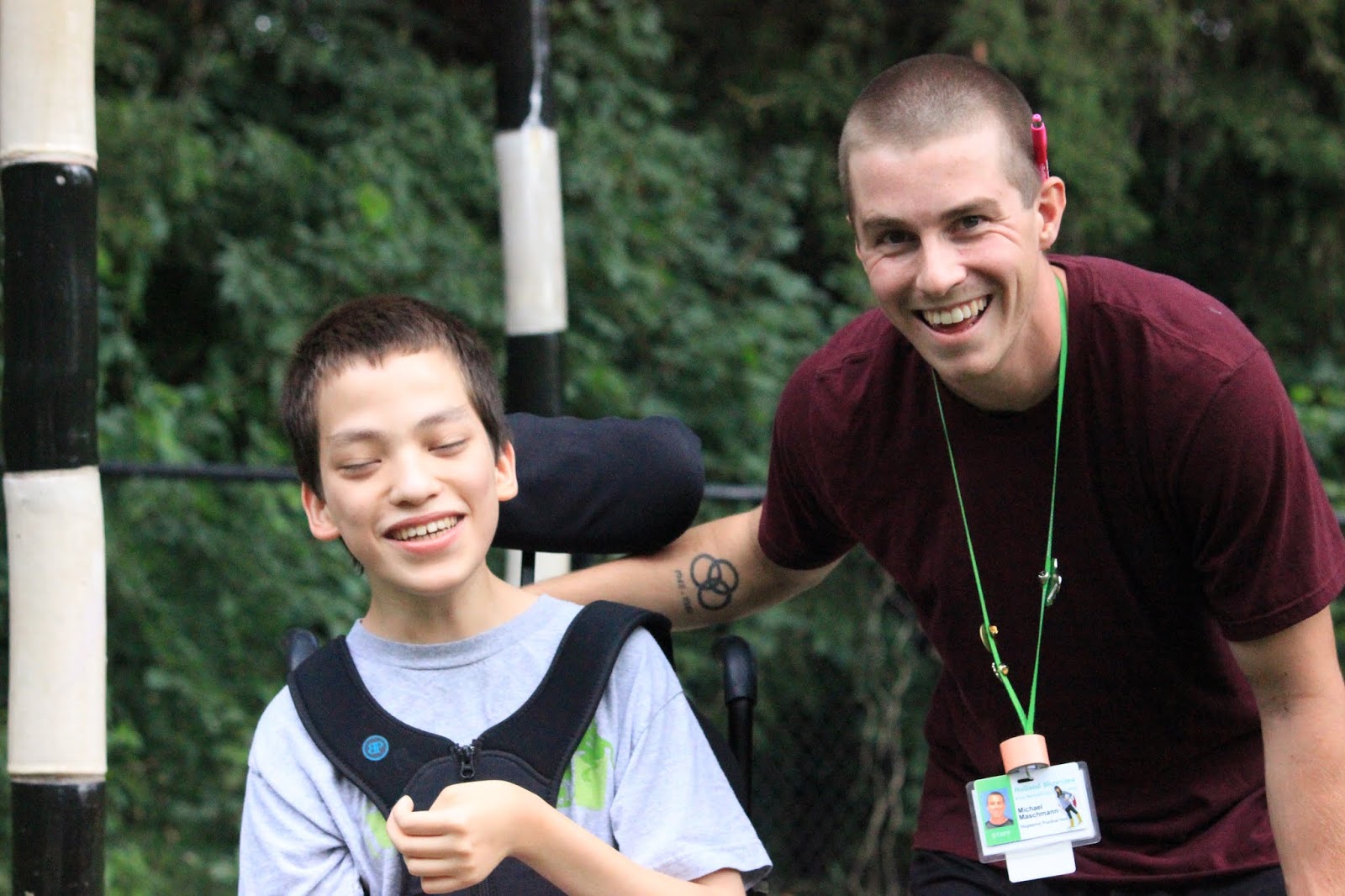
Michael Maschmann is a registered practical nurse at Holland Bloorview who works with children who are hospitalized following painful bone surgeries or life-changing trauma. He came to the hospital a year ago as a Seneca College student, and was hired full-time in February. He’s recently received a number of Spotlight awards from families, like this one that starts: “Michael is a very gentle, caring nurse.” We talked about how Michael got into nursing, and how he picked up a passion for running here.

BLOOM: How did you get into this field?

Michael Maschmann:
It was an experience I had when I was 12 years old. I went to SickKids to have a small operation on my kidney. My kidneys are upside down—they’re called horseshoe kidneys. But they didn’t discover that till I had a hockey injury and they gave me an ultrasound. There was a little blockage, so they wanted to put a stent in to open it up. I was in hospital for a week after the surgery, and I had two male nurses who were incredible. I was terrified to have the surgery and didn’t want to go. But by the end of the week, I didn’t want to leave the hospital.

BLOOM: What was it about these nurses that made an impact?

Michael Maschmann:
They made me and my mom, who was at bedside, very comfortable. It was during the hockey playoffs, and I was a Detroit Red Wings fan and they noticed I was wearing my jersey. So they made a point to turn on the Detroit Red Wings game one night. I was shy, but they got me out of my comfort zone. I was a lot more comfortable having a male nurse.

BLOOM: Was there anything they did that helped with recovery or pain?

Michael Maschmann:
I don’t even recall the medical part—which is good on their part. It was such a happy environment, and there was a lot of distraction, too. There was a place called Marnie’s Lounge for teenagers with a pool table and computers. I was probably there every day. They gave me my first introduction to nursing.

BLOOM: What is a typical day here?

Michael Maschmann:
I come on shift and I’ll review a child’s care plan and get a report from the previous nurse and go introduce myself. A lot of the children are here for a while, so I already have a relationship with them.

During the day I may be providing personal care to children with spinal-cord injuries, or doing wound care and range of motion exercises with a child who had an orthopedic surgery. Our physiotherapists will update on the child’s status board if we can help with stretches. I also give medications. I mostly work evenings and one of the things I like about that is that many tasks have already been done, so there’s a lot more time to sit down with children and provide emotional support. 


Last week I was here when we introduced white boards in the patient rooms. This is a great way for us to get to know what’s important to a child. They can write what they like and talk about their goals for the week and long-term. The kids were really into filling it out. For example, if I was a patient at SickKids, I would put the hockey thing on the white board. It helps us to find common ground with children who are often here for a long time.

BLOOM: What’s the greatest joy of the job?

Michael Maschmann:
Seeing a kid come in after surgery with big zimmers and wedges on, looking pretty miserable. And weeks or months later, seeing them walk out of here. I love working with kids. I get a lot of joy from some of the younger ones. They might not be able to walk like you or I, but they’re naturally happy, and that’s nice to see. It puts things in perspective.

BLOOM: What’s the greatest challenge?

Michael Maschmann:
I think emotionally, it’s a lot to see sometimes. For children who were in a car accident and have a spinal-cord injury, it’s so sudden for that family. It’s different from families whose children have had cerebral palsy since birth. Sometimes the families have really high hopes. Or they’ve gone from both parents working every single day, to being here 24 hours a day, and knowing this is a life-long journey. It’s very difficult because it’s all of a sudden. And it’s not just the client, it’s the emotions of the mom and dad.

BLOOM: How do you cope with the emotions?

Michael Maschmann:
When I was first introduced to this setting I think I took work home with me. I’d be thinking about the fact that I could go home, and I was upset that the kids I worked with were stuck here. Eventually I adjusted to it. I tell myself that when I walk through these doors I’ll do everything I can to help. I’ll give it 100 per cent. But then I have to leave.

BLOOM: Is there anything you do to manage stress?

Michael Maschmann:
I love running. When I first came here there were a few people on the unit who were into running, and they got me into it. I’m now running 50K a week, and was at 100K, in advance of the Scotiabank Waterfront Marathon in October.

BLOOM: You never ran, and now you’re running a marathon?

Michael Maschmann:
Yes. A bunch of us did a 15K. I find running helps with mental health a lot.

BLOOM: What was your experience as a student like here?

Michael Maschmann:
I was very lucky that I had Lisa Drumonde as a preceptor. What I love about Holland Bloorview is it’s very small. So Lisa had me follow around physiotherapists to learn about what they did, and build relationships with other disciplines that my work depends on. I also got experience working on the other units so it was very holistic.

BLOOM: What are the most important qualities in a nurse?

Michael Maschmann:
I think my teacher on my first day of nursing class did a good job explaining it when she said it’s both a science and an art. The medical side of it—understanding how the surgeries affect children—is important, but I stress the value of building relationships with families.

The caring aspect of it is where we can try to make even a little difference every single shift. It’s recognizing that it’s not just emotional for the client, but for the whole family. When we do build relationships, families start to open up, and that makes it easier for them. Sometimes just letting mom or dad know that nursing is here for their kid, if they want to go home for a night to be with their other kids, helps. They're dealing with a lot.

BLOOM: If you could change one thing in children’s rehab, what would it be?

Michael Maschmann:
I think Holland Bloorview does a great job with family-centred, holistic care. But what I hear from families is how hard it is for them when their children transition to adult rehab. I know that at age 19, the services are not there. I wish we could make it a bit more smooth for them. 


Monday, July 9, 2018

'Isn't it enough for art to be joyful?'

By Louise Kinross

Julia Gray describes her work as a post-doctoral fellow at Holland Bloorview as “the humanities reaching into rehab.” Julia trained as an artist, playwright and theatre director and did her PhD in education at the Ontario Institute for Studies in Education (OISE) at the University of Toronto. Before coming here she worked with Ontario rehab researchers to write and direct a play called Cracked—about how we stigmatize people with dementia. The researchers were interested in what they termed ‘the discourse of tragedy’ around dementia, Julia says. We talked about how a similar devaluation happens to people in the wider world of disability. 

BLOOM: How do you describe your research?

Julia Gray:
I’m interested in thinking about what it means to be disabled and/or able-bodied, and how art-making comes into that conversation. For example, I’m working on a study about the therapeutic clowns.

BLOOM: I loved the research here that showed that children who can’t communicate conventionally respond at a physiological level to the clowns.

Julia Gray:
Yes, research here and elsewhere shows tangible outcomes, but I’m interested in the art part. What techniques are the clowns using, and how does what they’re doing as artists link with those outcomes? What do kids with disabilities appreciate or value in that art part? This will be a pilot study where we observe 30 kids playing with the clowns, then debrief with the clowns on exactly what they were doing with the kids. We’re also hoping to interview three to five kids to ask them what is special about the clowns, and what helps them?

BLOOM: Why is there a need for this research?

Julia Gray:
My research focuses on the humanistic side of disability and the humanistic side of care. As a critical researcher, I try to flip over assumptions that we have. For example, we often think art has therapeutic value—that it can help cure or fix something. And my thought is: ‘Really? Does it?’ Do we have to assume that it always has only medical outcomes? Can’t it just be part of being in the world? Isn’t it enough for art to be joyful? As humans, we create things and that includes art sometimes, and kids with disabilities do it, too.

Medical outcomes are like an awesome bonus. If a child’s anxiety or depression is reduced, or their functional movement is improved—awesome. But what about all of the other stuff we’re missing, like joy, expressing sadness, producing something, or playing?

BLOOM: It does seem like a lot of our outcome measures are related to function, not happiness.

Julia Gray:
That’s rehab’s roots, and it makes sense that that’s the frame and the assumptions people bring to the work. We need to think beyond it. This is where my supervisor Barbara Gibson’s work is really critical in asking what the purpose of rehab is philosophically. How do we help people live their best life? What are the assumptions that we’re bringing about what we think a better life is? What are we valuing?

BLOOM: What do you love about working here?

Julia Gray:
I really love working with my supervisor. Barb is genuinely interested in helping me learn things and build my skills. She has a wonderful balance between being genuinely kind and critiquing, challenging and pushing me in the most supportive way.

I also love the way Holland Bloorview is genuinely interested in improving the lives of kids with disabilities. Many clinical settings are not like that. Here, people are receptive to different ways of working and doing things. As an arts person, I feel people are genuinely curious about what I bring, in conversation with science. I’m humanities reaching into rehab.

BLOOM: What is most challenging?

Julia Gray:
That cross-paradigmatic conversation!

BLOOM: Do you feel like you’re talking different languages?

Julia Gray:
Completely. The ways things are measured, or your outputs as a researcher, are done in a different way. There are outputs that aren’t on the radar of scientific research—like artistic creation, which is a kind of exploration. We’re in the process of having a discussion about how do we value that in a scientific research institute? And what is it that is valued?

For example, a lot of humanities- and arts-related work will be published in journals that have a low impact factor. The impact is in concepts and ideas and criticizing cultural norms and assumptions, not objective research or technology. Of course, all of these things can impact services or how care is provided, but the impact is different. To try to assess humanities with a scientific impact factor is challenging. Barb and I, and lots of other qualitative and arts researchers, are working to find ways to value, frame and talk about qualitative work. But we want to have that conversation without trying to fit it into dominant forms or frames.

BLOOM: What did you do your PhD in and why?

Julia Gray:
I did my PhD in education at OISE. In my practical work with health researchers, I felt I wanted the education degree to allow me to learn more about social sciences and qualitative research, since my background is as an artist.

BLOOM: Did you have experience with disability before coming here?

Julia Gray:
Before coming here my research was in dementia, which is cognitive memory loss. As a teenager, I worked at a summer camp with kids with disabilities. I was a special-needs counsellor who worked to integrate kids with special needs into the program. The emphasis was on helping kids be kids.

BLOOM: How did your play Cracked come to be?

Julia Gray:
I had worked on a previous play called After The Crash about brain injury, and one of the investigators told me there was a group of her colleagues interested in doing a play about dementia.

BLOOM: What did they hope to achieve with a play about dementia?

Julia Gray:
They were interested in what they termed the ‘discourse of tragedy’ around dementia: That we value cognition so much that if you lose that, you’re devalued as a human being, and you could only be in the world in a negative, sad way.

They wanted to look at how assumptions about dementia being tragic affect how people are cared for, and the way long-term homes are built and run. They didn’t want to address policy alone, or only the way health care providers are trained, but to look underneath at cultural beliefs around stigma. Why do we have to assume that dementia is sad? It’s not to say it’s not difficult, but is it only sad? Why can't it also be about just being in the world, being in nature and enjoying the sunshine on your face?

BLOOM: What is the play about?

Julia Gray:
It follows two characters who have dementia. With one character we see how her relationship with her children changes, and with the other we see how her relationship with her partner changes. We see both characters move from the initial diagnosis through to their life in long-term care.

Part of what we see is the way these characters thrive in their lives. We see them join a political activist group and work with their MP to develop a national dementia strategy. We see one move into long-term care and make new friends. So the care home isn’t just this dour, cavern of death. It’s vibrant, and the character grows and learns, which is not what we expect to see.

We see that the things that are causing this character to shrink are not related to her disease, but to the assumptions people bring, and the way people stigmatize her. Every single scene in the play, except for one, is based on stories we’ve heard from people living with dementia and their families and clinicians.

BLOOM: Where was the play seen?

Julia Gray:
We’ve toured it to many conferences, long-term care homes and community settings. Several performances were for the general public. It was also filmed and is available on DVD.

BLOOM: So you were trying to tackle stigma on a broad scale?

Julia Gray:
We wanted to look at the broad, underlying assumptions we have about memory loss, and how they manifest in the ways we stigmatize people with dementia. We wanted to show that life could be different, that full lives are possible.

BLOOM: Is this a model we could use here at Holland Bloorview?

Julia Gray:
It is a model we could use with disability stigma. Social justice and reducing stigma are right in our strategic plan, and the arts are fundamental to addressing assumptions that we don’t even know we have. We assume that something is a normal way of seeing the world—but why? And how is this thought or assumption possibly harming people? Art can provide that kind of insight, in a way that being lectured to about 'not stigmatizing' can’t.

BLOOM: What did you learn from your work on Cracked?

Julia Gray:
It’s very easy to get caught up in what it means to live a good life and to be successful. I’m always challenging myself to be aware of my own assumptions about what that means, and to reflect on assumptions that I bring to my work. It’s a constant. You never know enough. I learned that any social justice or anti-stigma work is about relationships—it’s not about you. It’s about listening and acting and doing things in ways that are as supportive as possible for everybody.

BLOOM: Did doing the play change how you feel about diagnosed with dementia yourself?

Julia Gray:
Hugely. I thought a lot about it. The thing that scares me the most isn’t having dementia, but the way people will treat me, and going into care. I know I can live a good life. It’s whether other people will make assumptions about me, and treat me poorly when I’m completely reliant on them.