Showing posts with label Music. Show all posts

Thursday, November 2, 2017

Finding the music in everyone

By Louise Kinross

The other day I posted a call for story ideas on the BLOOM Facebook page.

Karen Bojti wrote: “Another ‘out of the box’ person I have discovered is Laura Nadine. You can Google her. She’s a professional violinist, a wandering minstrel and music teacher. She is also a woman on the autism spectrum. She is teaching Charlie to play the violin.”

I hopped over to Enlightened Audio, which is Laura’s website, and this sentence jumped out at me: “I teach music to all humans.”

It sounds like common sense, but it’s revolutionary. Many children with disabilities struggle to find a music program they can attend, let alone flourish in.

Laura lives in Buffalo, but she travels to Toronto on weekends to teach here, so she came to visit me.

Laura primarily teaches string instruments, but she also teaches piano and guitar at a beginner level.

“The key ingredient to my teaching approach is presuming competence,” Laura says. “I truly believe every student can learn. We just may need to adjust the method or the way in which the student connects with me. I want to make it clear that I’m not a music therapist. I’m teaching children to acquire the skill of playing the instrument, and when they’re finished, these students are playing core material like everyone else.”

Laura says about 80 per cent of her students have disabilities. Most have autism, but she’s also worked with children with cerebral palsy, Down syndrome and ADHD.

“One of the things I think is flawed in understanding disability is that we think disability is static: when you’re assigned a certain IQ, that’s what it is. We don’t take into consideration the error of the measurement systems, and that kids are fluid. They can grow and learn more. I’ve seen this time and time again with autistic children going from being non-verbal to communicating with a letter board. We’ve got testing models that assume all humans fit into a static model. We really don’t understand the grey area of the spectrum, and the ability to make new [neural] connections to compensate for places where there might be flaws.”

When working with a new student, Laura encourages them to make a sound with the violin. “Their bow hold might not be perfect, but making a sound is rewarding,” she says. “I let the child take the lead. If the child is afraid to touch the instrument, we unpack it and look at it, and I talk about how it only makes sound when the child wants it to make sound.”

For a child with autism who has trouble getting her body to do what her brain wants, she'll take the child’s arm and help her bow up and down.

For some children with autism, touching the violin to their shoulder and resting a chin on it “can feel like lightning shocks going through the body,” Laura says. “The goal is to get it on their shoulder as soon as possible, so they can train their own body to tolerate the input. However, if I have to hold the violin first to get to that step, then I do that. I would face the student and say ‘I know your brain understands what you need to do, but your body needs time to learn.’”

The good news is that “the body and brain have an amazing ability to increase tolerance to input, so people on the spectrum can learn to be a little less sensitive through training and understanding. The more times we do something, the less intense those shocks will feel, until they can independently hold the instrument.”

Laura struggled in school growing up because her autism wasn’t diagnosed. “The hardest thing for me is my nervous system,” she says. “I went to public school in the states, and they had no windows in the classroom and fluorescent, vibrating lights. It was hard to be in this building with all this input. There were bells ringing and kids chewing on pencils. I could even hear the clocks tick and the water fountain pump turn on. I had meltdowns that weren’t physical—where I would shut down and couldn’t speak. It manifested in night terrors. My teachers thought I was sick. I dropped out of high school in Grade 10 and did correspondence school.”

Laura says that during her struggles at school, “music was my island of increased ability.” Within four years she was playing at a professional level, and was asked to tutor other music students after school.

Laura says she may have synesthesia, where “one sense gets confused with another. In my case, my vision has a sound. What I see creates music in my head. When I was in music class at school, I would pick up snippets of sounds throughout the day, then organize them into a song to play on my violin. It was an outlet for stress. I called these songs shadow songs, and one of the first I wrote was called All Alone. I wrote it at age 14. I call them shadow songs because everything has a shadow, but for me, everything has a song.”

It wasn’t until Laura was 27 that she learned she had autism. “My second child Jacob was doing some odd things that reminded me of myself,” she recalls. “He had to have things organized in a very special way, and he wasn’t speaking fully until right before he went to kindergarten. I took him to the doctor and he gave us the diagnosis of autism spectrum disorder. Then, while talking to me about Jacob, he handed me some literature about adults on the spectrum. I guess I was obvious.”

Laura says getting the diagnosis was freeing. “It was like someone wiped the fog off my vision. The diagnosis is a toolbox, not a label. It told me what set of tools I needed to adapt to succeed in the world, not just survive. Nobody wants to just survive. People want to have a quality of life and I knew I wanted to be more.”

She went to college to study psychology and education. “With a diagnosis, I was able to ask for help with note-takers and extended time on tests, and I went from being a failing student to having a high GPA.” Laura says she wanted to understand better how her mind worked. “I felt many of the interventions for autism were obedience-based, not development-based, and I wanted to understand more so I could do more.”

Laura says what she’s learned from her students is that “there’s always a way, even when it feels like we’re pressed up against a wall and not making any progress. I’ll wait for the student to shine a light on something else that ends up working for us. That’s part of being student-led. I’m not trying to fix the student. I’m teaching them to navigate through their disability.”

Laura receives lots of positive feedback from her students and their teachers. “One girl who uses a letter board told me that music changed her life, and was a new way for her to communicate her inner thoughts.”

Laura hopes to move to Toronto in the New Year and become a Canadian citizen. “When I came to Toronto, it was the first time ever that I felt like I was at home. The community here is so warm and embraces unique perspectives. I can’t wait to be a part of that society on a daily basis.”


Laura has a book: I am Snamuh: My Journey with Autism and the Power it Gave Me. She also has a few signed copies for anyone interested.


Friday, October 7, 2016

Disabled? Own it, says keyboardist Casey Harris


Renegades isn’t your typical music video: It’s about disabled people doing the things they love.

This summer American indie rock band X Ambassadors hit No. 1 on Billboard’s Alternative chart with this song about people who aren’t afraid to stand out. “It’s not a matter of enjoying it more or less,” a blind guy hiking on a mountain tells us. Then we see athletes with amputations working out. “It’s about enjoying it differently.”

Later the band emerges from a vehicle led by keyboardist Casey Harris, wearing his signature shades and using a white cane. Due to a rare genetic condition, Casey was born with vision loss and needed a kidney transplant six years ago. BLOOM writer Megan Jones spoke to Casey about growing up with vision loss, why disabled musicians matter, and how the Internet rules as a disability resource for kids.

BLOOM: Let’s start with talking about your history. How did your disability affect your identity growing up?

Casey Harris: I didn't go to a special school for blind kids or anything, so for most of my life, I was really the only visually impaired person I knew. I was born in Seattle but my family moved to Ithaca, N.Y., before I started school. Ithaca actually had an amazing school system, and all my educators were willing to work to be adaptive. They made me feel as ordinary of a student as possible.

I never really played sports [laughs]. But other than that, there’s nothing I can point out that was different for me about growing up with a disability.

BLOOM: At the time did you ever want to have access to other kids with disabilities?

Casey Harris: I’ve never really thought about that before! During elementary school there was one kid who had cerebral palsy and one kid who had Asperger’s. But I was no more friends with them than I was with other classmates. I think when I was young I didn’t really know any different so I never really had that craving for company of other disabled people.

If I were to relive my younger years with the Internet it would be much easier to find a community outside of the school system. Young people [now] have an incredible resource.

BLOOM: What was your biggest challenge growing up?

Casey Harris: During my middle school and high school years I sometimes struggled to learn the social ropes. I mean…those years are so awkward to begin with. On top of that, so much of communication is based on body language. There’s a lot of stuff that kids pick up by watching each other. Not being able to do that was difficult.

BLOOM: How did you work around that?

Casey Harris: I sort of didn’t [laughs]. I just did my own thing and tried not to worry. As I’ve gotten older I’ve learned, but it’s been a lot of trial and error. I think, again, if  I’d had access to the Internet, things would have been easier. You get this completely anonymous community and you can ask any question you want. It’s pretty amazing.

BLOOM: What about parents who have kids with special needs—any advice for them?

Casey Harris: One of the most important things you can try to do is to teach kids to own their disabilities. They shouldn’t be embarrassed by them—disabilities are just one thing that makes people unique. My parents instilled that thinking in me, and I think its one of the most important things they could have.

BLOOM: How did you get into music?

Casey Harris: Our mom was a cabaret, jazz and folk singer for most of her adult life. And our dad, a big music enthusiast, had also tried to become a songwriter at one point. So we were always a really musical family. We had a piano in the house, and when I was around six or seven I started plunking around on it and learned to play a few Broadway songs—I really liked Phantom of the Opera—by ear. Then, a few years later, I started formal lessons.

I also owe a lot to a music teacher in high school who introduced me to all sorts of rock and jazz music. It opened me up to the idea [that] music could be freer. Around that time, me and my brother Sam joined up to make the band. We’ve been playing together for more than 10 years at this point.

BLOOM: Tell us about your keyboard. Is it adapted?

Casey Harris: Nothing is particularly specially adapted. But the keyboards that I use are Nord brand—they’re known for not requiring any screen interaction. Everything has a button or a knob. A lot of keyboardists, visually impaired or not, tend to like that because you can completely change your sound on the fly without having to bury your nose in a menu.

I’m starting to branch out to computer synthesizers, but I’m running into that screen problem. It’s adaptable on a computer screen—you can use magnifiers and screen readers—but it’s still so much less intuitive and musical than turning knobs on the keyboard.

BLOOM: What’s your experience been as a person with a disability working in the music world?

Casey Harris: Honestly, it’s been really great overall. It sounds terrible to say but—it’s a good PR talking point. Weirdly, my visual impairment becomes a point of human interest. There’s a million and one keyboardists out there, but there aren’t that many visually impaired ones that are playing rock music.

BLOOM: At the risk of them stealing your thunder, would you like to see more musicians with disabilities in the mainstream?

Casey Harris: Absolutely. If kids can see more people with disabilities succeeding, then they’ll have concrete examples of what they, themselves, can do. There are a lot of things you obviously really can’t do when you’re blind. You can’t, for example, be a commercial airline pilot. That’s just not going to happen. But there are many other activities or jobs that you can figure out your own way of participating in. By seeing what other people have done, you can see yourself in their shoes.

BLOOM: Is that why you wrote a song like Renegades, which is about celebrating difference?

Casey Harris: My brother is the one who writes the lyrics so I hesitate to speak for him, but that theme has been present throughout a lot of our music. We were never the kind of band that managed to blend in or be part of a scene. I think that’s a strength—the more different you can be, the more interesting you are. That’s where the lyrics came from.

Renegades was the last song we wrote for the album. It wasn't a throwaway piece by any means, but we really weren’t expecting it to get placed in a Jeep commercial and get on the radio.

BLOOM: Did anyone ever suggest that it was risky to make a music video about disability? What’s the mainstream reaction been like?

Casey Harris: I don't think anyone involved in the music video process said anything other than, “This is a cool, inspiring idea.” I don’t think there was any hesitation.

The mainstream reaction’s been nothing but positive. I’ve met and talked to so many people who have said they’ve been inspired by. I had no idea it was going to be this global. It makes me realize that we now we have a responsibility and platform to use our voice to do some good in the world.

Monday, August 10, 2015

Are we really from a different planet?

Editor's note: No, this piece is not related to my Facebook post about my "bad day" today. It happened a few days ago. But I couldn't get it out of my mind. And I thought you might find it interesting. Louise

I bought an instrument for my son a couple of years ago but had trouble finding a teacher and it remained largely in the box.

My son took it out the other day for a little jam session and I thought I'd look again for an instructor.

I got some great recommendations on Facebook. Then I went online and found what looked like a really cool organization that offered lessons on this instrument to all age levels, privately, in school, in groups and even as part of corporate team-building. They hold all kinds of regular jam sessions open to anyone at venues that sound really fun. Even I was getting psyched at the idea of showing up one night. This is what I would call a high-profile group of musicians. In their signature, they use this tagline: "democratizing the arts, one strum at a time."

So I filled out their query form. See below.

Hi there -- Can you recommend a teacher who may have had experience working with children or adults with disabilities? I would like to find someone to teach my son and I. Thanks.

-------------------------


I really wish I could be of help, but I don't know anyone who might be a fit for you and your son. Best of luck with your search.

-------------------------

Hi -- thanks for your message. It doesn't necessarily need to be someone who has worked with someone with a disability. Just someone willing to try something new? Thanks.


-----------------------------

Silence.

If this group is unable to interest an instructor in "giving it a whirl," or to suggest someone in the industry who might be able to "stretch" themselves just a tad, who would? I'm a realistic person. I know sometimes things work and sometimes they don't. All I was asking for was a chance. A paid chance. So much for democracy. 

Wednesday, May 13, 2015

Finnish punk band rocks disability awareness at Eurovision

PKN is a punk band that's a little different. The four men are middle-aged, Finnish, and have Down syndrome and autism. Next Tuesday they're competing in Vienna in the Eurovision Song Contest.

The group was chosen to represent Finland by popular vote.

PKN has toured in the United States, United Kingdom, Germany, Norway, Canada and the Netherlands.

They were the focus of a documentary called Punk Syndrome in 2012. Their first hit, sung in Finnish, includes the lyrics: "I don't want to live in a group home, I don't want to live in an institution."

I think this is very cool. Did anyone see them on tour?

Tuesday, October 28, 2014

Star-studded 'Serenade' benefits Beverley School families

By Julie M. Green

What does indie music have to do with children with special needs? 

Toronto singer/songwriter Hayden Desser and his wife Christie Greyerbiehl worked tirelessly to marry the two for one extraordinary night last Saturday. 

The result was Dream Serenadea concert at Massey Hall to benefit children with developmental and physical disabilities at Beverley School in Toronto. The evening was spectacular, with performances from Feist, The National, Sarah Harmer and Billy Talent, to name a few.

Like many of us, disability wasn't on Hayden's radar until someone he lovedhis daughterwas affected. And while much has been done to raise awareness of disorders like autism, there's a glaring lack of funding for therapies and family support.

Three years ago my son was diagnosed with autism at Holland Bloorview. Aside from a block of publicly-funded speech therapy, any support he's received has been paid for privately, by us. Friends and family are staggered when they learn that this is our reality. I know of too many couples forced to re-mortgage their homes or cash in life savings (assuming they're lucky enough to have savings) in order to afford programs for their children.

With my husband’s family overseas, and my own family living several hours' away, respite is virtually non-existent. And our son's needs are such that we can't get the neighbourhood babysitter to look after him while we take a much-needed break.

Demand for public services outstrips supply. Many children simply aren't getting the help they need, when they need it. Some are rejected for programs they should qualify for, while others sit on wait lists for years, missing out on early interventions so vital to their development.

When searching for childcare for his daughter, Hayden discovered firsthand how hard it was to find an appropriate program. Today, his daughter is a student at Beverley.

Hayden created the annual Dream Serenade to support this cause close to his family's heart.

Proceeds from the inaugural event will fund assistive technology and a custom green playground at Beverley School and also provide respite services to families.

When artists lend their voices to meaningful causes, the result is a thing of beauty. On Saturday night, the atmosphere at Massey Hall was electric. 

But oddly, the highlight of the evening wasn't the Barenaked Ladies goofing around on stage. It wasn't the haunting tones of Matt and Aaron from The National, or the audience singing along to Feist's hit "1, 2, 3, 4." It wasn't even Hayden's moving tribute to his daughter in a new song.

No, the highlight was video footage of the lit-up faces of the Beverley kids during an impromptu jamming session with the performers the day before. 

See you at next year’s Dream Serenade!

Julie M. Green runs a special-needs blog at Yummy Mummy Club. Check out the photo of her below with her son. Photo of the concert above by Farida Peters.


Friday, October 17, 2014

An artist is born

By Kevin Vieira

Whether sitting at the piano, strumming a guitar or drumming with whatever he can get his hands on, my son Joseph (above) makes music.

Joseph is seven years old and has cerebral palsy. Joseph is also non-verbal (so far), yet he has a voice: a computer-generated voice that is produced in response to the words he selects or types into his computer.

This technology that has become the greatest source of liberation for our son—liberating his ideas which are as uncensored, funny, sometimes hurtful, deep and poetic as any child’s.

This is where the story begins. In finding his voice, Joseph also found opportunity, friendship and music.

Paul Alcamo, Joseph’s senior kindergarten teacher at the Bloorview School Authority, recalls meeting Joseph at rehearsals for a student song CD he was producing, when Joseph was just in junior kindergarten.

“A very articulate, voice-device-using boy named Joseph told me that he couldn’t sing,” Paul remembers. “I was temporarily stumped to find a way to get him into the songs and encouraged him to use his voice in his way. The accuracy of the notes didn’t matter as much as he made a joyful sound with us. That didn’t sit well with this very soulful and intelligent boy. For close to six months that also stayed with me in the back of my mind.

“Joe was then placed in my class for his senior kindergarten year…At one point early in the year I decided to save some of the writings of this witty and profound child. As well, the nagging feeling that I had to find a way for his voice to make it into music stayed with me.”

Joseph’s teacher Paul approached his friend Adrian Moody, a producer at the Ashley Ingram School of Music, for help. And, for reasons I will never understand, Adrian agreed to meet with Joseph and our family.

The meeting with Adrian (AJ) at the studio was unforgettable. AJ was very warm and welcoming, treating us to a tour of the studio that was complete with gold records on the walls and photos of some of the biggest pop stars in the world who had recorded there. AJ and Joseph hit it off immediately. Both fed off the other’s enthusiasm and sense of humour, both completely fascinated by the other.

We finally entered the studio where AJ and Joseph would record together. I apologized for not having a clear musical idea or even a complete song and handed over Joseph’s lyrics for his song That Thing. AJ was immediately excited and optimistic that something special was about to happen, and proceeded to transfer Joseph’s lyrics, as spoken by his computer, onto one of the studio computers. Then he asked Joseph for more lyrics.

“Gimme something,” AJ said, and Joseph responded, typing new lyrics on the spot onto his computer. With AJ’s support and encouragement, Joseph delivered.

After all the lyrics were recorded, AJ demonstrated how he would manipulate the digital voice recording from Joseph’s computer, by making pitch changes and varying the length of his words to emulate a singing voice. It was of course a transformative moment.


There was lots of laughter, shouting and high-fives. Joseph's emotions ranged from disbelief to joy to immense pride and validation.

It was a moment where everything changed. I had never heard or imagined anything like it. In an instant, a world of possibilities opened up. In an instant a wall of limitation came crashing down. AJ Moody and Paul Alcamo had changed the world for Joseph and many like him who are sure to follow.

This is how AJ describes it:

“I had been trained to treat everyone in the studio as an artist, and I was determined to approach this project with the same level of care and professionalism. When Joey and his family arrived, I knew that I wasn’t just treating someone like a star: Joey is a star. He was engaged, energetic and inspiring to work with. Using technology and software we often take for granted in the studio, I was able to work with Joey in creating a song that gave him his musical voice. I had no idea of the impact it would have on him, his family, his peers, or myself.

“Joey taught me that expression is not about what we see or what we expect, but truly about being free to express what lies directly in our hearts. In fact, the result was so powerful to me, I quit my job and founded a nonprofit organization—called Music Without Barriers—to help Joey and people all around the world find their voice, access music no matter the barriers, and give everyone the chance to shine.”

Joseph presented his song That Thing at the Breaking the ICE (Independence Community and Empowerment) conference in Toronto in 2012. At just five years of age he introduced it by saying he “wrote it to get rich” and was “still waiting,” to uproarious laughter. When his song played, it brought the roof down.


What Joseph, AJ and Paul accomplished together changed the lives of many of the people in that conference hall that day. That Thing has that kind of power because it’s not just a great piece of work for alternate communication users; it’s a great song, period. And, at the heart of it is a young boy with a big voice, big ideas, and lots of swagger.

Joseph may just represent a new beginning in what’s possible—and a new attitude in what’s acceptable—for this generation and future generations of alternate communication users.

The song That Thing (below) is available on
iTunes. Check out AJ's Music Without Barriers

That Thing

By Joseph Spahn-Vieira


That thing, that thing, that thing,

Don't be scared . . .

That's right I said it, I said it,


Don’t, don’t doubt,

That thing that thing that thing that thing,


Don't be scared,

don't be scared, it's better to love than to like . . .


I worked with you and you worked with me, so don't be scared,


The hearts fall like rain into my lunchbox, I take them out and give them to you . . .


it's a little bit of this, and a little bit of that,

That, that, that, that thing . . .


Don’t be scared,

don’t don’t doubt,

Don’t be scared,

don’t don’t doubt,


That thing that thing that thing

Don’t be scared,

That's right I said it,

Don’t, don’t doubt.

Friday, October 3, 2014

Composer finds the music in every life

By Louise Kinross

Northern Irish composer Deirdre Gribbin has produced over 50 works—from orchestral music to her opera Hey Persephone!—that have been performed around the world. Her UNESCO-winning work Empire States has played in 28 countries.

Writing music began as a way to express the conflict Deirdre witnessed growing up in Northern Ireland in the ’70s. “I saw things that kids don’t normally see,” she says. “Hijacked public busses blocking the road so you couldn’t go through, bomb blasts. I went to London to study and found myself writing about Northern Ireland. At a time when people couldn’t speak about Belfast politically, I could write about it in my music and I found it a powerful tool.”

Deirdre’s orchestral piece Unity of Being: A Peace Anthem for Northern Ireland was the first international work to be performed in New York City after the 9/11 al-Qaida attacks and was the subject of a New York Times piece. “It made me realize how music could cross barriers, redefine boundaries and have such strong purpose in people’s lives,” she says. “Music didn’t need words to communicate solace, sharing and comfort.”

After her son Ethan was born with Down syndrome in 2006, Deirdre came to see music as a potential voice for people with intellectual disabilities. “Why can’t someone with a learning disability who can’t speak write the most moving or the most joyful or the most angry piece of music?” she says. “If given the right and best technical support, people with intellectual disabilities can be the controllers of their own musical fate.”

Rather than skills-based music therapy outcomes, Deidre is interested in how music making builds self-worth. “If you give someone the skills to make decisions about how they want something to sound—about the shape of the piece or the structure or whether it expresses a certain emotion—it becomes their music, and then they have the confidence to be able to assert their own decisions in other areas of their life.”

Deirdre, who lives in London, is starting a composing group for eight-year-olds with Down syndrome—called Down Right Excellent—which includes son Ethan. “We may use colours or shapes to represent notes or emotions or types of music. I’m going to give them the language of music—so not just describing rhythm as fast and slow, but spikey and energetic, and how that links into emotions. They’ll learn about how to put music together. And if you can hear something that you’ve done, the sense of self you gain from that can really build your self-esteem: ‘I can’t do this and this and this. But I can do this.’”

Deirdre says raising Ethan has had a huge influence on her work. “The expectation when he was born was that he would compromise my work, or that I wouldn’t have the time to write music. But I’ve written some of the best music in the past few years.” Deirdre attributes this to her time being more focused—she goes away on retreats where she can write all day—and a greater emotional freedom in her work.

“I’ve always felt instinctively that it’s important to express emotional states through what I write, but now it’s very much at the centre of what I do,” she says. “I feel much stronger as a person because I’ve had to develop and nurture Ethan’s life and our family’s life. When you’re the parent of a child with a learning disability—and the mainstream is often acutely aware and subliminally critical of difference—you have to develop a side of yourself that is quite defiant and tough and never be afraid to challenge.”

After Ethan was born, Deirdre became interested in human DNA and how it works. “We were told that Ethan had an extra set of chromosome 21 and I came away thinking ‘What’s a chromosome and what does that mean?’” Last year Deirdre set a fragment of genetic code to music while working as artist-in-residence at the Medical Research Council’s Laboratory of Molecular Biology in Cambridge. Hearing Your Genes Evolve is the resulting string quartet.

“I learned that my son and a child without Down syndrome have 99.9 per cent the same genetic code,” she says. “And in that big 99.9 per cent, there are more similarities than differences.”

Deirdre wants to learn more about the content of chromosome 21. “Empathy, which is seen in people with Down syndrome, is genetic. It’s something in the genetic information that’s not just nurture. We should be looking not just at negative effects of Down syndrome, but at what it enhances.”

And instead of only measuring human qualities that have a market value—such as intelligence or athleticism—we should be interested in “things that make us better people, such as being selfless, caring and open.”


Photos by William Suarez

Wednesday, May 15, 2013

My son's climb is steeper than most


By D. Christine Brown


Our 4-year-old son is recovering from severe brain inflammation 20 months ago. Although he's now developmentally delayed, has an irregular EEG on the left side of his brain, and also has a resulting autism diagnosis, he's been looking progressively more "neurotypical" as his brain heals. It's been a journey of hope and optimism for his future.

But a few recent events planted some seeds of doubt in my mind. First there was the story of the parents who could no longer care for their 19-year-old autistic son, so left him at a government office. The boy is at the developmental stage of an 18-month-old, which includes unrolling the toilet paper, then trying to shove it all into the toilet.

Then I attended Silken Laumann's BLOOM speaker event. She mentioned worrying that her 17-year-old autistic stepdaughter could at any moment throw a jar across the room at the head of one of her biological children.

I'm also finally reading Bad Animals after seeing author Joel Yanofsky speak at Indigo last October. In it, he describes how you have so much hope when you first get therapy for your child after an autism diagnosis. Then, at some point, you realize that he's starting Grade 5 and maybe this is the way things are going to stay.

I began to picture our lives going forward. What if Lucas doesn't fully recover? Will these examples become our reality once Lucas is too big to pick up and move around?

I decided to give a music playgroup a third try. It was the same group we had started just before my son's brain inflammation, just over a year-and-a-half ago.

We tried it again last year, but he wasn't ready yet. I thought he might be ready this year so off we went to the indoor playground with the other parents (mostly mothers) and young toddlers.

My son towered over them, but they paid attention to the leader. They put their hands in the air on command, their knee up to balance during the appropriate part of the song. My son ran off to return to the slide and ball pit. There was zero participation on his part, aside from looking at everyone's face as he rotated around the middle of the room before racing out.

Towards the end of the class a father was leaving with his daughter and passed us on his way out. "Oh, he wasn't interested today?" he said, gesturing to Lucas up in the climbing structure. Here came the eruption of doubt.

"He's developmentally delayed," I said. "He's recovering from severe brain inflammation." The poor guy was sympathetic and asked if Lucas would recover. "Nobody knows," I said. "It's a wait and see." He commented on how hard it must be for us, and how he wished he could do something.

Tears welled up. "I'm sorry," I said. "I'm not usually like this, but in situations when I see other kids, it hits me." I also told him how Lucas has been recovering and making great progress.

"At least he looks really happy," he said. "He is," I said, then quickly scooped up Lucas, gathered our things and headed to the park before the rest of the class let out, wiping the tears off my face.

Lucas' behaviour has recently regressed a bit. He's mouthing and throwing all objects again for the first time in months. It's relentless; he's throwing everything in sight. As we walked to the park, I was in a cloud of despair, trying to be cheerful as I ran with my son through the grass on a beautiful sunny day, watching him kick sand and throw sticks. I was more discouraged than I'd been in a long time.

On the way home from hearing Silken Laumann speak, I heard philosophers interviewed on CBC about the moral obligation of helping others. One discussed the lack of difference between saving a drowning child in front of you and donating to famine relief in Africa: they're both going to make a difference in someone's life.

I thought about the misfortune of my son's brain inflammation and subsequent setbacks and how determined I am to facilitate his (full) recovery. He indeed, might recover. I thought about the children who don't. What about their parents? Some never get a break.

Our current reality is but a glimpse into the hardships in their world and it is draining. It is defeating. It isn't fair. Of course there are also gifts, insights and great moments, but how would I feel if my son escaped the fate that others don't? What if the day comes when my son no longer has disability status?

I know I can't go back to a normal life after all we've experienced.

It's my moral obligation and duty to advocate, and if my son recovers, I'll have the energy and time that others don't. I'm a researcher by profession and have gained a wealth of new knowledge since our road turned. I'm persistent and resourceful. I'll do what I can make to a difference: to promote and facilitate more understanding and support for other families living with disabilities.

After the failed music group, Lucas decided to run along the path surrounding the park. At the end there were only three choices: on to the road of oncoming traffic, turning back, or going up a very steep hill. Lately Lucas has enjoyed saying "too steep" about the slides at the playgrounds. I saw this as a great opportunity to incorporate another context for the word steep. "Lucas!" I exclaimed, "Look at the steep, steep hill! Can we make it up the steep hill or is it toooooo steep to climb up?"

He laughed, I grabbed his hand, and up we started. I suddenly remembered that as a small child I hated group activities. I didn't like to conform. Maybe Lucas just has my personality, I thought.

Lucas was laughing and giggling as we zigzagged up. It was exhilarating. At the top I stopped and held Lucas, looking down. "Look!" I said. "We made it!"

And then, BAM! It came to me: this was our last 20 months and we've made it to the top. Lucas is doing great. He's recovering and making tremendous progress. We don't have to compare ourselves to the other toddlers. Their hills haven't been as steep.

Monday, May 13, 2013

'The soundtrack of my life'


By Jason Nolan


I have always made sense of the world through sound and music, so it's not strange that the music of my child and teen years, the late-70s and early-80s, had such an impact on me. I’m also autistic, and have a strange obsession with words. Sound, music and words are a part of my echolalia—the automatic repeating of what I hear and read—that have become important placeholders for my thinking.

My music is probably not your music and my music was largely angry music. What I remember is a time of anarchy in the UK: not that of the Sex Pistols, but rather well thought-out social protest. A quartet of songs come to mind that influenced my thinking on social justice decades before I located myself as someone seen as ‘other’ or different in a manner reflecting these voices.

Tom Robinson’s twin anthems “Sing if you’re glad to be gay” (1977) and “Power in the Darkness” (1978), and Ian Dury’s “Spasticus Autisticus”(1981) are obvious statements about racism, homophobia and ableism. Although I was neither gay, a visible minority nor (as I thought at the time) disabled, these songs spoke to me in their rage against intolerance. The Only One’s “Another Girl, Another Planet” (1978) was an unrepentant challenge to the social norms proscribing self-medication and drug addiction, as well as a statement about feeling like being from another planet. Incidentally, this song plays through the opening credits of the comedy Paul (2011), a movie about an alien trying to get home.

I chose these songs because they all popped into my head this morning, one after another. But there is always a logic to my seeming randomness. I was thinking of a title for this piece and I thought of translating “Autistic Professor” into Latin: something like “Professorius Autisticus.” But I thought it sounded too much like “Spasticus Autisticus.” And as the train of thought left the station, I was overwhelmed by the associations of the music and mood of British pub rock from which the music sprung. In a few moments I’d worked out all these songs, and had to get up to write it down. It was 5 a.m.

My sounds and my music rotate at high speed around the central core of me. It is not anyone else’s music, just my way of ordering and making sense of the world. Take it away from me and you will see a catastrophic meltdown. But you can’t take it away from me. The words and sounds echo in my head whenever I need to flush out the crass sounds of the world of typical folk. Conversations, trucks reversing, air conditioners, fluorescent lights’ 60Hz hum, that strange 13kHz reverberation of the tinnitus that follows me wherever I go all bleed into nothingness when the songs and sounds I like take prominence. Call these my auditory stim, even though the sounds may be swirling only in my head; I’ve long since been socialized out of making strange vocal utterances.

Luckily for me, I was a latch-key child. When I grew up there was no MTV, Disney Channel or CDs, and little of the mass-marketed musical commodifications that today overwhelm children and deaden their senses. But neither was I overwhelmed with prescribed parental culture. My parents had few records I remember. I only remember Festival of Light Classical Music (Reader’s Digest), A Taste of Honey (Herb Alpert), Living in the Past (Jethro Tull) and Beyond the Fringe (Peter Cook and Dudley Moore). Most importantly, however, I was never institutionalized in daycare, and subject to a standardized regimen of age- or developmentally-appropriate music. Jethro Tull’s counterpunctual Bourée, and Liszt's Hungarian Rhapsody, are the two songs I remember transporting me the farthest. I would get my stim as I hummed along and conducted in time with the music.

Largely left to my own, and living on my own, on and off since I was 17, I have been free to form my own acoustic palette of sounds and words that interest me, soothe me and help me to organize my thinking. They are not sounds and words that others might choose, but as always with me, they spring forth fully formed from my lips or fingertips, or merely float about in my mind. I do not plan what I am going to do or say, and each word written here has been laid down one after another without reflection or compositional intention. Most importantly, they have not been prompted, directed, demanded or cajoled by anyone according to anyone’s notion of what should go where, beyond the general influence of having read too many books and having finally figured out how to construct sentences and paragraphs.

My words, like my music, like my movements, choices of clothing, tastes, curiosities, interests, desires and passions are, to me, intrinsically situated in myself, and are the foundation of my motivations. To take them away from me is to remove me from myself, and there is nothing left.

As I sit here, age 50, as a professor and director of the Experiential Design and Gaming Environments Lab at Ryerson University, I don’t have to wonder how I got here. I got here because I fell through the cracks somehow, and was largely left to my own devices. Without heteronomous (that is invasive or helicopter) parenting, institutionalizing influences or the normalizing of commercialized children’s culture, I have survived largely intact. My therapeutic interventions followed the social rather than medical model. I was shown how to engage with others when I wanted to, and the normalizing expectations that were as onerous as any Acquired Behaviour Analysis (ABA) session were directed at enabling me to accomplish basic tasks and social interactions. However, there was so much room for me and my interests that both escaped below the radar or were allowed to roam unchecked, perhaps because they were not so outlandish. Or perhaps because, by having such outlets and freedom, I was not so over-stressed as to feel the need for a more dynamic mode of expression.

Left on my own, I was a happy child. When I was forced to engage I was not. Yet I did like being around people when I was able to choose, and I was always interested in knowing how to engage with others when I was the one choosing when. John Locke said that we should keep children healthy and safe from harm and from harming others, but otherwise give them no parental interference whatsoever, neither direction, admonition or even toys. They should be left on their own without adult influence until they so choose to come to us. They will come with their own intrinsic interests and motivations, their own goals and aspirations, their own sense of self. For, as he put it, there is nothing so sad as an adult who does not know what drives his or her own passions.

We live in a world where few have the chance to ever learn what really drives their passions. We live in a world that does not provide equitable support and opportunity for those of us with non-standard and inconvenient special needs. We live in a world that lacks respect or understanding for diverse ways of thinking and living. We live with parents who want the best for us, but are often lead to believe that the relative anonymity of neurotypical and institutional norms—trying to fit in and act normal in school, social situations and the workplace—are the only path worth following.

If our goals, and the goals we have for the children in our care, is to help them to be all they can be, then it is incumbent on us all to ensure that we are doing everything we can to nurture every scrap of intrinsic interest in ourselves and all children, in the face of institutionalized norms and standardizing influences.

I fell through the cracks, and luckily not much attention was given to try and fix me. And what was tried, didn’t work very well. Yes, I dropped out of high school and worked a string of dead-end jobs, then returned to high school when I found an inclusive learning environment that helped me find my interests and strengths. I wandered through a liberal arts education, slowly learning how to communicate properly with others through the pages of stories of how others engaged. After a dozen years fumbling through school and jobs and even some teaching, I realized that I wanted to learn about learning.

Another dozen years later I got my first full-time job, at age 43. And I sit in my lab, with grad students working on various projects, while the soundtrack of my life plays on the speakers at my desk, perhaps bothering others somewhat. But I know it is the sea in which I swim. Brian Eno’s “Another Green World” or Hawkwind’s “Quark, Strangeness and Charm” can be heard day in, day out. These sounds are my stim. And it is this stim that makes the world possible.

Tuesday, August 14, 2012

Tell your own story


A research project at Guelph University in Ontario helps women write their own storyline about what it means to have a disability.

In a three-day workshop called Project Revision, female participants aged 20 to 70 collect footage, music and still photos. They write out the story of their own disability, then edit everything together into a three-minute video. Along the way, they receive constant instruction, guidance and technical support.

At the project’s end, the videos are shared with health-care professionals. Eventually, the researchers hope to share them with the public.

Researcher Eliza Chandler (photo above) created her own digital story when Project Revision began. In her work, Eliza, who has cerebral palsy, portrayed the initial anxiety and shame – and eventual pride – she felt about her disability while attending university.

She says creating a story helped her to express ideas and feelings that she wouldn’t typically have been willing to discuss.

That’s why she believes that digital storytelling can be useful not just to adults, but to children with disabilities and their families.

“As a child growing up, disability wasn’t something I talked about with my family,” Eliza says. “It was obvious it was there, and we dealt with it, but we didn’t really talk about it. If I were to have experienced something like this with my parents when I was a child, I think it would have been really useful and helpful to open up tough conversations.”

Digital story making can also be an effective outlet for children who don’t have a strong command on language. They may be better able to access and share their feelings through pictures or music or tone of voice, Eliza says. And kids are often tech-savvy.

Creating a video about disability may be useful for parents and children.

“Everybody can make a video, and I really do mean that…” Eliza says. “The end product is accessible to a lot of people. Most people can find some sort of entry point into the digital stories.”

Eliza feels the process of digital story-making is an opportunity to alter common depictions of disability.

Too often people with disabilities are portrayed in the media as being pitiful, sick, shameful or regrettable. However, given the chance to represent themselves, Eliza says a different picture emerges.

So far, many participants have framed their disabilities as being "generative" – as adding something to their lives rather than taking away. While the women involved have not always shown pride in their disabilities, Eliza says they have presented them as a catalyst for new and positive things – like an improved perspective or a new relationship.

The stories are truthful and multi-dimensional, a necessary foil to the conventional depictions that are currently so pervasive.

“With a real story, [participants] are able to represent the lived experience, which is much more nuanced than a straightforward stereotype,” Eliza explains.

“It’s not a as though someone’s making an argument you can counter. It’s their truth. That’s really powerful, I think. And really necessary because these are stories that aren’t usually represented.”

Story by Megan Jones

Monday, November 21, 2011

Violin solo: 'It's not something I thought I'd be able to do'


We've written about Eric Wan (above) before, a graduate student in engineering at Holland Bloorview who helped develop the Virtual Music Instrument, a software that allows children who can't manipulate conventional instruments to make music. Eric, who was paralyzed at age 18, will play violin -- with head movements -- with the Montreal Chamber Orchestra tomorrow. Watch this YouTube video and read more in this Montreal Gazette piece.

Saturday, August 20, 2011

When Somebody Loved Me


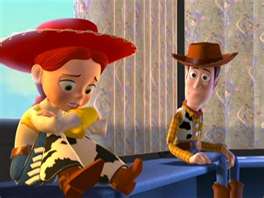
I know I mentioned that Ben loves Jessie, the cowgirl from Toy Story.

If left to his own devices, he'll surf the internet to listen to her soulful song, When Somebody Loved Me, over and over and over again.

We may hear it in English, or Spanish or Portuguese.

He will proclaim his love for Jessie (I love Jessie, he'll sign).

Why was Ben so drawn to this song, I wondered. But listening to the lyrics, I think it's somewhat of  a metaphor for Ben's life.


When somebody loved me,
Everything was beautiful
Every hour we spent together lives within my heart
And when she was sad,
I was there to dry her tears
And when she was happy,
So was I
When she loved me

...
So the years went by
I stayed the same
But she began to drift away
I was left alone
Still I waited for the day
When she'd say I will always love you

Lonely and forgotten...


I wonder if, like Jessie in the song, Ben feels the ache of staying largely 'the same,' while everyone around him grows up and drifts away.

He had friends at the elementary school he went to. But they've all progressed at an amazing pace and he wasn't able to keep up.

If only Ben could live in a world where the rules were simpler and no one got left behind.

Tuesday, October 5, 2010

Canadian helps disabled speak through music


The AFP news agency posted this story about Stefanie Blain's research yesterday. Stefanie recently completed her doctoral studies in biomedical engineering at Holland Bloorview and is now a postdoctoral fellow at the University of Michigan. I just bumped into Krystal Char (with clowns above) and her father Fred and Fred tells me that when Krystal visits with our therapeutic clowns, her physiological signals are translated into a song which produces an enormous smile. "My wife says it's amazing." 

Canadian helps disabled speak through music

MONTREAL, Canada — Children immured within their severely disabled bodies may soon be able to communicate thanks to a newly unveiled device that translates physiological signals into music.

Stefanie Blain studied for five years the interactions of children with severe disabilities and their parents, as part of her doctoral studies at Canada's largest children's rehabilitation hospital, Holland Bloorview, in Toronto.

"They can 'read' their children by observing minuscule movements of their lips, or changes in their breathing," she told a Technology, Entertainment, Design (TEDx) conference in Montreal.

By measuring those tiny physiological signals, Blain was able to show that Max, a 15-year-old adolescent who was seemingly in a vegetative state, became animated when he spotted his favorite toy.

Even completely paralyzed, the body continues to react by changes in body temperature and sweat levels, as well as heart and breathing rates, she explained.

Blain initially created a graphic translation of these physiological arousals.

"But my curves and 3D simulations didn't speak to anyone," she said with a smile. So, being a musician, she wrote algorithms to convert them into sounds," she said.

"Another child, whom we believed was always sleeping, started to emit a 'biological song' whenever clowns entered his room. It was the first time that his parents and hospital staff realized that he was conscious of the world around him," she said.

The software she created deciphers physiological signals and translates them into a range of tonalities, from soft low-pitched sounds when an individual is calm to high-pitched and more complicated tunes when they are thinking of pleasant things.

"Each 'song' is unique," she said.

"Imagine that when I arrived at the hospital, the hallways were quiet leading to the rooms of children who could neither move, nor speak, and not even make facial expressions," she said.

"Imagine these hallways now (full of music), imagine parents who can really get to know their children."

Currently, the research team lead by Tom Chau is seeking to expand the technology to make it possible for severely disabled children to answer yes or no when prompted, and use a computer.

Copyright © 2010 AFP. All rights reserved.

Friday, February 12, 2010

Music serves to soothe the pain


No child likes needles, and coaxing kids to remain calm while receiving Botox injections to relax tight muscles caused by cerebral palsy was stressful for parents in Bloorview’s spasticity clinic.

But an innovative program that combines music, visual arts and medicine is reducing children's anxiety, helping them find creative ways to cope, and cutting procedure times in half.

Armed with a guitar and a variety of drums, rattles and art supplies, Bloorview music therapist Andrea Lamont (above) and artistic co-ordinator Sarah Dobbs meet with families before the procedure to “assess what type of music will work well to distract this child and what pieces are soothing – whether there's a familiar lullaby mom and dad sing at home,” Andrea says.

Dr. Darcy Fehlings, the developmental pediatrician who leads the clinic, says the music intervention reduces anxiety in most children before the procedure and decreases injection pain in about 50 per cent.

Before the procedure, “they have fun, find instruments they like, make choices, make mom and dad play, conduct the music, and feel more in control,” Andrea says.

Children then take the instruments as companions when they get up onto the clinic bed and lie down to receive injections. “We let them know that it's okay to bang the drum hard when they hurt,” Sarah says. “Normally when a child is in a medical environment and makes a lot of noise, they're told it isn't good behaviour.”

Andrea, who sings and plays the guitar during the procedure, matches the child's emotions in her music. “I watch Dr. Fehlings and as the needle goes in, I increase the tension by going from regular sounding music to something like the Spanish or Middle Eastern idiom, or adding volume or texture and more tension in my voice. From a therapy point of view, when you're willing to match the child where they are, they feel the music is a partner through the procedure. It's telling the client 'I hear you and I recognize your pain, and I'll scream along with you.' When the needle is removed I bring down the tension and sing soothing, calming pieces and the parents give the child a hug.”

While Andrea sings, Sarah supports children by offering them ways to express themselves with a drum or rattle. “A child may feel trapped by their vision of how the procedure will be," Andrea says. “They may tell themselves: ‘It was terrible last time and I'm going to be in pain and there's nothing I can do about it.’ We help open the blinders by offering creative activities that promote problem-solving: ‘I can't do anything about the pain, but Sarah is offering me the shaker. I can do something. I can hold onto something and I can make the bells go.’”

Megan Perron, a nurse in the clinic, says the procedure time of 10 minutes has been cut in half since the introduction of “the music ladies. When the anxiety level is down and the child is cooperating and less scared, we can get the injections done in five minutes. They can hit the drum or bang the symbol to get their frustration out, and they know it’s acceptable to be upset by the whole process. They may still scream, but with the music, they lie still. The parents see the difference. When the child is calmer, everyone is calmer.”

A favourite instrument is a large ocean drum with a pattern of fish on the outside fabric and a clear plastic top. Inside are ball-bearings that move and swish as if in water when the drum is moved. “You can increase or decrease the intensity, so it sounds like a soft lapping of water or a big rush of waves,” Sarah says.

She notes that the arts are accepted as “an integral medical tool” at Bloorview and are increasingly used alongside traditional medicine and therapies. “In the 1950s the World Health Organization said that health had to do with the wellbeing of body, mind and spirit. The clinicians on the medical side can take care of the body, the child's physical needs. But the mind and spirits, those are fed by the arts.”