Showing posts with label SickKids. Show all posts

Monday, October 17, 2016

Why I can't be 'for' the 'SickKids vs' ad


By Louise Kinross

Disability is personal. It’s part of identity. When your child has significant disabilities, it becomes part of your identity too.

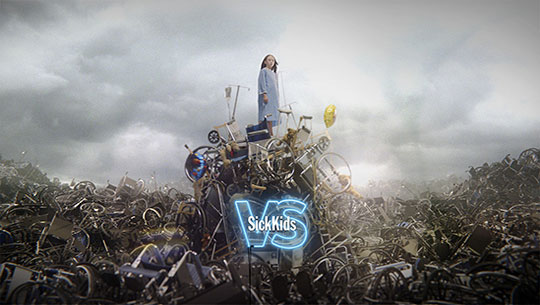
Perhaps this is why the Hospital for Sick Children's latest campaign video SickKids vs—which positions the hospital and its patients against cancer, kidney failure and autism, and includes this image of a girl standing defiantly atop a huge pile of discarded wheelchairs—feels like a betrayal. It’s trending now on YouTube with close to 200,000 views.

“We’re on the front line every day. And we are winning,” says the copy on the foundation page. Indeed, in the video, patients join a simulated battle line with armed 'Fort York' soldiers, hop in a boxing ring to fight cancer and smash apart a kidney dialysis machine with a bat.

I get why it’s so appealing. Viewers are encouraged to choose a fight and donate. Who doesn’t want to be a “winner?” 
From a fundraising perspective, I'm sure this ad has hit the ball out of the park.

But what about the messages it sends to kids and families who aren’t on the winning side?


When you define things in simple terms, you also imply that those who don’t beat their illness or disability are “losers.” Were they not as tough as the kids wearing the super hero costumes in the video? SickKids vs. plays to the song Undeniable by Toronto rapper Richie Sosa. The chorus goes We undeniable.

Are the kids who live with permanent disabilities or chronic illnesses, or who die from their condition, not “undeniable” enough? The word “defeat” flashes during the video. Does that mean some kids “surrender?” Do we really want to believe that children have that much control over their medical conditions? And at some point, doesn’t the concept of fighting just miss the point when we're talking about health and healing?

In her 2015 book Malignant Metaphor: Confronting Cancer Myths, science writer Alanna Mitchell writes about why the battle metaphor isn’t helpful to cancer patients and their families (she also writes about why it's not a great analogy for the latest clinical treatments). “A main concern is that when someone dies of cancer, the message that remains is that that person just hasn’t fought hard enough, was not a brave enough soldier against the ultimate foe, did not really want to win,” she writes.

Many children with congenital disabilities or complex medical problems are patients at SickKids. Their conditions and disabilities are not ones that can be defeated. Did they, or their parents, not try hard enough?

And is it really so easy to define “the enemy?”

The inclusion of autism in the video as something to be battled against is surprising given our current understanding. Autistic adults tell us that accepting and valuing their differences is the way to go. To them, eradicating autism isn’t possible without eradicating who they are as people. Most people in the disability field don’t believe autism can be “cured,” any more than sexual orientation can be changed. Even Autism Speaks just removed cure as an objective from its mission. The focus now is on helping people live good lives that they value.

I honour and respect the families who participated in the video. I understand why viewing their kids as warriors is empowering. I certainly think of my son, and our family, as warriors, but as fragile ones.

From a health organization, I expect a more complex, nuanced depiction—one that includes all kids, whether their disease is cured or not. One that shows that there are many rich ways of living, and dying. In the video, all of the triumphant patients stand on two feet. I’d like to see one rocking a wheelchair, because that’s how she’ll get around for the rest of her life. And I’d like to see more images of kids who look different, like my son, due to their genetic conditions or disabilities. These kids are SickKids patients as well. I’d like to see a video that expands our conception of human value, beauty and diversity. 

We are fierce, but we are also afraid. As parents, we often feel inadequate to the enormity of our child's illness or disability. And that's okay. My dad, who served for almost six years in World War II, told me: You learned to live with fear. 

We don't need to buck ourselves up with flashing neon lights that say: 
Sick isn't weak. For one, who ever said that patients and families were weak? And for two, what is wrong with weak? Weak just means vulnerable. It's who we humans are. 

As someone whose child has had close to 20 surgeries at SickKids, I would say the humanity, the compassion, of the doctors and nurses, is what's made all the difference in our care. 

I asked Alanna Mitchell what she thought of the ad.

“Yeesh!” she wrote back. “Imagine if they had those patients dancing, instead of fighting.
” 

At the end of her book, she asks readers if dance, rather than battle, might be a more apt metaphor for cancer. I think it’s a useful one for any disability or difference. Indeed, for any life. “Not a win or a loss,” she writes, “but a pirouette.”

Wednesday, August 26, 2015

'P-what?' A dad teaches doctors about child's rare condition

By Louise Kinross

Yesterday a dad came to visit me.

His name is Syed Haider and his daughter Zahra, 5, has pantothenate kinase-associated neurodegeneration (PKAN)—a progressive genetic disease caused by mutations in the pank2 gene. A missing enzyme damages nerve cells and causes iron to accumulate in the brain. Syed’s story of having a child with a rare disorder reminded me of another dad, Matt Might, I had read about in this
New Yorker piece. Matt wrote a blog post that went viral and moved forward research on NGLY1 deficiency, a new syndrome his son has been diagnosed with. In fact, Matt and another parent co-authored a journal paper on how this scientific discovery happened thanks to advanced DNA sequencing and Matt’s ability to connect with families and researchers worldwide through social media. I tweeted Matt and he said he’d be willing to connect with Syed.

Here’s a bit more about Syed and his daughter's journey.

BLOOM: What is PKAN and how does it affect Zahra?

Syed Haider:
PKAN is a neurodegenerative condition caused by a mutation in the pank2 gene. It falls under the spectrum of Neurodegeneration of Brain Iron Accumulation (NBIA) disorders. It has a rapid rate of progression. Some of the major symptoms are dystonia (uncontrolled movements), dysarthria, dementia, spasticity, writhing movements and toe walking. In Zahra’s case, when she was one, she couldn’t sit by herself. When she was two she would stand up and fall. These kids seem to be clumsy in the beginning but as time passes problems become evident with walking, talking and swallowing. Zahra falls down like a tree falls. These falls can cause injury to the face and chin.

BLOOM: How many cases are there in Canada?

Syed Haider: To the best of my knowledge, I've only been able to find eight or nine. There are about 300 cases in the world.

BLOOM: What does Zahra enjoy? What is her personality like?

Syed Haider: Zahra is a pretty social person. She likes being around other children and people. She likes to dance, and the reason she likes to dance, I believe, is it helps her with her dystonia. It reduces the pressure on her body when she’s dancing. She doesn’t have any typical way of dancing. When there is music going on she will move with the flow of the music. She does walk, but she toe walks, which causes her to trip and fall down. She doesn’t know how to defend herself if she falls. She doesn’t have the reflexes to put her hands out. She likes swimming. She feels kind of free in her body. She likes to play with cats and pigeons. I buy feed from the dollar store and put it in a basket and there’s a flock of pigeons that come on our balcony. Zahra enjoys the pigeons. She is reaching to a stage where she realizes she isn’t able to do things like other children can do. She has a strong personality in terms of emotions which I’ve noticed with other children who have PKAN. They don’t look for sympathy.

BLOOM: Tell us about the four year journey to have her diagnosed.

Syed Haider: That was after enormous visits to different hospitals, genetics, family history trees that they kept making, MRIs, but they couldn’t figure out what this thing is. When she was one I took her to the pediatrician. He said “It’s your first child, you guys are being over-protective. Once you have the second one you won’t be so concerned about it.” By the time she was four she looked normal physically, but she wasn’t achieving her developmental milestones. She would walk and fall over something as small as a carpet. And in terms of communication she wouldn’t be able to say a complete sentence. She would use words or sounds.

BLOOM: How did you get the diagnosis?

Syed Haider: One day I picked up the Metro newspaper at the subway on the way home from work and read an article about advanced research that SickKids is doing. They mentioned whole genome sequencing and how it can help to develop research techniques to avoid someone developing a disease in the years to come. The next day I walked in to the hospital and started talking with people, and they sent me to the genetic department. I learned they were doing a study, but that the enrollment was closed by the time I got there. When I explained the way Zahra functioned and how we don’t have an answer, the doctor said ‘Let’s try to find out why she is the way she is.’ She enrolled Zahra after all. All that was required was a blood sample from all three of us. Then we waited for eight or nine months for the results.

BLOOM: What was it like to have someone take your concerns seriously?

Syed Haider: It felt somewhat of a relief that someone was willing to listen to us the way we want them to listen, and take initiative in helping us out. But when they finally told us why Zahra is the way she is, at that point we felt ‘Why did we ask for it?’ It’s a catch-22. But today, one year down the road, I think it was the right decision for us to know. The way I look at it, if it doesn’t help Zahra today, maybe 30 years down the road whatever I can do, with everyone else around me, will benefit someone else.

BLOOM: How was PKAN explained to you?

Syed Haider: There were three geneticists and a social worker. They had a box of tissue papers. They were out of words themselves because the head of neurology wrote on the letter clearly that you need to choose a setting in which you can comfort the patient while explaining the situation. They said this is the second case in the history of SickKids. They left us in the room alone for half an hour when my wife and I couldn’t control our emotions. They were with us for the whole afternoon. We were in that room for four hours. There’s no solution to the disease but they couldn’t tell us how it would progress in Zahra.

PKAN is an autosomal recessive disorder and my wife and I are carriers of the mutated gene. That’s the only way Zahra got it.

I asked ‘Was there something that I could have possibly done when we thought of having a child?’ The doctor clearly said that if Zahra is your first child, with the way this mutation occurs, doctors couldn’t have known. They wouldn’t have known where to look. The chance of it happening is almost impossible. One copy of my gene is normal and one copy is mutated, and it's the same thing with my wife. In order for Zahra to have it, out of all 60,000 genes she took from each of us, she had to take the mutated one from me and the mutated one from my wife. The only answer one is left with is God meant this life to be on earth so it is.

BLOOM: What is it like to have a child with a rare condition that so little is known about?

Syed Haider: The hardest part was I ended up losing my job. Last summer I spent my days and evenings sitting in the library, which happened to be across the street from our home, reading books or ransacking the Internet. I had to study exactly what this disease is. My priorities in life had changed suddenly, taken a 360-degree turn. I couldn’t concentrate on my work or my career, naturally. I was on the web 24/7 and the more I got into it, the more I got answers, I said ‘Why did I ask for this?’

I learned that the symptoms and progression are so severe that I wouldn’t want my enemy to have this. As a parent, to find a cure, I first have to understand the problem. But the deeper you dig, the more difficult it gets emotionally. It’s like a double-edged sword. You can’t live with or without the information. I was focused on finding people in a similar situation and I found the Neurodegeneration with Brain Iron Accumulation (NBIA) Disorders Association. It supports families affected by the group of disorders that includes my daughter’s condition. Patricia Woods, the founder and a parent, has worked devotedly for almost 20 years to help other families.

BLOOM: What are you trying to do in terms of raising awareness about PKAN?

Syed Haider: Most doctors are not aware of the condition. When I tell them she has PKAN they say ‘P’-what? I met a mother from Newfoundland whose son has a type of this condition. Her son was diagnosed a month after Zahra. It was good that we both met and talked and were on the same lines in terms of wanting to form a non-profit. We have registered as NBIA Canada and are waiting for charity status. Our two objectives are to raise awareness in the medical community and in the general public for funding. We also want to enlighten the community that disability is not a choice. We are in the very initial stages with NBIA Canada, but with guidance, hard work, and a passion for cure and with the help of others around us we will eventually succeed in making a difference in the lives of these children.

BLOOM: If you're able to get funding for research, what do you hope to do?

Syed Haider: The concern we have is there’s only one doctor in Portland, Oregon, Dr. Susan Hayflick, who’s working to find a cure. Dr. Hayflick has a small team of sincere and devoted people working to find a cure. She and her team discovered the gene associated with PKAN in 2000 and since then they've discovered four more NBIA genes. We want to help her out by bringing in other researchers who can take on bits and pieces of the research.

You can learn more at NBIAcure. If you have any advice for Syed on raising awareness of, and research dollars for, a rare disorder, e-mail him at
syedbilalh@gmail.com.