Showing posts with label grief. Show all posts

Monday, January 29, 2018

Stars for children who die, and those who remember

By Louise Kinross

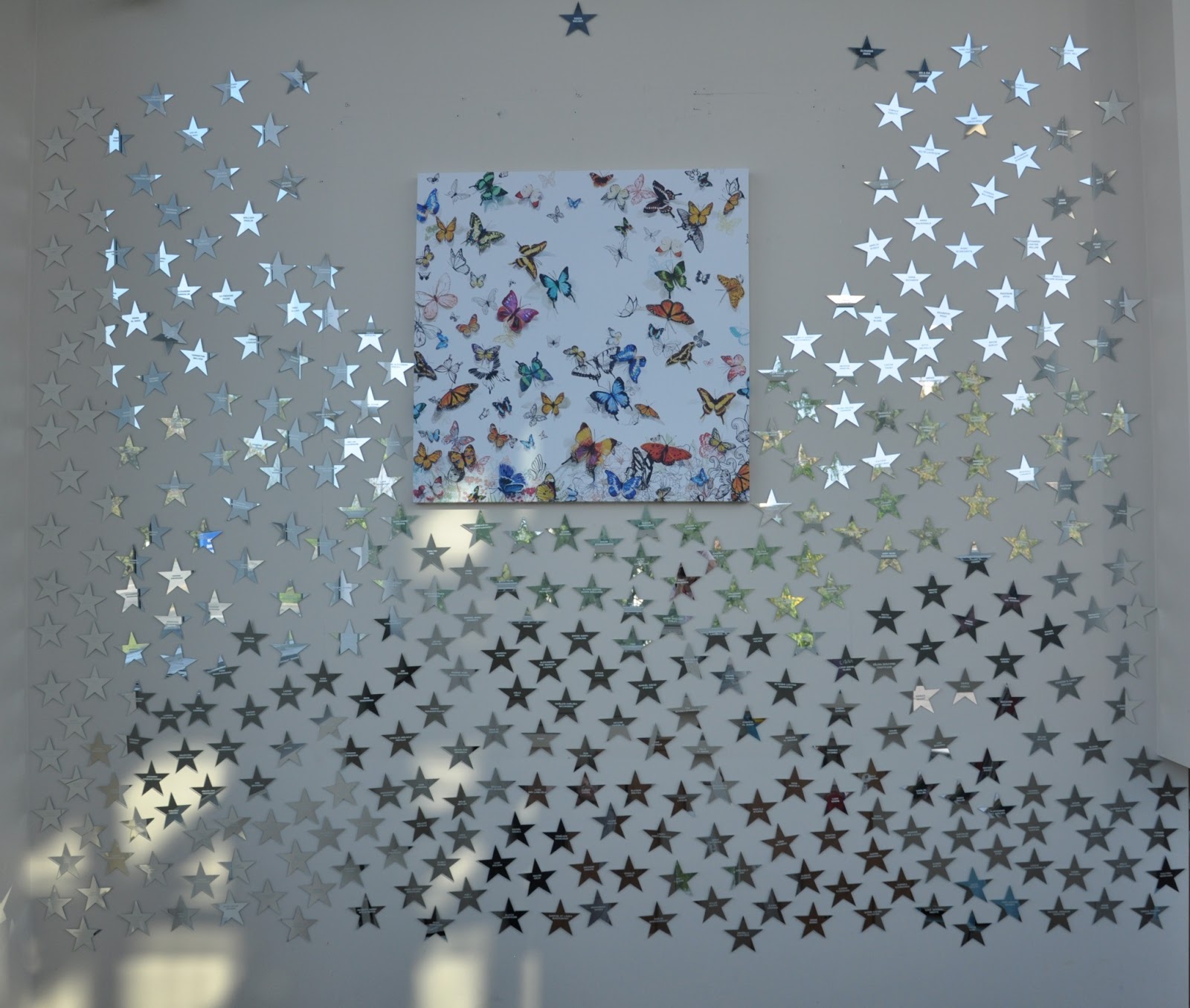
In 2012, Connor McHardy, 7, “got his star,” says his mother Mindy. It’s one of 370 glass stars on the wall in the playroom at Roger Neilson House in Ottawa, a hospice for children named after the NHL hockey coach.

“It’s the idea that although a child has died, his or her star shines brightly at Roger Neilson House, which provides comfort to many,” Mindy says. “It’s one of those spaces you ‘feel,’ and many find it hard to describe. It’s a definite feature both in beauty and meaning for families, staff and volunteers.”


Families whose child has died are invited to come back to the hospice for a ceremony that involves revealing the child’s star.

“It’s important for families to know that we honour and love their children and maintain that legacy for them,” says Megan Wright, the hospice’s executive director. Almost 20 years ago, Megan was operations manager for two units at the old Bloorview site of Holland Bloorview.

“The wall is beautiful and powerful and impactful,” she says. “Many families come back often, and some come back on birthdays or on the anniversary of their child’s death. Roger Neilson’s star is at the very top. Roger is a big part of our history and legacy and it’s like he’s looking over the children. It’s helpful for staff to know their work has meaning long after a child has died.”

After their child's death, families continue to come to Roger Neilson House for grief counselling and other supports. “The star wall is an important connection to the place where they spent the most time with their child, or the last few minutes with their child.”


Some parents come to monthly drop-in groups years after their child died, Megan says. “After the death of a child there is a secondary loss to the people in the organizations that were so much a part of the child’s life. We always invite our families to come back.

Roger Neilson House is located on the property of the Children’s Hospital of Eastern Ontario and works with the CHEO palliative care outreach team.

Mindy took the photo below the day her son Connor's star was added.


Tuesday, January 23, 2018

'We are hungry for neat, tidy stories.' Grief 'is much more messy'

By Louise Kinross

Last year, several parents whose children had died came to Holland Bloorview staff with an idea: They wanted to hold an annual celebration of life at the hospital to recognize their children and to develop supports for bereaved families. “When you walk through the door for the first time after, there’s a sense that you don’t belong anymore,” recalled Bruno Geremia, whose son Matthew died three years ago. “We live in a culture that doesn’t want to talk about death, especially if your child is really complex or fragile.”

Since then, the group hosted its first celebration of life event in Spiral Garden and offered a workshop on coping with the death of a child with Andrea Warnick. Andrea has worked as a pediatric oncology nurse and director of Camp Erin, a bereavement camp for kids. She now works as a grief therapist in private practice with children and adults. BLOOM interviewed Andrea about what it’s like to grieve the death of a child, and how to support parents and siblings.

BLOOM: What would be helpful for our parents to understand about grief?


Andrea Warnick: I think we often simplify grief. A lot of my job is helping people understand that it can involve such a wide range of emotions, and conflicting emotions.

For example, parents may feel heartbroken and relief at the same time, particularly if they’ve been caring for a child for a long time, or if they felt the child was suffering.

We don’t talk enough about guilt. For most of the people I work with aged 10 and up, guilt is often a part of the process. They may feel guilty that they didn’t do things with the person earlier, or that they were somehow responsible for the death. If the death resulted from a car accident, the person may think: ‘If only I had called five minutes earlier, maybe they wouldn’t have been in the accident.’ Perhaps the last time they were together they had a fight.

It’s not uncommon for adults to feel guilty the first time they laugh after their child has died, or the first time they realize they haven’t thought about the child momentarily. I always want to validate that it’s completely okay to still feel gratitude and joy and 'do' sorrow at the same time.


I find children are better able to balance joy and sorrow. They could be at a sibling’s funeral and be devastated one moment, and the next they’re running around with their cousins and having the time of their life.

BLOOM: Do you do a specific type of grief therapy?

Andrea Warnick: No. I’ll often use elements of narrative therapy, but what I do wouldn’t fall under one category. As a pediatric oncology nurse I was on the front end of things as kids were dying and I got to know grief in families really well. I also came to understand there was a massive gap when it came to supporting kids who are grieving.

I like to emphasize that grieving is natural and rooted in our humanness and it’s not pathological. For the vast majority of people, grieving is healthy. Unfortunately, we live in a society that’s death-phobic, and uncomfortable with grief and intense emotions in general.

As a result, families often receive well-intended but misguided advice. For example, it’s not uncommon, a few months after a child has died, for families to feel that people are suggesting they need to ‘move on’ or ‘get over it.’ We have to throw those sayings out the window.

Grief is not about getting over your child and it’s not about forgetting your child. What we want to do is help people figure out how they can stay connected to the person that died in a healthy way.

BLOOM: How do you do that?


Andrea Warnick: By talking about the person. If you’re supporting someone whose child died, let them talk about the child. Don’t tiptoe around talking about her. What often happens is people think ‘I don’t want to bring up the child’s name, because it will make the parent sad.’ What parents tell me is that they're terrified that people will forget their child and stop talking about them.

I always encourage supporters to ask if the person wants to talk about their child. Use the child’s name. You can say ‘This is one of the memories I have’ and share a memory. If you never met the child, you could say ‘I wish I got to meet your child. Can you tell me about him?’

BLOOM: Do parents of children who had disabilities or complex medical problems ever feel that people minimize their grief?


Andrea Warnick: Families where there’s been a prolonged illness, or where a child had a condition their entire life, tend to already be dealing with society underestimating the attachment and importance of the relationship. That gets magnified in death. Often the assumption is that the parent gets their life back, and the death is minimized because it wasn’t a healthy child. I work with a lot of families who are contending with that, on top of all the other complications that come with grieving in our society.

BLOOM: What I’m hearing from you is that grief is individual and personal, and also, that there isn’t an end-point.

Andrea Warnick: We are hungry for neat, tidy stories where we can package things in a linear way. Many people who come in to see me ask ‘How can you help me get to where I need to go?’ Grief doesn’t break down into Elizabeth Kubler-Ross's five stages and an end-point. It’s far more messy than that.

Grief is a process of learning how to live with loss. For most people, the feelings won’t always be as psychologically intense as they are at the beginning. Many get to a point where they learn how to live with the heartbreak in a way that still allows them to experience joy and gratitude.

BLOOM: So it’s about learning to live with pain.

Andrea Warnick: A lot of families come to a point where their pain isn’t as acute. But it’s the missing of the child—of the life the child led and the unlived life—the time they didn’t get with their child, or what their hopes were for the child’s future. People often get the idea that they have to hold onto the pain in order to hold on to the child. A lot of my work is helping them get to a place where they can stay attached to the child, but they don’t have to hold onto the pain.

BLOOM: So pain isn’t a marker of the degree of their love. How long do families usually come to see you?

Andrea Warnick: Sometimes a family comes in just for one or two sessions. They only need validation that they’re on the right track, and that what their gut is telling them is right. I validate for them that we live in a grief-illiterate, death-phobic culture, and that grief is not about ‘getting over a child.’ Sometimes they may see me for years, or not see me for years and come back.

Grief can come and go, and grief bursts can happen for years.

BLOOM: What is a grief burst?

Andrea Warnick: It’s when you’re going about your day and something happens, and a wave of grief washes over you and it feels very intense, like you’re right up in those early days. It’s totally natural, and it happens to everybody. We just don’t talk about it enough.

A parent may be walking through their house and come across something of the child’s that she wasn’t expecting, and it’s a trigger. Or sometimes we don’t know where a grief burst comes from.

Often times families feel as though they’re grieving ‘wrong,’ or that it shouldn’t be this hard. Families need to know that grief bursts are totally natural. As time goes by and they process the death, they may get further apart, but they still come every now and then.

BLOOM: I guess the problem is that we fear grief. We're afraid it’s going to pop up, or that we're going to get consumed in it.

Andrea Warnick: Often, as adults, we’re hesitant to feel the depths of our sorrow. We’re a society that’s so busy. I often come across a dynamic where parents keep themselves very busy, or let themselves feel some pain, but hold the intense sorrow at bay. They can’t see the utility of experiencing it.

My job is to help them understand that feeling emotional pain and longing and grief is actually, in the big picture, going to serve them well. I encourage them to find the time and make space for that. Often it’s when they’re in the shower, or in the car listening to music.

Of course we all feel things to different depths and there isn’t a right degree.

I help people learn that they have the capacity to feel deep sorrow, and that they’ll still be able to get up and continue on with their day.

Teenagers may be afraid that they’ll be sucked down into a black hole. There aren’t any absolutes, and there are situations where people can get stuck. But for the vast majority of people, they can feel extreme sorrow and not get stuck in it. I help people to gain the capacity and confidence to know that they can go to these places, and be able to process death in a healthy way.

BLOOM: I know that the families who started the supports for bereaved families here want their children to be recognized and remembered in a more formal and ongoing way.


Andrea Warnick: The most important thing is that death is acknowledged. Many pediatric hospices have a memory book that everyone passes when they come in. I was recently at the Roger Neilson House in Ottawa, and there was a wall with the names of children who had died. It's called The Wall of Stars.

BLOOM: Several years ago our beloved therapeutic clown Jamie died of a brain tumour, and some inpatient parents asked that their children not be told. This created a very difficult situation for the remaining clown, Helen, who had to field questions from children.


Andrea Warnick: A lot of this is rooted in our death-phobic culture. Parents think ‘I don’t want my children to know, because then they’ll be upset.’ What they don’t realize is that it’s far scarier for a child when a beloved therapeutic clown has gone missing, and no one is saying what’s happened, but people seem upset.

In a situation like that, I would do an education seminar with the parents to reassure them about why it’s important to be honest with children and to use correct language, rather than saying ‘he passed away’ or ‘he is no longer with us.’ I would say: ‘He died from a brain tumour and it isn’t anybody’s fault, and it’s not something you can catch.’

BLOOM: Is talking to children something you addressed in your workshop here in December?


Andrea Warnick: Yes. I wanted to give parents the language to talk to their surviving kids. These children need a narrative if someone asks ‘What happened to your brother?’ They need to have a response, whether they’re comfortable saying ‘He died’ or ‘I don’t want to talk about it.’ I want to make sure the child has that language in their back pocket.

I always use the word ‘die’ with children. When we skirt around it with euphemisms, it’s confusing for kids.

BLOOM: How do you suggest parents explain what death is?

Andrea Warnick:
I encourage parents to begin with talking about the physical part. So I say: ‘Death is when the body stops working, and will never work again. And the body doesn’t feel anything anymore.’

Oftentimes, parents don’t want to explain certain things—like cremation. But it’s very important.

Quite often, parents fall into the trap of thinking ‘I’m not going to explain death physically. I’ll give them an existential explanation, like he went to heaven.’ That is very confusing for kids, who think concretely.

I encourage parents to start by explaining the physical aspects of death to children, and then introduce their beliefs once the child has demonstrated an understanding of what happened physically.

BLOOM: What if as a parent you don’t have a belief about what happens to a person, separate from the body?

Andrea Warnick: It is okay to say you don’t know! 


I often have parents tell me: ‘I’m saying she’s gone to heaven, but I don’t know if I believe in heaven.’ 

Kids as young as three, where English is a first language, tend to understand the word ‘mystery,’ so it's a great one to use in these situations. Historically, we've lived with a lot of mystery, and this is a unique time in that if you don’t know the answer to something, you just Google it. It's okay to explain to kids that there are limits to what we can understand as human beings. So in these situations, I coach parents to explain that when it comes to the part of a person that is not the body, it's okay to say: ‘We don’t know what happens, and it’s a mystery.’

A great book for kids aged four to eight years old is When Dinosaurs Die. At the back of the book, they share a lot of different belief systems. It’s good for young children to learn that people believe in different things.

Canadian Virtual Hospice just released a whole website called Kids Grief which I contributed to. It has three modules on how to talk to children and youth about death and dying, as well as webinars and other resources.

Any child in Toronto whose sibling is dying or has died can access free counselling through Dr. Jay Children’s Grief Centre. And Camp Erin, which is a weekend camp for kids, is totally free.

Friday, December 15, 2017

A letter to myself

We just finished our first six-week narrative medicine group for parents. The group brought together nine parents for 90 minutes each week to work with BLOOM editor Louise Kinross and Shelley Wall, a biomedical illustrator and assistant professor at the University of Toronto.

Each session we addressed a theme related to the emotions of raising a child with disabilities. Participants would read excerpts from a graphic novel, memoir, poem or interview, then do a writing or drawing prompt, and discuss their work. 


The group was made possible by Holland Bloorview's No Boundaries fund, a donor-supported grant that enables staff to bring projects that benefit children and families to life.

Below is a parent's response to this writing prompt:

Imagine that you've just received your child's diagnosis. Write a letter to your younger self, knowing what you know now, and share your best advice.


A letter to myself

Don't be alone in this. Make sure you have someone to be your cohort, your side kick, the bad guy, the good guy, whatever it is that you need to balance yourself out.

Find the agencies that say they know the most about the disease, the syndrome, the symptoms and visit them, online, in writing, in person. They have seen it all. Don't wait for anyone to come to you.


Always have a good paper trail and learn to file. File your contacts, every name, number and e-mail and put the paperwork in a file. There will be a day when you need to pick it all up in a hurry and start again.

Remember yourself. Remember your relationship, why you became two, and then three or more. Allow yourself and your partner to grieve differently, to feel differently than each other about the diagnosis and the outcome.

Do the research, try the therapies, but be realistic. Get to know the researchers, the scientists, the people behind the doctors. They want to make it better and need to see the thing they treat, to name it and see it. 

Spend real time with your other children. They will not be okay. You can not be normal, their life with you will not be normal, sharing your grief and tears with them is not always caring, it can be scarring.

When people say respite, take it, do it. Your child will have more people looking after them that sleep longer than you do, work less hours than you do.

If you think therapy is worth it, go do it, find the money, go with your gut, even if it does not fit with your partner's gut. There is nothing worse than getting to a point when you wish you could go back.

And always look after yourself as best as you can. Before you put others first, oxygen mask on you, then the next person.

Try and keep up whatever it was (before kids) that made you delightedly happy, even if you only do it once a year. Try not to do it alone. 

Thursday, April 20, 2017

'Care for the family shouldn't stop when the child dies'


By Louise Kinross


When Bruno Geremia’s son Matthew died two years ago, Bruno's sense of loss extended to the people he knew at Holland Bloorview during Matthew’s life.

“When you lose your child, you also lose your care team and the community at Holland Bloorview,” says Bruno (centre, with wife Marlene right and family leader Vivian Low left).

“When you walk through the door for the first time after, there's a sense that you don’t belong anymore. We live in a culture that doesn’t want to talk about death, especially if your child is really complex or fragile.”

Bruno and other parents want to change that.

They’re working with Holland Bloorview staff to create an annual celebration of life event and other supports.

The first event will take place in Spiral Garden on June 11. It’s for Holland Bloorview families whose child has died in the last two years. There will be photographs of the children, fun activities for the whole family, and the dedication of a piece of art. “We’re working with Spiral Garden staff to create a butterfly that will honour the children,” Vivian says. Her son Ethan died almost 10 years ago. “The plan going forward is that every year we will have the celebration and install a new piece of art.” The parents also hope to have a dedicated art work inside the hospital.

Vivian recalls that after her son died, “there was no support besides Bereaved Families of Ontario. But it’s in the community, and you have to retell your story to strangers.”

Families feel cut off from “the people who know the road we’ve travelled, and who knew our child,” Bruno says. “We believe it shouldn’t end like that.”

Bruno and Vivian, who are both members of Holland Bloorview’s family advisory, say the group has been an important ongoing connection for them. “I was lucky because June Chiu called and said ‘I hope you’ll come back and be part of the family advisory,’ Vivian says. “Sometimes it was hard, and I’d feel a little like a fraud, like my child isn’t going to any of the clinics, maybe I shouldn’t be here? There’s a fear of being an outsider.”

But Vivian says she was welcomed back. “When your child dies, you get the feeling that nobody else understands, and they can’t. That’s why it’s so important to talk to someone with the same experience, who knows what it feels like to live through that. I had June, and then Bruno and Marlene, to talk to.” Too often, Vivian says, Holland Bloorview families “don’t have that opportunity.”

To remedy this, the parents plan to set up coffee talks a couple of times a year where parents meet at Holland Bloorview to remember their kids and share support. “We’d also like to look at supporting siblings,” Vivian says. “For us, that was a huge gap when parents are struggling themselves.”

Bruno says his continued participation on Holland Bloorview’s family advisory “is a tribute to Matthew’s life. Before Matthew died, I didn’t think I’d be strong enough to do that. But after, I thought, everything I’ve learned, I’ve learned because of Matthew. This keeps him alive.”

Vivian agrees. “We’re a voice for our children and the needs of our families. Our children keep us connected to Holland Bloorview and we honour them by staying involved.

Bruno and Vivian shared these reflections that may be helpful to other parents whose child has died:
  • There is no road map for grief, no time line or 12 steps. It’s individual, and you have to accept that your journey is going to be that way. It will change from day to day and year to year.
  • Anniversaries, especially in the first year after your child dies, are very hard.
  • Grief can ambush you when you’re least expecting it.
  • Talking to other parents who’ve lost a child is soothing. You don’t have to explain anything, and if you fall apart, it’s okay.
  • Counselling helps.
  • Find ways to honour your child. Vivian’s family raised money for a multi-sensory room in the school her son went to, and where her daughter still attends. Bruno’s family participates in the Hike for Hospice to make people aware of the amazing care they received at Emily’s House.
Advanced care planning with a palliative care team can help families build beautiful memories with their child. “We spend so much time going to appointments, doing therapy, and for the more complex kids, just feeding them, that we don’t get to have family time,” Vivian says. “We need to be encouraged to not feel guilty about putting that aside, so we can have fun times as a family.” Bruno notes that his family cherished Thanksgiving, Christmas, birthday and Easter celebrations with Matthew while he lived at Emily’s House.

Most important, “Care for the family shouldn’t stop when the child dies,” Bruno says. “If we are family-centred, we need to continue to provide care to the family that has to go on.”

Bruno and Vivian say social workers, nurse practitioners and senior managers at Holland Bloorview are eager to participate. The other parent on the celebration of life committee is Cheryl Runstedler. You can read about Cheryl and her son Jordan here. To learn more about the June event, e-mail social worker Barb Germon at bgermon@hollandbloorview.ca.

Friday, February 12, 2016

A novel drawn from light and loss

By Louise Kinross

In 2011, cartoonist Tom Hart was living an idyllic life in Gainesville, Florida. While his wife Leela, also a cartoonist, worked on a book, he spent time with his daughter Rosalie, not yet 2—bike-riding, visiting ducks in the pond, tracking the moon, painting watercolours on the back-porch.

Then Rosalie died suddenly and unexpectedly.


Tom did what he'd always done: he began writing, furiously, and then drawing, about it. His graphic memoir Rosalie Lightning was released last month.

BLOOM: How soon after Rosalie died did you start writing about it?

Tom Hart: I wrote to stay sane pretty instantly. When I wasn’t walking around the neighbourhood with my wife, or sort of lying down on the grass or in bed, I was writing mostly. In some cases it was just recording what was happening. More often it was trying to understand something and stave off despair.

We did a bit of travelling to get out of town—because town was so hurtful—so I kept the writing and the notebook going. After about five weeks I had a binder of notes. I felt it was time to stop, partly because I was repeating and partly because what happened at the end of the book was that this little girl came up to me, and that was a sign that I should stop writing.

I took some time off and then began the process of turning it into a narrative, and that took about three-and-a-half years.

BLOOM: What role did drawing and writing play in grieving for Rosalie?

Tom Hart: I’ve always used comics—this mixture of words and pictures and cartoons and boxes as a way to navigate the emotional world. Even as a child my first memory at age seven or eight is of tracing Peanuts—Charlie Brown. I later realized that I was really drawn to the emotional content: people were screaming and fighting and there was lots of punching. It was a way I learned to comprehend the larger emotional world. So unconsciously, throughout most of my life, I’ve always taken whatever I’m feeling and tried to wrestle with it on the page.

BLOOM: How did drawing help you focus on all of the details you wanted to remember about Rosalie?

Tom Hart: I wound up wanting to focus on how lively she was, and how the time up till she died was so fun and so magical. I wanted to recap it and recount it for people. It seemed strange, when I looked back at it, to want to draw all that stuff. In a way I think I was trying to summon her back. And again, since I have drawn cartoon characters for so long, it seemed like the most direct way to try to capture her spirit somehow, or to connect to her spirit.

BLOOM: What’s the main theme of the book?

Tom Hart: It’s trying to show a person’s mind as they work from a state of complete shock to some sort of comfort or integration with their new experience. Since reality has been so uprooted, it’s trying to find signs from outside of how to exist in this new reality, of how to work within a new world.

BLOOM: It seemed like the book was alternating back and forth between the beauty and pain that comes from the mystery of life. So on the one hand, we see Rosalie’s reactions of wonder to things like the 'big moon' or how acorns contain what will be a tree. But on the other, we feel your unbearable loss when she dies.

Tom Hart: It’s nice that you came away with that. I did the book very intuitively. Had I thought through what you just said ahead of time, it would have been a good structuring device. The world is big and full of joy and sorrow and bouncing or oscillating between the two is what I was trying to capture. In doing the book I really just followed my nose.

BLOOM: I think when a child has a disability, or an illness, or dies, it’s hard for parents to accept the random nature of it. In your book you go over the events immediately prior to Rosalie’s death. It seems like you’re trying to decipher the 'why' or the meaning of it. Was there a cause? Should you have anticipated it? Can you talk about that?

Tom Hart: The world is full of random, horrible circumstances and there’s not a lot of justice in the world. There’s not a larger justice in the world. To be honest, in my case I think I was able to do this book because it was so random. I think if she had had some prolonged illness, or worse, if there was a violent cause of her death, or someone to blame, I would have been a lot more immobilized.

I think a lot of what the book was about was trying to come to believe that there was cosmic purpose, because it seemed so cosmically ordained in some ways. In a weird way it was empowering that it was random and sudden and without an immediate way to comprehend it. There was nobody to blame and no blame on a personal level. That enabled me to stay focused on her spirit and on my moving on.

Early on I intellectually understood I needed to accept it, because there was no going back. It happened. Of course it’s very easy to say things intellectually, or to write them, or in your best moments to believe them. More often than not our emotional bodies are so much slower. For me I knew I had to find a way to exist with Rosalie in my memory.

It took me three years to incorporate those five weeks of writing—the lessons and ideas that came out. At the end of finishing the book I do feel like I’ve integrated that experience, so that I no longer live in denial of it.

BLOOM: Over time did your need to find a meaning for the tragedy change? Or did you just stop asking the question?

Tom Hart: If there’s a larger meaning, I can’t comprehend it. I’m not a religious person, but I have an inclination toward the spiritual. Every major religion in its own way says you can’t know God’s reasons. It’s too big for our consciousness. It’s unknowable.

And the sad thing is that it’s mostly injustice down here on the physical plane. At some point everybody has to find the balance between seeing that clearly and moving on anyway. They have to square that with their own drive to stay alive and care for their loved ones.

BLOOM: Time is an important theme in the book.

Tom Hart: Is it? I haven’t read the book in a while.

BLOOM: I guess because before Rosalie died time was moving in the way you expected, and you had a sense of how it would continue as she grew up. You had dreams of her future.

Tom Hart: There was this horrible ending of what seemed like ordinary life. Up till then, time made sense. When this happened, there was no time. Time became different. There was only 'before' or 'after,' and how time was measured seemed different.

BLOOM: There’s a panel where you write 'the hospital – no I don’t like that part.' Were the professionals at the hospital compassionate in the care they gave you?

Tom Hart: There was never any hope, but for the most part everybody was compassionate.

BLOOM: Your depiction of Rosalie brings her to life. She’s such a character—from the way she spoke, to the way she moved, and how she brought what you read together in books or saw in movies into her own life.

Tom Hart: That’s really nice. It was part of my plan, but not the biggest part. I think mostly the book was me trying to get through it. But early on someone said to me that a person never dies, or their spirit never dies, until the people they’ve touched die.

It made me realize I had an opportunity to keep her spirit alive, especially in the way she was so alive for me, so vivacious. So it’s something I wanted to do—not exactly capture her spirit, but have it come through on the page.

And I needed to have that connection with her. It was very strange to draw her alive and happy. It was such a contradiction. Drawing those images was fun and delightful and horrible.

BLOOM: Did you have any hesitation about writing such an honest book?

Tom Hart: I didn’t have any hesitations about it. I’d been making books or stories for so long and I was so utterly broken open for that entire time that it didn’t matter whether or not it was too revealing or I was being too honest.

BLOOM: What do you hope people take away from it?

Tom Hart: I think I joked to another interviewer that I have such a long history of no one reading my work that I don’t have many expectations at all. I needed to do the book for my own sake and it really helped me in my grieving.

I think I needed to integrate the experience so it was no longer something I denied. I intended to do that in the way I’ve most dealt with the world, which is through writing and drawing.

For three years I was forced to focus on that time when my life changed so dramatically and become that new person. I became the person that has this in his past and has this experience in his heart. In general I did the book for my own healing.


Tuesday, September 15, 2015

This time my husband used a new line: 'He has a brain injury'

By D. Christine Brown
 
We were sitting in a nice Italian restaurant in Kingston, Ont., en route home from our vacation. Our son Lucas was very tired, hungry and cranky. He wasn't settled or quiet. We were in the back room by ourselves when the hostess sat an elderly couple in the same room. It wasn't five minutes before the man approached my husband and asked him to keep the noise down.

Now, usually by this point, there are a lot of things happening with us.


We are thoroughly exhausted from another day of the emotional swings of a toddler with sensory issues. We are beaten down from hearing the onslaught of screaming and whining, feeling helpless about how to satisfy our son “enough”  so that he will be calm and quiet. We are desperate for a nice meal, and at the same time eager to make it a quick one. We are protective of our son and his needs. And, we are on the defense from the time we enter the public realm until we're back in the safety of our car.

If anyone had approached me, I might have answered: “He has autism so it's difficult” when I'm really thinking “You can feel free to go sit in the other room” or “Well, I don't like seeing your ugly face in my line of vision either, so can you please leave?”

But this time my husband firmly, and almost accusingly, used a new line: “He has a brain injury...so...it's kind of hard...”

The man cowered coyly, apologized twice and returned to his wife. Our son continued to exclaim his scripts of protest loudly. We ate as fast as we could and left before their food arrived.

I am so completely sick of us feeling compelled to “shush” our son in public when I want to just let him be himself. And yet, we need to give others the respect we expect for our son.

This is an example of a stressful part of each day in our new normal.

Four years ago our son's brain suffered a massive inflammation attack. We spent three months in hospital and he's been recovering ever since. Our lives completely changed and there was no way we could have anticipated the magnitude of the impact.

But four years later, we are somehow finally settled into our new normal. This anniversary is the first one where those events of September, 2011, feel like a lifetime ago. The extent of what happened has dimmed. We are now just who we are and our reality is our own.

It's clear to me that you have to process a lot of unfinished business before you can get to this place. We have had to process all of the unspoken thoughts, fears, wishes, desires, and regrets that we could easily choose to bury, and often do.

I have
said before that each day of our parenting feels extreme, with shifts from sheer joy to utter despair. We have higher “highs” and lower “lows” in our daily life than we ever had before. For the cycle of these highs and lows to be so short-lived and so frequent is what has taken time to adjust to. All in one day, I will have a rainbow of affect. But most days are good.

I'm at a point now where cherishing every day with Lucas and being involved in his growth and development fuels my fire to help others. I recently became a certified grief recovery specialist after going through the
Grief Recovery Method and finding it extremely useful in processing my loss around what happened to our son. I'd like to help other parents of children with special needs process their grief.

I also became a certified
DIR/Floortime provider in order to help other parents of children with developmental delays know their treatment options and that there is an alternative to Applied Behavioural Analysis (ABA).

As I relish in the joy of feeling Lucas's soft little warm feet next to me in bed and stroke his angel cheeks, my heart fills with warmth and pleasure. Being Lucas's mom is the greatest gift in my life.

We've come to see that our son is doing great and continues to show growth and development as his brain heals and as nature intends.

We have to accept that people will make assumptions about our son based on his behaviour that are incorrect and ignorant. Rather than turning into “Mama and Papa Bear” in attack or defense mode, we need to educate the public to change perceptions of behavioural challenges in children like our son.

We are ready to share our new normal with the world and hope that our experience can help others
.


Monday, August 24, 2015

There isn't a detour around grief

By Louise Kinross

A very wise person—Julie Keon, who wrote What I would Tell You: One Mother's Adventure with Medical Fragilitytold me that you can’t grieve something you haven’t lost.

So, you can’t choose to preemptively grieve an event, so that you can avoid mourning the loss when it actually happens. It seems like a very human thing to do—to imagine that there’s something we can do to avoid pain. But it’s not possible.

This may explain why when I was speaking with someone this morning about my son and his dreams, I started crying when I remembered that for so many years he wanted to be a zookeeper. I thought I'd pushed that memory right out of my mind.

But this morning I recalled how a number of years ago I’d contacted a few zoos and farms to find out about volunteer opportunities, and been told that volunteers have no contact with animals at any of these places. So it was a non-starter in terms of getting experience.

And then I’d googled to see what kind of education you had to have to become a zookeeper and realized that it typically required a university degree (which my son wouldn’t get) and skills like public speaking for giving talks about the animals (and my son doesn’t speak).

So after a number of years of asking my son what he wanted to do, and him signing that he wanted to be a zookeeper, I stopped asking. Because I didn’t know how to tell him that it wasn’t on the table.

The topic of zoos came up recently because he was part of a camp program that involved visiting local zoos and farms. He was ecstatic. One day he and his worker showed me the sign they’d devised for tapir (see above), his favourite animal: tapping your nose with the letter “T” because of the short trunk it uses to snatch fruit and leaves.

Maybe, now that he's left the school system and we're looking at realistic volunteer jobs, it was that reminder of his love of the tapir that caused me to voice the ludicrous “zookeeper” dream. 

And my chest stung and for a moment I thought I was hungry, till I realized my heart was hurting and my cheeks were wet.

Wednesday, May 13, 2015

What Barbara Turnbull said about rehab and grief

By Louise Kinross

In 1983 Barbara Turnbull was shot during a robbery at a convenience store where she was working a night-shift as a Grade 13 student. Last Sunday, The Toronto Star, where she worked as a reporter, wrote that she had died at age 50 as a result of complications from pneumonia.

Barbara gave a fabulous talk at Holland Bloorview in 2002 about her 18 months in rehab and how she learned to navigate the world with quadriplegia and a lot of technology. I wrote about it in our staff newsletter at the time.

What jumps out at me as relevant today was a comment she made about professionals not allowing her to express her grief. "At one time, when I was going through the worst depression, a nurse said 'If you're not careful, people aren't going to want to be around you,'" she recalled. "It had such a devastating impact on me, because I felt I had to be upbeat for people or else I'd end up alone."

Holland Bloorview scientist Barbara Gibson spoke to BLOOM recently about how therapeutic environments may send the message that negative emotions are to be repressed. "Sometimes patients are made to feel that they can only express positive emotions with professionals," she said. "You know, 'we're all cheerleaders here.'"

I thought that was an important message to keep in mind.
What Barbara Turnbull told us she found most helpful during her rehab was talking to people with acquired disability who were further along in the journey and could encourage her and offer practical advice.

Photo by Toronto Star photographer Lucas Oleniuk

Thursday, May 7, 2015

Grief? A friend? Don't miss this interview


I am delighted to be interviewing Julie Keon (right) about her book What I Would Tell You this Saturday May 9 at Holland Bloorview. You can still RSVP to the event here.

Julie’s book is about raising her daughter Meredith (above with dad Tim), who was born with severe brain damage. I’ve read many memoirs about parenting a child with disabilities, but this is the first one that’s packed with deep, practical truths. When you read What I Would Tell You, get ready to feel like Julie can see into your heart and understands when your courage for what some people call 
extreme parenting has run dry. 

As I flipped through the book, so many chapter titles resonated with me. Then I hit “Befriending Grief.
 What? I’ve always resisted grief, pushed it down. The  thought of making it a friend that I welcome in for a cup of tea, as Julie suggests, was hard to imagine. Then I read the chapter and when I next felt grief I did what Julie said. And I realized that it did, indeed, change the dynamic, turning it into an act of great self-compassion. 

This is an excerpt from that chapter. Read the words carefully, and then when you feel the pain of grief, stay with it, as a friend would, follow these steps, and tell us what happens!

“Grief can be our silent companion, something to be tended and nurtured. Think of grief as a person knocking on your door who really wants to see you. They knock incessantly...When the knocking starts, instead of hiding, you can take a deep breath and welcome this person into your home. You set a few reasonable boundaries as to how much time you have to give and then you put the kettle on. You settle in for some hot tea and conversation. As the visit progresses, you notice that it isn’t as bad as you thought it would be. You are discovering that this person you had always hidden from is wise and has much to offer.”

And later:

“Trust that the deeper you allow yourself to know your grief, the deeper the joy you will feel when grief's visits get further and further apart. There is no barricade large enough to keep grief out. Welcome it with open arms, serve it warm tea and sit with it without judgment, knowing that grief will come and then it will go, as long as you give it the attention it needs.”

Tuesday, September 9, 2014

Joy and grief: The dance

By D. Christine Brown

Three years ago today our son Lucas’s high fever and subsequent seizures sent us by ambulance to hospital where he suffered severe brain inflammation.

Thankfully he survived and is recovering nicely, albeit with brain injury that includes significant developmental delay and autism.

Every single day I juggle the intense feelings of joy I have with my son with immeasurable grief and resistance to the difficult reality of parenting him with his acquired disability. I feel left out of the real world of raising children when I see "typical" school kids everywhere.

This last week has been especially trying on my husband and me as parents. Lucas had a few minor "accidents" that required some first-aid attention which triggered Lucas's hospital memories of being poked and prodded.

Three years ago, Lucas was forced to endure endless IV changes and needles for bloodwork, screamed for hours on end with his steroid treatment, would get wound up in his IV from trying to spin out of the discomfort, shrieked in terror as the student eye doctor checked his eyes, and the list of horrors goes on...

So his new coping mechanism to deal with daily routines that involve touching him—such as changing diapers, bathing, brushing teeth or tending to "boo boos"—is to scream at the top of his lungs, kick non-stop and squirm. This means both of us have to physically hold him down while he shrieks in distress.

He transmits such terror in his prolonged screams that I fear the police will show up at our door. I worry that our neighbours must think we’re trying to beat him. Luckily, a script from his current favourite Thomas and Friends song has provided some relief. We tell him "Accidents happen now and again, sometimes just by chance!" 

We both agree that Lucas’s resistance now is more about fear than pain, but it rips at my heart strings nonetheless.

This makes me reflect on our own resistance to Lucas's new life, post brain inflammation.

As parents, I believe we’re resisting the overwhelming responsibility of parenting Lucas after his brain injury—a degree of fear, uncertainty and change that most parents don’t face.

Since leaving Holland Bloorview as inpatients, each week brings new challenges, and we are worn down. We want a break from watching our child suffer needlessly, even if the suffering is sporadic. We want just the good and to leave the bad aside.

Instead of embracing the new and heightened responsibility, we feel burdened by it. We’re so relieved when finally things start to flow again, just to get slapped down by the next cold, fever, scrape, sliver, or trip to the dentist. Every normal life event brings such trauma into Lucas's life. We don’t know if it’s because it sparks memories of his hospitalization, or if it’s his autism or just his personality.  

Lucas’s resistance to our helping him cope with daily activities makes me think about our own resistance to the reality of parenting a child with an acquired disability. And just as his resistance appears counterproductive to us, perhaps fighting our “new normal” makes things harder than they need to be. Reflecting on this three-year-anniversary, it strikes me that life has ups and downs. Ours are just more extreme, in both directions!

I believe my own current favourite Thomas and Friends song says it best: Every Cloud has a Silver Lining

Life is full of surprises, full of ups and downs 
And so to have a silver lining, first there must be cloud 
Every cloud is silver-lined, even when it rains 
So don't get too downhearted, as things are bound to change 
All you've gotta do is wear a smile and you will find 
Your sun will shine 
When you're feeling down it doesn't help to wear a frown 
Never lose hope, you're sure to cope and you can carry on. 

Just as Lucas resists what is uncomfortable, so we resist the discomforts of feeling responsible for Lucas's suffering.

We know we need to accept and take responsibility for our son’s behaviour while he’s at this developmental stage. But we can't allow ourselves to feel responsible for his or anyone else's feelings. We just have to keep doing what's right and show him the path of joy.

We have to be tolerant of life's ups and downs. This will in turn teach Lucas to accept his own ups and downs, and the fact that we can only control how we react to what life throws at us.

As I sit in this restaurant today waiting to pick up my son from school, writing this blog, the two songs that just played couldn't be more timely: That's Amore and L-O-V-E. I feel that it is fate—or my late grandmother, from somewhere in the universe—reminding me that our life with Lucas is all about love. Focusing on the joy and love will get us through the bumps in the road.

Lucas's mom has written for BLOOM previously: I am warrior mom: Hear me cry and roar. Follow Lucas's progress on twitter @LucasRecovers.


Tuesday, June 3, 2014

Filmmaker Kelly O'Brien on grief, siblings and honesty


A recent BLOOM night focused on filmmaker Kelly O'Brien and a screening of Softening, her film about raising her son Teddy, who was born with brain damage and a grim prognosis. 

Softening is a candid story about a mother's love and pain, a sister's magical bond, a father's joy and devotion and a little boy's experience of the world. This Youtube clip is a portion of an interview we did with Kelly following the film. 

A condensed version of Softening that focuses on Teddy and his sister Emma was posted on The New York Times. Thank you Kelly!

Tuesday, May 6, 2014

'I loved my grief because that was my brother'


By Louise Kinross

Family Life by Akhil Sharma is a semi-autobiographical novel about a family’s journey to two new worlds.

In 1978 the Mishra family from Delhi, India moves to New York, a place that’s fairy-tale like to the Mishra boys with its hot-water taps, elevators and wall-to-wall carpeting.

Then, just as the older son, Birju, is accepted into a prestigious school, the family is upended by a catastrophic accident: Birju survives a near-drowning, leaving him with severe brain damage. He is unable to move, speak or see.

The story is told from the perspective of the younger brother, Ajay. While his mother becomes a round-the-clock caregiver who can’t give up the dream that Birju will "awaken," his father becomes an alcoholic.

Ajay stands alone in his grief and guilt, raging against this new world in which the brother he knew is gone. “Seventy per cent of it is true,” Akhil told me.

My interview with Akhil began with his responding to a question I asked about what kind of internal life his brother had after his injury.

Akhil Sharma: I was thinking about your question about how much sentience remained in my brother. He could laugh, and I’m not sure what he was responding to, whether it was our tone. My mother said he could hear us and she believed he could understand us.

I remember right after we brought him home I spent hours talking to him and trying to get him to laugh and climbing on his bed and making noises so he would grimace. I do have the sense that something was there. An earlier draft of the book had more of the brother laughing.

My experience was that there were two horrible things that occurred. I began to feel that I could get him to make little grimaces but I didn’t know what this meant. I was only 12. And I found it frustrating, not only because the response was so little, but because my mother was forcing an interpretation upon this which made me unhappy. She said [Birju] was still inside, he was still the same. This made me really angry.

The other thing going on was I felt I had to do everything. I felt I needed to sit with him for hours every day and all day. At some point I began to not do so and my mother would shout at me and tell me I was selfish and that gave me further incentive to not interpret his reactions as meaningful. For me, and the character, his grimacing didn’t signify much, because there was no emotional satisfaction for me.

BLOOM: Because the brother you knew was no longer there.


Akhil Sharma: Correct.

BLOOM: Why did you decide to write the book?

Akhil Sharma: I want it to be useful. I felt something really bad has happened, let me make something good out of it.

BLOOM: I think the book beautifully captures the love and resentment that exists between siblings. Before Birju’s accident you describe him as the person who’s most valued in your family.

Akhil Sharma: In the end what matters is not what the parents actually do, but how it’s experienced by the children. The child views the parents focus on the brother, whose studying to get into a special school, as sort of ‘Thank God they’re bothering him instead of me.’

BLOOM: Yes, but after the accident Birju becomes the focus because of his severe disabilities and you’re completely overlooked.

Akhil Sharma: They say the way deprivation works is you don’t know what it is. You don’t know what you’re missing. It’s like a vitamin deficiency. For me there are two things. It’s reasonable for parents to focus on the sick child. The character and I to some extent choose to make ourselves small. We realize that there’s this enormous need and we shouldn’t be in competition for resources. At some point Ajay begins to hold his breath and asks God to give the extra breath to his brother. The child chooses not to be a problem and chooses to win attention in other ways.

BLOOM: Initially you spend a lot of time praying with your mother and trying to behave.

Akhil Sharma: After the accident it was a hopeless situation, so you do the one thing you can do, which is pray.

BLOOM: But in one scene you’re bathing your brother and you begin to cry because you say ‘We’re not good enough people.’ This resonated for me because I’ve often found that my son’s disabilities seem to show up all of my inadequacies, all of the ways in which I wish I was a better person. At other times, if a negative thought about your brother enters your mind you immediately chastise yourself.

Akhil Sharma: That is exactly right. Another way you are constantly aware of your inadequacies is that there’s this enormous need and you can’t behave in a perfect way, so you’re constantly getting angry. You’re always aware of your inadequacies and also of not having enough money, enough resources, of not being smart enough. You’ve got an insurance form to fill out and why does it take three hours to fill out? All of these things make you aware of being a failure.

BLOOM: You talk about wanting others to see that Birju mattered. Why did you feel he had been stripped of his value?

Akhil Sharma: Because I didn’t understand what this thing meant. I felt that because this thing was so enormous for me, I wanted everyone to value it in the same way I did, and other people couldn’t. They couldn’t comprehend it. They didn’t know what it meant to spend all of our time in hospitals. I felt that since our world had ended, other people’s world should have ended also.

BLOOM: Did no teacher or health professional ever tell your parents that you, as the sibling, needed special support?

Akhil Sharma: No. We had none of that. I had an aunt who is a doctor who is an utterly useless woman. A colleague of hers said ‘Hey, this thing occurs to the entire family, and they should go to talk to a therapist about it.’ And my aunt said: ‘Oh, all you do in therapy is talk and in our families we talk all the time anyway.’

BLOOM: But that kind of conversation would have had to be facilitated by professionals.

Akhil Sharma: I remember how shocked I was when I read in Shakespeare where a king tells a mother ‘You grieve too much for your dead child’ and she says:

Grief fills the room up of my absent child,
Lies in his bed, walks up and down with me,
Puts on his pretty looks, repeats his words,
Remembers me of all his gracious parts,
Stuffs out his vacant garments with his form;
Then, have I reason to be fond of grief.

(Constance, in The Life and Death of King John)

I remember reading that and thinking holy shit: I loved my grief because that was my brother. If Shakespeare can do that to me, I hope when people read this book they feel that they’re not alone. When I was growing up it felt like I was the only one.

BLOOM: The feeling of shame comes up quite a bit in the book. At first you don’t tell kids in your school about your brother. Were there other students in your school with disabilities?

Akhil Sharma: There were not. The shame was vast and it was survivor’s guilt and it was attached to everything. It took on whatever form there was to take on. There was the shame of racism. That maybe I deserved to be shouted at or cursed at because I’m actually a bad person. Or the shame could be because I got good grades but really, I had to work like an animal, so basically I’m a loser because all I can do is work like a donkey.

BLOOM: One of the saddest parts of the book, I think, is when your dad gets treatment for alcoholism, and then starts telling people about it as a way of proactively helping himself stay dry. And instead of supporting him, the Indian community shuns him.

Akhil Sharma: Who would want their father to go around telling people ‘I’m an alcoholic?’ In middle class Indian culture it matters a lot how you appear to others and a lot of the status this family has was attached to it being considered holy. The father’s behaviour destroys all of that value.

BLOOM: The injustice of Birju’s accident, and how you come to see yourself as the lucky one in the family, leads to a lot of grief and guilt. There’s a line in there where you talk about how ‘Birju needed to be okay to be okay ourselves. I think that’s a common feeling for parents and siblings.

Akhil Sharma: For me there were two things going on with survivor’s guilt. There was survivor’s guilt relative to my brother. I remember walking around my school field and crying and having a conversation with God and in one conversation he asked if I would switch places with [Birju] and I said no. And I immediately thought I can’t be trusted. I’m selfish. It wasn’t that I survived, but that I would choose to survive over him.

And the other type of survivor’s guilt was with my parents. When [Birju] first came home from the nursing home there’s a scene where I leave my mother behind to go to school. And while it’s okay that I have a life different from my brother, it’s not okay having a life different from my mother. I didn’t want a life like that, that allowed me greater privilege than my mother.

BLOOM: You never got a chance to express your grief because your parents were so devastated. The one time you tell your dad how sad you are he shuts you down by saying he wished he could hang himself.

Akhil Sharma: The line, and I’m proud of this line is: ‘If you were half as sad as I am you would hang yourself every day.’ The father is tired, he’s unhappy, he’s hungover and he wants to push his son away. ‘You’re sad?’ is almost like a punch. And then he moves to ‘If you were half as sad’ because he doesn’t want the punch to land. He acts from anger and then he tries to correct it.

BLOOM: Your mom wants to ‘try everything’ to cure Birju, even when some of the treatments are wacky. This makes you feel lonely and disconnected from your mom.

Akhil Sharma: I viewed my mom as crazy. He was not going to get better, this is crazy. And some of this stuff costs thousands and thousands of dollars which we didn’t have.

BLOOM: I think it’s common for parents to go overboard with treatments even when there’s no evidence that they will be helpful.

Akhil Sharma: But the [healthy] child can see it. And the [healthy] child feels alienated.

BLOOM: If your parents had been more able to accept Birju’s accident, would that have made a difference for you?

Akhil Sharma: I think the sort of person who doesn’t go overboard would be a different person than my mother. Like someone who doesn’t go overboard might also not be the person who calls me selfish for not doing things for my brother. For my mother, it was ‘I will do anything and it doesn’t matter to me what I say or do to you because in the end my words won’t kill you. I’m willing to apply all the pressure in the world to get what I want.’

BLOOM: Every member of your family had an immense need for support and understanding and never got any of it.

Akhil Sharma: I’m sure professional help would have been very useful. But really, what would have been best was seeing other people in similar situations and not feeling so alone.

BLOOM: I couldn’t get over the scene in the book when you and your mom come into the nursing home and find Birju propped on his side and tears streaming down his face because he hadn’t been turned during the night. Did that make you feel that he had more of an internal life than you thought?

Akhil Sharma: Yes. But I didn’t know what that internal life meant. Even a dog can suffer. For me I was always comparing him to before the accident. The pre-accident brother was the real brother and he was always absent. What was left was a thing.

BLOOM: Your mom comes to the conclusion that to ensure Birju’s dignity you need to care for him at home. Was that the best solution for your whole family?

Akhil Sharma: When I was there and it was occurring, it was so horrible, the nursing home, that it seemed like ‘Let’s do this. Let’s bring him home.’ But in retrospect I think we should have left him in the nursing home and let him suffer and get sick and die. The best solution would have been a painless death. Bringing him home destroyed my family and me.

BLOOM: It seems that you were never given the opportunity to process your emotions in a way that would allow you to move forward, or to at least carry them in a different way.

Akhil Sharma: We don’t really move forward, we carry it with us, but viewing it in a different way, that seems to be a valid way of thinking about it. ‘Oh, that kind of thing happens to human beings. I’m a human being so why shouldn’t it happen to me?’ There are also wonderful things that have come out of this. It’s made me very attentive and loving.

BLOOM: What advice would you give parents in terms of how to treat siblings when a child is healthy but then has a catastrophic accident?

Akhil Sharma: I think one thing to keep in mind is that the healthy child will spend a lot of time trying to protect you, the parent, and that that is a bad thing. Our very best qualities end up damaging us. I would say be engaging with your child. Talk regularly about how whatever the child feels is okay. You have a right to love the sick child and you have a right to take care of him, but part of the healthy child's right is to receive his share of love and attention and we need to honour that.

BLOOM: Do you feel there are parallels between your immigrant experience and the experience of entering the world of severe disability?

Akhil Sharma: It’s a very strong parallel. It’s like a country of the sick vs the country of the well. When we left the nursing home we felt like we were escaping but we were not really escaping because we were going out into loneliness. At least at the nursing home there were other people who had similar experiences and understood what we were doing. But now we were all alone.

BLOOM: What did you learn about yourself while writing the book?

Akhil Sharma: I think I learned most of all I have to love my parents for who they are. And the other thing is I have to take care of myself and my first loyalty needs to be to my own happiness.

BLOOM: What do you hope people who haven’t experienced the world of severe disability take from the book?

Akhil Sharma: Until someone you love has a stroke, and suddenly you’re in that world. I think most people will experience something like this. I think what they gain from any fiction is that it takes away the loneliness and sheds light as to what you need. That this is okay. That you’re going to behave badly. That you’re going to have weird thoughts. That it’s going to be okay.


Photo by Bill Miller

Thursday, April 17, 2014

I am warrior mom: Hear me cry and roar


By D. Christine Brown
It was the morning of our son Lucas’s 10th EEG since his acute brain inflammation in September 2011 and subsequent autism diagnosis.

It was cold and raining so we drove to SickKids hospital instead of walking. Lucas’s last EEG was over a year ago and it was still abnormal then on the left side of his brain, only slightly improved from the previous one six months earlier. I vowed that this time, I would accept the results, whatever they were. It is what it is. What will be, will be. I was too scared to get my hopes up high.
After Lucas was sedated and the testing underway, my husband went down to get coffee and breakfast. I watched the computer monitor and burst into tears. The brainwaves looked identical to last year, and with each abnormal spike, the attendant typed in a message marked by a yellow rectangle.

“You aren’t trained in reading EEGs,” my husband reminded me on his return.
The way my husband and I have grieved since our son’s brain injury couldn’t be more different. I have been plagued with sorrow. My husband has shown no reaction. His behaviour hasn’t changed at all. I have been an “extreme caregiver,” to quote author Donna Thomson, and a mother warrior. My husband, on the other hand, seemed to return to leading his normal life.

Back in the hospital in 2011, my mother-in-law assured me that if my husband grieved differently than I did, that was ok. “You don’t have to talk to him about it to find relief,” she said. “You can talk to others. Men don’t like to talk.”
But I never found anyone to talk to. I kept going and did what had to be done to get through each day. We had countless appointments, therapies, school, my own research and my own activities.

I was in a state of adaptation and acceptance. I didn’t realize that I had grief I needed to process.
I was driving my son to his specialized school this past winter and stopped en route for a sandwich. While waiting in line, my son was restless and active, as he usually is, drumming his hands on the sandwich counter and squealing loudly as he enjoyed watching the ceiling fans spin. People looked at us. I implemented my usual distraction techniques to keep his behaviour under control: “Look! Now the lady is making Mama’s sandwich. Oh, look! She’s putting it in the oven!”

When it was my turn to pay, I said “autism” as I pointed down to my son. The middle-aged woman of a Southeast Asian culture gave me a look of sympathy and said with her accent, “I know. I could see”…pause… “I’m sorry.” Fighting back the tears, I responded with a thank you, paid, and led Lucas to the car, where I let the tears drip down my face.
By the next week I had signed myself up for family counselling at Holland Bloorview through the Brain Injury Rehab Unit where we had spent three months of our lives. Family therapist Caron Gan helped me realize that for the first time, post-hospitalization, I had had my feelings validated—by this woman at the sandwich shop. 

I’ve read many accounts of parenting following trauma and it seems to be a common theme that while family and friends are well-meaning and supportive after a tragic event in a child’s life, most want to focus on the positive. They’re unable to just cry along with us. Our society is uncomfortable with tears. I had many upbeat pep talks from people who gave us a ton of encouragement after my son’s injury. And those who focused on the negative focused on “why” this had happened. Why?
People expressed their feelings about what happened to us, but not mine.  This woman in the sandwich shop simply connected with me, a stranger, and validated my reality.

Suddenly it all made sense: why I was completely unable to drop my crying son off at school and leave; why I accompanied him to school until February with only practice “trips to the store” so he could adapt to school without me; why I caved into Lucas’ wants at my own expense, and, ironically, his, unable to set boundaries when he screamed at the door while I showered every morning.
Caron explained that it’s common for parents of survivors of brain injuries and severe illnesses to be over-protective with their recovering children. After all, we are desperate to prevent them from suffering more.

But my hyper-vigilance about Lucas had distracted me from my own feelings of grief about what had happened.
Last year I heard former Canadian Olympian Silken Laumann speak at a BLOOM night about her experience parenting her stepdaughter with autism. I recently had the opportunity to speak with Silken again. She told me that nothing I feel is wrong. I may have intense sadness that this happened to my son or I may be angry and jealous when I see families out and about enjoying activities that we can no longer participate in due to our son’s autism. I may feel guilty that our son’s outcome and prognosis is so positive compared with other families who have suffered similar injuries, or grateful for having our beautiful son still vibrant and with us. These are all simply honest feelings, and they are all okay.

I had just returned home from my first session with Caron, the family therapist, when I opened my email and read this blog by Tali Berman, a developmental play expert: Redefining the meaning of ‘mother warrior!’.

Tali, who works with families of children with autism, suggests that being a warrior mom doesn't mean stuffing your feelings down. “Are parents living their lives with this niggling feeling that it is not okay to stop, fall apart sometimes, cry about the worry/stress/fear and overwhelm?” she writes. “That is what I want to offer to you today. The permission to be with it, to cry, crumble... release.” The timing couldn’t have been more appropriate.

I am a mother warrior! Hear me roar! (And cry!)
As it turns out, our son’s EEG was normal this time. He can be weaned off of his anti-seizure medication at last. Hear an exuberant sigh of relief! We drove home and by now, late morning, the sun had come out. The healing begins.

Caron informed me that my crying during the EEG was anticipatory grieving and I got something else I wanted at the EEG that day. Before the good news about Lucas’s results, I hugged my husband in silence, while crying, and he hugged back. Perhaps my mother-in-law was right.