Showing posts with label Clinical-care. Show all posts

Thursday, July 11, 2019

Spiral Garden means freedom, creativity and time together

By Louise Kinross

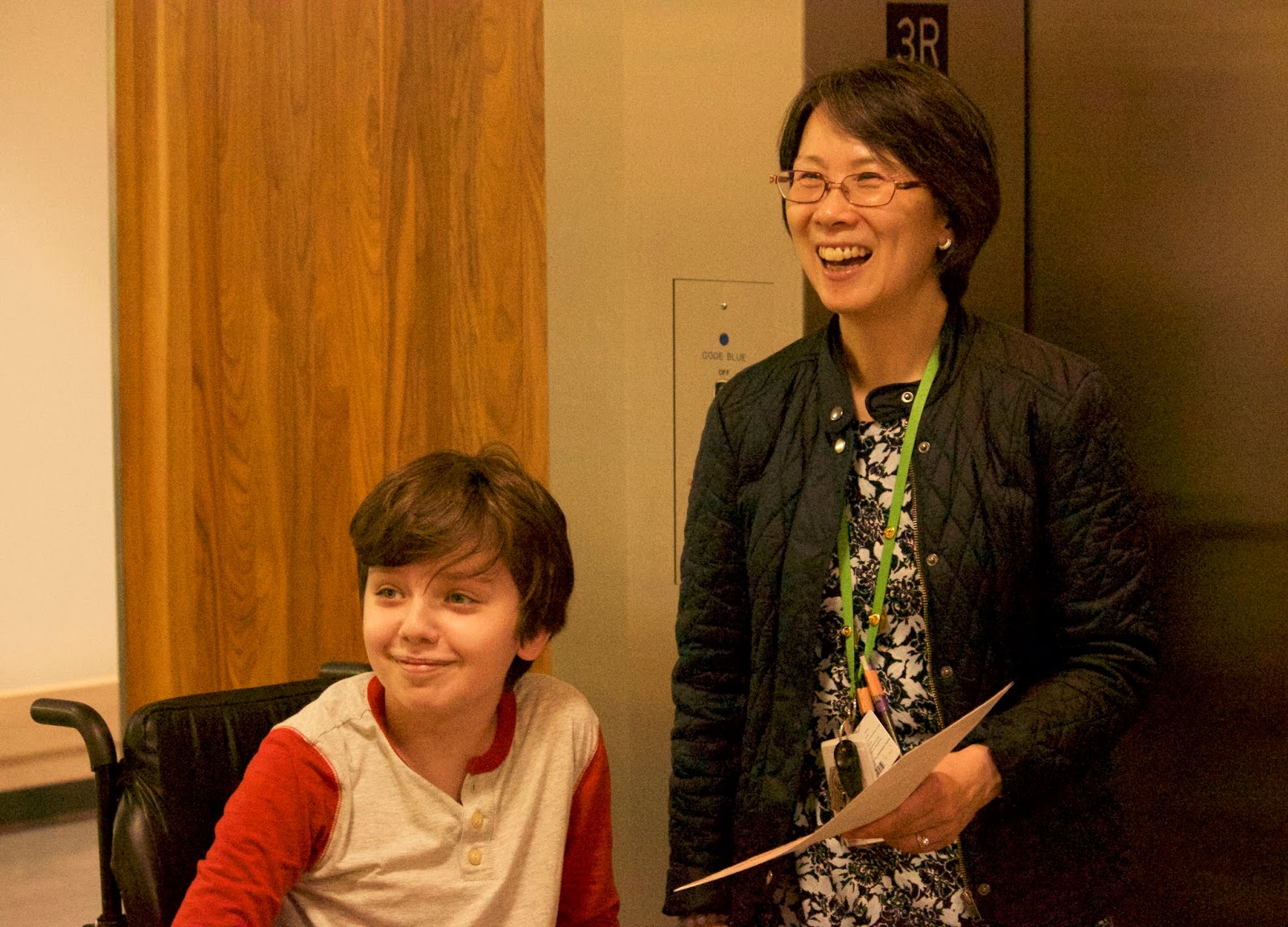
This summer is bittersweet for brothers Osmond (above right) and Edmond Shen (left).

That’s because it’s the last one they’ll spend together in Spiral Garden.

Osmond, who is 21, has been attending the artist-run camp in the ravine behind Holland Bloorview since he was five, and is graduating out of the program. Edmond, now nine, has been coming for four years.

The camp brings children with and without disabilities together under a canopy of trees to tend an accessible garden, sculpt clay, work wood, make puppets and tell stories.

Each brother has a different passion. For Edmond, it’s gardening. “You get to water plants and help,” he says.

For Osmond, it’s woodworking. Osmond envisions finished products—like a stand for his Nintendo DS, a wheelchair cup holder or a robot—and directs Edmond in how to execute them. “A lot of youth come for an hour and go, but Osmond is determined to stay until his project is finished,” says Brendan Byrne, one of the counsellors.

On the day we met, Osmond had Edmond sawing a thick branch into small circular pieces to form the four wheels he wanted on his robot. “He’s the boss,” Edmond says.

“What I like about this camp is that it teaches ‘normal’ kids about disabilities,” Osmond says. He and Edmond also appreciate the open schedule. “You can go anywhere you want, and do anything you like,” Edmond says. “At my other camp, we had a schedule, and we had to do this, then this, then this.”

Edmond says one of his favourite parts of camp is going to the hospital cafeteria for lunch. “Osmond takes me for lunch, and I get to have a hot lunch.”

Osmond encourages other families to send their child with a disability with his or her brothers and sisters. “It’s a great opportunity for siblings,” he says.

The camp, which welcomes over 200 children and youth each summer, is donor-funded through our foundation.


The photo below is of Osmond and Edmond enjoying their first summer at Spiral Garden.


Tuesday, April 16, 2019

Hope: 'We cannot take it away from parents'


By Louise Kinross

Imagine coming to the scene of a car accident and being told it’s your child that’s been hit. But your child is not there. She's been taken to the trauma centre, a 30-minute drive away.

Or entering a room and finding your teen unconscious from a self-inflicted injury.

Or hearing a code blue called after taking your child to Emergency with what you thought was the flu. He's suddenly developed a life-threatening illness.

For almost three decades, Holland Bloorview family therapist Caron Gan has heard hundreds of stories from parents whose children suffered a brain injury as a result of unexpected trauma or illness.

“One of the most important things I’ve learned from working with families is the power of supporting hope,” Caron says. “We cannot take it away from parents. Hope is what helps parents keep going for their child. It helps them to catch their breath, so they can be at their best for their child, and be active in their care.”

According to the National Child Traumatic Stress Network, 80 per cent of parents who witness a child’s accident, self-injury or sudden, serious illness experience symptoms of traumatic stress. For about 20 to 30 per cent, these problems will persist in a way that affects everyday life.

“I see a range of responses,” Caron says. “Some parents need to talk openly and candidly about how awful or horrific the experience was. Then I have parents who are not yet ready to talk. It’s way too painful. Avoidance is a common feature of traumatic stress. I know underneath, they’re all experiencing high levels of distress, but coping with it differently.”

Parents often struggle with sleep. They may have trouble falling asleep. They may have nightmares, or wake up in terror, recalling how they found their child, or what doctors told them at the hospital. “They remember every word and detail, and when they describe those earlier experiences, it’s seared into their memory,” Caron says. “Common things I hear from parents are that they were told their child will not walk, or talk, or be able to go to school like they did in the past. Some parents are even asked about organ donation.”

Supporting parent hope is essential, Caron says. “My role is to gauge where the parent is at, and to walk alongside them in that journey. It’s not uncommon for a distraught parent to say ‘I don’t want to hear anything about my child’s brain injury unless I know he or she will have a 100 per cent recovery.’ I've learned that if I don’t hear what that parent is saying about how they want to remain hopeful, and launch into education about what can happen after brain injury, I’ve lost that parent. That parent will have difficulty opening up and trusting me to have further conversations.”

Parents’ readiness to accept their child’s current situation is a process that can’t be rushed. Hope is fluid, Caron says, and changes over time. “Initially, their hope may be that their child will live, and they are so relieved that their child survived. Then it may move to hope that my child will recover fully from their injury or illness. That may morph into hope that my child will make gains in rehab, will walk again or return to school, or adjust to their new normal. It changes from hope for survival, to hope for a full recovery, to hope for the child to live a good life, in spite of their illness or injury.”

Caron embraces the journey. “It’s not something I would try to change by giving a blunt reality check, or telling them what the literature says about outcomes. Families need time to slowly absorb the information, and their hope narrative will change over time.”

Caron says there are variations in how children heal from brain injuries, and offering the range of possibilities helps parents. “They want to know recovery can range from worst-case to best-case scenarios, and that there is no crystal ball. They want honesty from their healthcare providers, but the way it’s delivered can either shut them down, or help them hear what’s said.”

Knowing that most parents in their situation experience depression, anxiety, irritability, guilt and blame helps to normalize their feelings. “When I show parents a handout about what we call pediatric medical traumatic stress, 
I often hear a sigh of relief. They’ll say ‘You mean I’m normal?’ They need to be given permission to feel what they feel, and to know that it's okay. Acknowledging your feelings doesn't mean you are giving up hope, or will stop fighting for your child. 

Caron shares tools to help parents calm their symptoms of distress. It may be teaching grounding strategies if they're having flashbacks, to remind them that they aren’t reliving the event. For example, they may learn to name five things they see, hear, feel in their body, and smell, so they know they’re not “back in that nightmare.” They may be taught deep breathing exercises, to visualize a calm place where they feel safe, or to track their emotions in a journal.

Telling their story, in a guided way, is an important part of healing. “I really listen carefully, and with compassion, when families share the details,” Caron says. “They need to reprocess what they’ve been through, otherwise the distress gets locked in the emotional memory of their brain, and can be reactivated when they least expect it.” For example, when they hear a code blue on the unit.

Caron keeps a celebration board in her office where former inpatients have posted graduation pictures. “It helps to cut through some of that despair or fear of hearing the worst-case prognosis. I can talk about how these young people got to know their brain injury, and how it affects them. That these young people had hoped for 100 per cent recovery, but they all had some persisting effects. However, they learned strategies to help them manage those effects, graduate from school and live a good life worth celebrating.”

Acquired disability happens out of the blue, and changes the child the family knew. In this way, it’s different from learning your child has a disability at birth, Caron notes. “These parents had memories and an imagined future with their child that didn’t involve disability. These parents have to mourn the loss of the child as he or she was.”

Brain injury may alter a child’s abilities and personality. “Psychologically or emotionally, the child may feel to the parent like a very different person. Mourning, and letting go of the child that they remember, is really difficult. And outsiders don’t always make it easier.”

That’s because children with brain injury often have an excellent physical recovery, and the lingering effects on thinking, concentration, memory, personality and mood are invisible.

“People will say ‘It’s so great that Johnny’s walking now. He’s in rehab and he’s going to get back to the way he was.’ That creates more distress for families who are grieving inside. They may be told ‘It’s time to move on. Just focus on the positive, and put this behind you.’ But that type of positivity is almost dismissive of the pain they’re going through. Parents may shut down or isolate themselves when their feelings are misunderstood or minimized.”

Sometimes, changes in a child’s abilities, behaviour or emotions may not show up for years, when some people have forgotten that the child even had a brain injury. Often these changes emerge in the teen years, so it's difficult to know if they're due to the brain injury or to adolescence.

Being part of a support community where other parents understand exactly what you’re going through helps. Caron is working with eight parents at Holland Bloorview and the Ontario Brain Injury Association (OBIA)to co-design a four-hour parent workshop that will be launched here in September, and then rolled out across the province. “It’s a place where parents can be comforted, validated and supported, all while learning from one another.”

Traumatic stress in parents tends to be under-identified, Caron says. “There may be a tendency to dismiss the severity of trauma for parents. People may think ‘parents weren’t the ones who went through the traumatic event—it was their child.’ We know that these events have a huge impact on families.”

Clinicians need to remind themselves that they often don’t have the full story of what a parent experienced before arriving here. “If the parent is irritable, or questions staff around what we’re doing, we can’t take it personally. We know from narrative groups with parents that many had to take their child to multiple Emergency rooms before anyone would listen to them. 


“Sometimes, when parents are reactive, or presenting with high stress and anxiety, we need to take the time to hear what their fears are. Learning their back story helps put a different spin on it for us, as clinicians. It’s not about us. It’s about the parent needing to ensure their kid isn’t going to fall through the cracks, like they did before.”

You can register for the OBIA parent education and training program, or, for more information, e-mail Caron at cgan@hollandbloorview.ca.

Thursday, April 11, 2019

Pushing a tube down your nose hurts. Lorry knows firsthand

By Louise Kinross

Lorry Chen has a passion for promoting access to healthy food. “I wanted to solve world hunger,” she recalls of her time in dietetic school at Western University. For 28 years, she’s been a clinical dietitian at Holland Bloorview, initially working at our Bloorview site. She now works with our brain injury and orthopedic and developmental units, as well as in an outpatient nutrition clinic. We spoke about how she chose her career, and an instrumental preceptor at the Hospital for Sick Children who had Lorry put in her own nasogastric feeding (NG) tube, so that she’d understand what it felt like for patients.

BLOOM: How did you get into this field?

Lorry Chen:
We emigrated as a family from Hong Kong when I was 12. Our aunt sponsored us. My parents wanted to come to Canada to have a better life for their children. At that time, in Hong Kong we were required to speak Cantonese or Mandarin. I had no English. Before we boarded the plane my aunt told us 'You need two phrases: Excuse me and thank you. That way you’ll be able to get out of your seat to go to the bathroom.'

Throughout school, English was my weakest subject. My guidance counsellors in both elementary and high school said I don’t think you should aim for university. Luckily, I hung around with great people, and all of my friends were aiming for university and said I should try for it. I was the first one of my siblings to go. I initially took science.

That was when I wanted to solve world hunger. I loved nutrition and thought I could go into the lab and make a super plant. That’s all good in theory, but there were two problems. One, I had a black thumb. And two, undergrad experiments often involved animal models, and I have a phobia about rats and mice. At about this time I met my future husband and he said ‘You’re interested in nutrition, why don’t you look into dietitian school?’

BLOOM: How did you move from your training to working with children?

Lorry Chen:
After a four-year degree, you have to apply for an internship, or you can’t become a registered dietitian. I did my internship at SickKids and I loved it.

BLOOM: Why?

Lorry Chen:
I learned so much. The dietitians there were so dynamic. My first clinical rotation was in cystic fibrosis. I had two lovely patients who made me reindeer and Santa magnets when they were doing crafts. I was at SickKids when they discovered the cystic fibrosis gene. Talk about being in the epicentre of discovery! And that spawned my passion for research.

BLOOM: What did you do after SickKids?

Lorry Chen:
The internship was for a year. After that I got married and then I typed and hand-delivered
resumés to all of the hospitals in Toronto. I had to take the bus everywhere. I applied to North York General and a friend of mine said Bloorview is just down the street, you can walk there from North York. So I dropped off my resumé and voila—I got an interview and the HR person hired me right after. I’ve been here ever since. 

BLOOM: What is a typical day like?

Lorry Chen:
It’s changed so much from 1990 to now. In 1990, I might have one or two patients who were on g-tubes. There were no NG tubes. Now, at any time, I will have five to 10 patients who are on g-tubes or NG tubes. The complexity of our children has increased. Most of my patients have a tube through their nose.

BLOOM: I’ve heard that those nose tubes are extremely painful to put in.

Lorry Chen:
When I was doing my cystic fibrosis rotation at SickKids, the dietitian felt we needed to experience what it was like to place one, so that we could have empathy.

BLOOM: That is so smart! Did you put them in for each other, or on yourself?

Lorry Chen:
We did it ourselves. It was so hard. I thought I was going to gag and throw up in front of my preceptor and everyone else. That’s why I can relate to an adolescent who needs an NG tube. I’ve put one in myself. Also, before I recommend any kind of feed, I taste it myself and I have my students taste it.

BLOOM: So feeds kids would get by tube?

Lorry Chen:
Yes, because sometimes you burp, and then you will taste it. I want to be able to tell them if it’s not the most pleasant taste.

BLOOM: What’s the greatest joy of your job?

Lorry Chen:
Taking the NG tubes out! Last week I had two come out. It was the best week ever. The patients and the parents were over the moon. It was a gold-star day.

BLOOM: Besides your work with tube feeding, what other type of work do you do?

Lorry Chen:
We’re big on the clinical practice guidelines on bone health. Often I’m asked to make sure if a patient is at risk—especially if they have a spinal-cord injury—that they have appropriate calcium and vitamin D intake. Another part of the job is working with children who are too skinny or too heavy.

BLOOM: I was on a panel at a Food Summit on Monday, and it was for food centre staff who work with people who can’t afford to eat at all, or to eat well. It got me thinking about our families, who are often strapped financially with all of the extra costs of raising a child with a disability. Is that an issue for inpatient families you work with?

Lorry Chen:
Oh yes. Patricia Rebia, the clinical assistant in our nutrition clinic, and I have been chatting about applying to the No Boundaries fund to provide tools to families about how to eat nutritiously on a very tight budget.

BLOOM: Perhaps we could also develop a partnership with a food centre locally, or with our foundation. What is the greatest challenge of your work?

Lorry Chen:
When you work, and put in your best intentions with a client, but things aren’t going the way you envisioned. For example, if a child has a huge food aversion and he’s not eating.

BLOOM: When my son was an inpatient here, he went on a hunger strike. He was in a body cast and was taking so many meds and was in pain. So he refused to eat.

Lorry Chen:
Literally, there are clients that go on hunger strikes. Luckily we can give them an NG tube that provides nutrition, but we want a happy balance with oral intake. Sodexo as a group have been very responsive to some of the food requests we’ve made. Sometimes I’ve brought in some of my kids’ toys from home, if a child responds well to positive reinforcement with toys.

One thing I do communicate with caregivers, when a child won’t eat, is that ‘He’s the captain of the ship. We’re just passengers. We have to let him lead.’ Choosing whether to eat is one of the only things children have control of in hospital.

BLOOM: That’s right. What emotions come with the job?

Lorry Chen:
The two extremes. Wonderful joy—when I got to take out two NG tubes last week, I was dancing down the hallway. Stress
when you’re grappling with what can I do to help a child, because the things you’re trying aren’t working. 

BLOOM: How do you manage stress?

Lorry Chen:
I’m an exercise fiend. I’m at the gym at 5:30 in the morning. My husband and I go. He kicks me out of bed. We go to a cycle-fit class. Then I take a shower and come to work. On the weekend I do yoga. Exercise, absolutely, is my stress relief.

BLOOM: What kind of qualities does someone need in your role?

Lorry Chen:
As dietitians, we tend to be very precise—sometimes too precise. I’ve learned that a little flexibility is a good thing. Sometimes, when there’s an emergency, you have to come up with a solution that may not be ideal, or might have flaws to it, but you do the best you can with a solution, while mitigating all the risks.

BLOOM: You must be good at explaining things.

Lorry Chen:
The car is a great analogy for the body. Everyone knows how a car works, so they understand that food is like fuel for your body. When kids say they don’t like breakfast, I tell them to think about how their engine has been idling all night, and when you put your foot on the gas, but the tank is empty, you stall. I tell them breakfast can be different things to different people. It could just be a glass of milk, or a piece of toast.

BLOOM: If you could change something in children’s rehab, what would it be?

Lorry Chen:
Always the resources available to our families. Here I think we’re well supported, but in the community, I often find that there’s not enough. I wish there was a barometer that I could use to assess how much support a family needs, and then be able to give it to them.

BLOOM: If you had to give yourself advice on your first day, but from where you stand now, what would you say?

Lorry Chen:
Two words: patience and flexibility.

Friday, March 29, 2019

Nick turns to teens to help raise reporting of concussions

By Louise Kinross

Nick Reed is an occupational therapist who joined Holland Bloorview as a research associate. In almost six short years, he’s become a senior clinician-scientist, co-director of our pediatric concussion centre, and most recently, the Holland Family Chair in acquired brain injury. He’s passionate about bringing an occupational therapy lens to rehab for children with sports and other concussions.

It all began when he followed a youth hockey team for a season as part of a graduate research project. Nick put sensors in the players’ helmets, then tracked the number of times they were hit in the head, and how hard. “That opened my eyes to what research could be,” he says. “There weren’t a lot of occupational therapists working in pediatric concussion. I saw it as an opportunity to carve out a niche.” We spoke about his early days and how he’s grown Holland Bloorview’s concussion centre into an internationally recognized leader.


BLOOM: How did you get into the field?

Nick Reed:
Growing up I played every sport under the sun. I started lacrosse at age five and played through university and Junior A and was drafted into the National Lacrosse League. So sports were big for me, and I always had injuries. I thought I wanted to bring health care and sports together, and that I’d go to med school or physio school.

One night in third year of my undergrad, I went to an information night on physio. But they ended up presenting first on occupational therapy. It blew me away: This idea that a knee isn’t just a knee—it’s a knee on a body on a person in a family in the community. Thinking about this holistic focus on the person and asking the person what they need—not making assumptions—excited me. I took the leap and changed my plans.

BLOOM: What is a typical day like now?

Nick Reed:
A busy one. It’s an exercise in prioritizing across different demands. I’m no longer directly in the clinic but I support our clinics with advice and integration of research. In the early days it was the physicians and me—I was the rehab team. As the clinic grew and we secured more funding and brought on more staff, my role transitioned to focus more on the research, teaching and advising.

BLOOM: One of the clinics it the persistent symptoms clinic.

Nick Reed:
It’s our flagship clinic. It’s a globally funded outpatient clinic for kids who have had concussion symptoms for four weeks or longer. We also have an early care clinic that is fee for service for children with a concussion that’s four weeks or less old. They come in to get diagnosis, consultation and rehab.

While I advise these clinics, the majority of my time is spent growing and directing our research program as a clinician scientist.

BLOOM: Can you tell me about that?

Nick Reed:
It’s quite large. We have about 20 projects, and five or six of them are major grants. The one I’m most excited about now is a Canadian Institutes of Health Research grant. We want to extend our thinking in novel ways about how to raise awareness of concussions and change behaviour in reporting them among youth.

BLOOM: Why is there still a problem with teens pretending they’re okay when they’re not?

Nick Reed:
There are two reasons. The sport culture of never being allowed to be hurt: ‘Just rub some dirt on it and get back out there.’ I had my own concussions, and we didn’t talk about it, we just kept playing. And people didn’t know a lot about concussions—they didn’t know the signs and symptoms.

Eighteen high schools across Canada will be part of a project we’re launching in September. We’ll be getting them to create concussion clubs—to raise awareness of symptoms and what to do, and to provide support to peers who have concussions. Young people will come up with creative and relevant and meaningful ways to educate their peers.

All through this process we’ve had high school students tell us what works and what doesn’t. They’re co-investigators. For example, we created an online portal to support them, and we thought it looked amazing. We took it to a local high school that has a cyber arts program to get their opinions and they didn’t like it at all.

BLOOM: Why?

Nick Reed:
They said the colours and feel were too corporate. So we handed over the reins to them and they came up with a whole new colour scheme, logos and flow. One of our family leaders—Gideon Sheps—linked us to that high school. It goes back to that occupational therapy idea of anyone you sit down with is the expert in their own domain. The real strengths come from the person we engage with—whether it’s clinically, or in this case youth in their high school.

BLOOM: What’s the greatest joy of your job?

Nick Reed:
People. Engaging with people and watching and supporting people do amazing things. Whether that’s working with and learning from my PhD and master’s and undergrad students, watching them develop and grow and become inspired. It’s a dream, a real luxury of academia. You’re able to build relationships over time, over years.

And it’s not as ‘I’m a supervisor,’ but ‘We’re in this together. I’m learning from you as much as you from me.’ Working with people—whether it’s with sports organizations in the community, schools or youth or family members—is what drives me to get up every day. To be part of a team and engage as many people as possible in a meaningful process that will make a difference.

BLOOM: What is the greatest challenge?

Nick Reed:
My role is unique. I’m not just a scientist, or a clinician or an educator. I see myself as all of these things, and we’ve attempted to design our program to integrate all of them. We want to break down the silos. So trying to bring it all together is the greatest challenge. You can’t do meaningful research without the knowledge and experience of sitting down with the families who need it. We’re here to help at every step of the way, be it in our clinics, or through the research and education and support. But these programs fall under different areas in the hospital. So it’s trying to integrate them so we have proper communication and all work together.

BLOOM: What’s the biggest misconception about concussion?

Nick Reed:
There are two ends of the spectrum. One is that continued thinking that ‘it’s not a big deal.’ It is a brain injury and it’s a serious injury if you don’t receive medical attention and diagnosis, so you have the potential to prevent repeated injury.

On the other end of the spectrum is hysteria about concussion. We read a lot in the media about brain disorders like depression and Alzheimer’s, or we hear about a professional athlete with serious issues who has died by suicide. A parent may feel ‘If my child has a concussion, everything will change forever.’

We need to tailor a message to land in the middle. It is an injury you want to get treated, and to have rehab support along the way. But it’s also an injury we can manage, for the most part, for most kids. About 70 per cent of kids will feel well within a month. The probabilities of getting back to what you love to do are extremely high.

BLOOM: What emotions come with the job?

Nick Reed:
Being in academia and health care, there are always challenges with regards to funding, or to sustaining a program. But I’m a very positive person and I’m always optimistic. That’s good for someone in my role. I truly believe if you put good stuff out, that good stuff will come back. And if you co-create with the people who need it, you will do work that matters.

BLOOM: Do you have problems with overworking?

Nick Reed:
I do wear a lot of hats and have a crazy schedule. I think we all do. There was one time two years ago when I got shingles and my body shut down. I had three little kids at home, and I was balancing that with work and my personality of ‘go, go, go.’ I live off adrenaline. I don’t have caffeine, but I get up early, at 5:30.

Three days a week I go to Variety Village. I run the track, do a little bit of weights or play a bit of basketball and swim. I need to be home by 7 to make my kids’ lunches. The other days I tend to get up early and work, either at home or here. Physical activity is a big part of my life. My father had a heart attack at 45, when I was in early high school, and he did his rehab at Variety Village. I really appreciate the opportunity there for my family to be exposed to individuals of all abilities and ethnicities and cultures. I get great questions from my kids, who are seven, five and three.

BLOOM: If you could change one thing about children’s rehab as it applies to concussion, what would it be?

Nick Reed:
It’s what we’re trying to do—really focusing on the child. So having the perspective that what this child needs, and loves to do, really matters. They have an opinion, even if it’s a little guy, and we need to engage the child actively in rehab. I’m really proud that we do that at Holland Bloorview, and not just in concussions. We need to move past a focus just on symptoms like headaches to ‘How do you feel? What do you want to do today? What can I do to help you do the things that make you happy?'

Thursday, March 28, 2019

When parent hopes and rehab truths clash

By Louise Kinross

Sarah Davidson is an occupational therapist at Holland Bloorview. For 14 years she’s worked with children with complex medical needs who are hospitalized here after painful surgeries or life-changing illness or trauma. Of course, that also means working with their parents. She worked with my son when he was an inpatient. We talked about what it’s like to work with families who are under enormous emotional stress.

BLOOM: How did you get into this field?

Sarah Davidson:
I always knew I wanted to work in healthcare. When I finished my undergrad degree, I took four years off and explored different professions. I looked at nursing, medicine and physio and occupational therapy, and OT
was what worked out for me. At the time I worked at SickKids in an administrative role. I’ve always wanted to work with kids and once I finished school I waited to start my first job as an OT at Holland Bloorview so that I could find a job that fit with my interests. 

BLOOM: What is a typical day like now?

Sarah Davidson:
A lot of the OTs start early. We’re here at 7:30 a.m. That way if a child is learning how to get dressed in a different way, we can assess them and try to help them become more independent. We see a lot of inpatients for active therapy, so we book sessions throughout the day. It could be to work on strengthening their arms, being able to sit while they play and finding ways for them to self-feed. Our main goal is to help kids to be as independent as they can be.

Equipment is a big part of what we do—trying out equipment to toilet, or to be able to have a shower or bath. We do a lot of wheelchair prescriptions and prepare families to go home. It could be talking to a family about how to transport their child with a ventilator.

BLOOM: What’s the greatest joy of the job?

Sarah Davidson:
I think, like everyone who works here, we love coming and seeing the children and the families. I love seeing kids make changes and be able to go home with their families, because it’s difficult to be in hospital. I also really love learning about the experiences of the different families I work with and where they come from.

A huge part of my love of this place is the team I work with. I’m surrounded by people who support me and who I can learn from. They’re there when you're not sure what to do, or have a difficult situation. They bring treats. They make you laugh. They know about your life outside of Bloorview, so they know a lot about you as a professional and as a person.

BLOOM: What is the greatest challenge?

Sarah Davidson:
One of the greatest challenges for me is balancing a family’s hope for their child’s recovery with my own understanding of what their recovery will look like. We may know, deep down in our hearts, that a child is not going to do some of the things they did before.

I’m thinking about what the family will need to do to get home. Will they need to change how their home is set up? Or move to a different house? Or make decisions about wheelchairs and equipment that they never anticipated their child needing?

We’re at a place where we’re ready to have these conversations, but families often aren’t ready.

The wheelchair conversation is the hardest. 

BLOOM: I know Barbara Gibson has done research about how our culture places so much value on walking.

Sarah Davidson: Sometimes Holland Bloorview is the parents’ first exposure to disability. Their child may have gone through something traumatic and lost a lot of their abilities. And the parents are still grieving and in crisis. Sometimes needing to make significant decisions that will impact their child’s future is just too much. 

BLOOM: It sounds like it’s an emotional process that you can’t rush. On the other hand, you must feel pressure to make sure they have what they need when they go home.

Sarah Davidson:
The time they’re here isn’t indefinite, and it’s a window during which we can help support them. The fact that they will need to be discharged is a pressure.

What I’ve learned, after being here for so long, is that some families won’t be ready to make those big decisions while they’re inpatients, and that’s okay. Sometimes they need to go home and live their new reality first.

BLOOM: What kind of emotions come up for you around difficult conversations with families?

Sarah Davidson:
Sometimes I get nervous. I can also feel sad when I put myself in the family’s situation—they have to think about things they never thought they would think about.

BLOOM: Do families sometimes lash out at you?

Sarah Davidson:
When the family’s stress level is high, it can be directed onto staff. Parents may say hurtful things. I don’t think families realize that we take their situations home with us. I try not to take things personally, but it can be very difficult at times.

BLOOM: As a parent I didn’t think about how it felt to be on the staff side of hard conversations until I heard a therapist here describe it. Is there anything you do to support yourself?

Sarah Davidson:
We use our team to help deliver a consistent message. That may be during a family team meeting, or by pulling together a smaller team. So the physio and I may meet with the family together. If the physio has been working on walking, having us both there to make suggestions is helpful.

BLOOM: What do you do to manage your own stress?

Sarah Davidson:
I do my best to take my lunches and take advantage of what’s offered at Holland Bloorview. I go swimming at lunch or participate in the weekly mindfulness session. I also participated in the mindful self-compassion group last fall. I go for a walk or come and read in the library. It’s easy to get stuck at your desk working through lunch but when I do, I’m exhausted at the end of the day. Then I’m not really there for my own family.

BLOOM: What qualities are important in your role?

Sarah Davidson:
Being able to listen to what families want and need. Even if you’ve done something a few times with clients with the same diagnosis, every family needs something different. Being patient, and realizing you will have to say the information over and over again, in different ways, for families to hear and understand it. Being able to have empathy and compassion for what they’re going through.

BLOOM: What about creativity?

Sarah Davidson:
That goes with knowing every family is different. Sometimes you’ll plan for a session but it doesn’t go as you thought it would, and you need to think on the spot to try something different. For the older kids, you can negotiate things, because they understand that you’re trying to help them. But for the younger kids, you have to make what they need to do appear fun.

BLOOM: If you could change one thing in children’s rehab, what would it be?

Sarah Davidson
: I think better access to services and resources when families leave here. Our families are fearful and worried about finding community nursing to support kids who have tracheotomies and ventilators. Respite services are limited and families are burning out. Even in a big city like Toronto, the home nursing isn’t there to support families.

Funding is another big area of need. A lot of the equipment is very expensive. We also need better access to therapy services in the community. There’s some, but not always the frequency that is needed.

BLOOM: If you had to give advice to yourself on your first day, from where you stand now, what would you say?

Sarah Davidson:
It’s okay not to know everything. You’ll never know everything, and you’ll continue to learn from your colleagues and from every family you work with. When we’re honest with families that we don’t know everything—that we’re not sure about what the best solution is—it makes it easier to partner with them and get their input.

BLOOM: Because we can’t necessarily ‘solve’ things in a traditional sense for many of the kids and families we work with.

Sarah Davidson:
 Sometimes you can’t change what is. Sometimes you can’t make it better.

BLOOM: If you could change something about our workplace, what would it be?

Sarah Davidson:
Recognizing that staff are under an incredible amount of stress. They’re dealing with an ever-increasing complexity of clients and families, and it’s important to offer supports.

For example, I felt valued that we were allowed to take the eight-week mindful self-compassion course. It was a significant amount of time out of our work week that enabled me to connect with clinicians, not just in my program, but across the organization. I got to hear their stories and learn how to better take care of myself.

Friday, March 8, 2019

A pharmacist who burnt out has a new mission: mental health

By Louise Kinross

Amy Hu is a pharmacist at Holland Bloorview who became interested in children’s rehab after doing a student placement here. She’s been with us for seven years, was the clinical pharmacy coordinator, and is moving into a new role with our quality team. I know Amy from the weekly staff mindfulness sessions offered by social worker Anne-Marie Batelaan. Amy says it was her own experience with burnout that made her want to talk about the importance of staff mental health. ‘I’d like to make staff mental wellbeing a priority in our organization,” she says.

BLOOM: How did you get into this field?

Amy Hu:
I fell into pharmacy because I wanted to do something with science that involved helping people. In second year I had a placement here and discovered this amazing place. I learned about the uniqueness of working in a rehab setting. Most people in pharmacy work in an acute-care or community setting, and pediatric rehab is such a niche. The unique part is how we get to follow clients for much longer than in acute-care. That means you really get to know not just the client but the whole family, and it’s very gratifying from that perspective.

I came here after the hospital moved into our new building. The natural light throughout the building, and the idea of bringing nature in, was so different from other older hospitals I’d been in. It's a healing environment.


The clients and families are resilient and courageous and inspire you every day, and the staff are incredible. The breadth of care we offer, and the amount of skill and passion people bring to their work, left a huge impression on my mind as a student. After my schooling and training, there was an opportunity here and I snatched it up.

BLOOM: What is a typical day like?

Amy Hu:
There’s a lot of activity happening in the basement. That’s the control hub of medication management in this hospital.

The pharmacists could be rounding with the interprofessional team, reviewing medications with families, calling a community pharmacy to help transition a family back to the community, or helping to wean a client off of pain medicines.

Our technician team could be preparing medicines for our inpatients and adjusting them constantly as they change over time. We also sit on many hospital committees to ensure medication safety and do project work at a higher level. We mentor many students and end up hiring about half of them. So there’s a great variety of clinical and project and teaching work. We also support clinical trials at the hospital.

BLOOM: How many people work in pharmacy?

Amy Hu:
There are 10 bodies overall and we have just under three full-time pharmacists.

BLOOM: How did you move from being a pharmacist to your coordinator role?

Amy Hu:
I think it speaks to the increasing complexity and acuity we’re seeing in our population, which I feel started about five to six years ago. I realized that the clinical skills I learned in school weren’t enough to serve the clients here, whose needs were shifting. It required more collaboration and problem-solving at a higher level and more leadership skills. So I went back to school for a master’s of health administration while I was working here.

BLOOM: How did you do that?

Amy Hu:
It was an incredible program at the University of Toronto that enabled me to take two days off every three weeks, and you carry close to a full-time work load and do courses back to back. It allowed me to bring real-world problems and issues into the classroom, and what I learned I could apply back here. I loved the program and use the skills I learned every day.

Now I’m about to move onto our quality team in a new role the organization has supported. The goal is to support front-line teams on projects related to quality or process improvement. It’s something I'm passionate about, and have done for the pharmacy team as a coordinator, but I haven’t had a chance to work with many other teams. This role will allow me to work with inpatient and outpatient teams across the hospital. I'm really looking forward to meeting and learning from our teams, understanding their work flow and hopefully bringing forth meaningful change.

BLOOM: What is the greatest joy of your work?

Amy Hu:
Meeting the amazing people at our hospital. It takes special people to work here, to be a nurse or a social worker or a therapist or a therapeutic clown. It’s incredible to have everyone working together, and that includes the non-clinical staff from departments like information systems, teaching and learning, the research institute and our leadership team.

BLOOM: What is the greatest challenge?

Amy Hu:
The greatest challenge is that there’s so much that can be done here and so many well intentioned people, that it’s easy to go overboard.

BLOOM: You mean in terms of staff?

Amy Hu:
Yes. These days on the frontline I feel like it’s rare to bump into somebody who is coping really well. There can be a lot of stress and symptoms of burn out. That's concerning. It affects people’s capacity to do the work they love to do. Clinicians are put in positions where they have to say I would really like to do this, but I just physically can’t. How do I choose? That’s a tough place when you’re trained as caregivers to give.

BLOOM: What kind of emotions come with the job?

Amy Hu:
All the myriad of human emotions. Like many other people, I have high expectations on myself and feel guilty when I feel like I should be doing more. There’s work stress, and then conflicts between team members can be challenging as well. A couple of years ago it really kicked in for me and I burnt out.

BLOOM: What happened?

Amy Hu:
Work was really tough and I had a family crisis on the side. I remember one day sitting in front of my computer, double checking a medication order before it went to the unit, and the words were not registering. I thought to myself: ‘What am I doing here? This is not safe. I need to stop.’ With the support of our occupational health nurse, my physician and my team, I was on stress leave for almost two months.

BLOOM: What did you learn?

Amy Hu:
As a clinician, you never intend to get to a point where you can’t work. I really learned my own limits. I’m human and I’m fallible and I need to take better care of myself. I needed to actually learn how to be kind to myself. While I was off, I took the mindful self-compassion course, and that was transformative for me.

BLOOM: That’s the course that our social workers Anna Marie and Dagmara offered to staff here recently.

Amy Hu:
Yes. It's amazing that this program was offered here. I did it elsewhere. It helped me to get back to work stronger than I was before—to be more present, and to take time to reflect on what’s important to me, what I value, and how can I bring more of that into what I do. I acknowledged that I needed help from counsellors and mentors. It was a very humbling experience.

BLOOM: What do you do differently now?

Amy Hu:
 With practice, I can take micro pauses throughout the day and become more aware of my experience. I notice if I’m getting triggered, or if certain emotions are coming up, and I allow them to be there. By pausing, leaning in to the emotions, and befriending them, I find I can respond in a kinder way. 


In the past, I was relentless at pushing myself beyond my capacity. Now I say ‘Let’s take a breath.’ The self-awareness helps to regulate my emotions and I also find it helps me to be with the challenges that other people may be experiencing. Finding inner compassion helped me to be a more empathetic person and to better support the people around me.

BLOOM: I think many staff may feel burnt out, but are afraid to approach someone with what they’re going through.

Amy Hu:
That’s why I want to share this story. I think there can be a lot of fear and shame and guilt around recognizing that you may need more support. And it’s not your fault.

The work is quite challenging: we go towards people’s suffering every day. There can be stigma around seeking support, and it’s so important to share the message that getting help is okay. In fact, it takes a lot of inner courage and kindness to go towards our own challenging experiences and emotions.

I had to learn that getting support didn’t take away from my ability to perform—it enhances it in so many ways. I gained so much self-knowledge from this experience and that enabled me to bring a lot more depth and care into my work.

BLOOM: So when you came back from leave, were your hours staggered?

Amy Hu:
Yes, it was a very gradual approach over many weeks, and I kept the counselling support on the side. My manager and teammates were very accommodating, and I'm grateful for their support.

BLOOM: Was it hard to find a therapist?

Amy Hu:
I started with our Employee Assistance Program, and then they suggested I find someone I can work with over the long term. That has been incredibly helpful. 


As I transition into my new quality role and train my team members, sometimes they ask me ‘How do you do it all?’ I remind them that I continue to seek counselling support for my own wellbeing.

For another person, maybe it’s not a counsellor that makes the difference—maybe it’s a friend or a colleague that you trust who is able to be there for you. Through that relationship and self-reflection, you come to a deeper level of understanding yourself. There are people who care and can support you. No one has to do it alone.

BLOOM: What qualities are important on the pharmacy team?

Amy Hu:
The medication safety process is so intricate that you need to be detail oriented. Collaboration is also crucial because it takes the whole team to deliver the right drug to the right person at the right time. One person can’t do it. You need a lot of problem-solving skills. And more and more, we need resilience to change.

BLOOM: You said there’s been a change in the type of clients who come through our doors.

Amy Hu:
They’re coming in with more medications, and more acute medications that have higher risk profiles. Our clients are also younger, so they’re more vulnerable in general to side effects of medicines. We’re also seeing a psychosocial complexity with the families we’re working with.

BLOOM: What’s an example?

Amy Hu:
We may be supporting families who are involved with children’s aid, or who are trying to cope with huge financial challenges. Finding them drug coverage is becoming more challenging. Our families are pulled in so many directions. Trying to figure out equipment, where will they live, how do they feed their child, and on top of that there’s the medication. It’s a lot for them to manage, and in a short period of time. We work with our social work colleagues and our whole team to try to problem solve.

BLOOM: How do you cope when, despite best efforts of everyone on the team, an error occurs? Because we know that every person in this building has made a mistake at one point or another.

Amy Hu:
When medication incidents happen they can be very challenging. We have a good system from a problem-solving perspective. We have a clear process to disclose to the family. As a team, we come together to debrief about where the system could have gone wrong, what the contributing factors were, and what we can do to reduce risk moving forward. From this process perspective we’re very experienced.

The part I find more challenging—and I know other clinicians find challenging—is the emotional impact. It’s the guilt and self-judgment of ‘How could I have done that? How could we have failed?' It’s a tough burden.

No clinician wakes up with the intention to harm somebody. When the stress isn’t so high, these incidents don’t happen. They happen when the system is being stretched, often for a long time, and relies on humans to hold it together, and something eventually falls through the cracks.

These incidents stay with you, and they affect your sense of competence. There's not too much about this in the literature yet. I know from speaking with colleagues at other hospitals that this is something they struggle with.

BLOOM: I know that in the narrative group for inpatient nurses we ran, participants came into the intervention thinking that they were the only ones who struggled with guilt or regret when an error occurs.

Amy Hu:
I agree. That’s why I believe we need to place more priority on debriefing, and foster psychological safety in these conversations, so clinicians aren’t living with the guilt and fear by themselves. If you can process as a group what happened, find support in each other and feel you’re not alone, it helps everyone to cope better. I think it takes time, and every person may be at a different stage of readiness for conversations like this.

BLOOM: If you could change one thing about our workplace, what would it be?

Amy Hu:
It would be to make staff mental wellbeing a priority in our organization. That could be at multiple levels. We could support teams to have open conversations about challenging experiences that make clinicians feel vulnerable. It could be supporting more mindfulness programs at the hospital, so more staff have access to these tools.

It could also be at the individual level—for each of us to reflect on what wellbeing means to us, what matters to us, and what we can each do to support ourselves and each other. It takes a whole village to run this operation and care for our children and families. We need a cohesive approach to addressing this.

Tuesday, February 26, 2019

'I wanted to make sure this didn't happen to another kid'

By Louise Kinross

Laura Oxenham-Murphy is the interim director of Quality, Safety and Performance at Holland Bloorview. Laura first thought about improving hospital care when she was a child. That's because at age eight, she was on the receiving end of a medical error. "It ended up having a huge impact on my life," Laura says. We spoke about how this experience spurred her career.

BLOOM: Can you tell us more about your story?

Laura Oxenham-Murphy:
When I was eight I was scheduled to have a routine surgery to remove three child teeth. That was that, and I was supposed to go on my merry way. But the surgeon that was operating on me had the wrong patient chart. He ended up doing a procedure that was completely incorrect and removing three adult teeth.

It meant three or four follow-up surgeries that I wouldn't have had to have. And quarterly visits to a specialist, who lived over an hour from my house, from age eight to 18. What was most significant was that the incorrect surgery was visibly obvious for many years. For all of junior high I was missing teeth. It wasn't pleasant.

BLOOM: Why did you have to have the follow-up surgeries?

Laura Oxenham-Murphy:
They removed enough adult teeth that the bone disintegrated, or stopped growing, so when I was old enough to have a permanent implant put in, the bone structure wasn't there. I had to have bone grafts and the recovery from that involved missing a lot of school. Then I had to have surgeries for permanent implants. It was painful. And none of this had to happen.

BLOOM: How did you initially cope?

Laura Oxenham-Murphy:
Even as an eight-year-old you're concerned with what will people say, or what will people think at school? I'm going to look a bit different from other people. At eight, I didn't really understand why this happened. Why did he make the mistake?

When I went back to follow up with a different specialist, even as a child I could recognize that he was trying to cover up what happened and minimizing it. 'Well, you might have had to have these teeth taken out anyway' was the argument he got into with my mom. I piped up: 'No, I specifically remember I was told it would only be my baby teeth and it wouldn't have affected my adult teeth.'

BLOOM: How did that experience lead you into quality?

Laura Oxenham-Murphy:
From a young age I wanted to make sure this didn't happen to another kid. At first I thought that meant going into clinical practice.

But my mom is a health-care practitioner and she said if you really want to make change at a system level, you should consider doing a master's in health administration and work in an administrative and leadership capacity. That spurred me into taking a pretty non-traditional route into the role I have today. I went straight into the administrative role, as per my mom's coaching.

BLOOM: Has not having a clinical background been challenging?

Laura Oxenham-Murphy:
It can be, and certainly comes up from time to time, primarily in job interviews and when I meet new colleagues for the first time. However, I think I'm able to bring a different lens and ask different questions.

That said, when working on quality and safety improvement projects I make sure to have a strong team that always includes clinicians.

I don't regret the path I've chosen. When I got into my master's and was able to take a couple of elective courses in quality improvement, that's where it hit me. Yes, yes, this is what I've been thinking about since I was 10 years old!

BLOOM: What is a typical day here like?

Laura Oxenham-Murphy:
Oh boy. You may have a plan for what you hope to accomplish, which are mostly projects at a strategic level. But then incidents, complaints or concerns come up, and most often those are things that require immediate attention, so your plan for the day gets derailed. I manage urgent risk cases as they come to me, or privacy concerns.

I work closely with the people on my Quality, Safety and Performance team, as well as others across the hospital. We're a very close-knit QSP team, so to meet deadlines and get the work done, I rely on my colleagues. It's a very dedicated team and I'm proud to be part of it.

I spend a lot of time in meetings, and work with my counterparts in other hospitals to further the quality agenda at a system level. We share resources and best practices we can take back to our own organization.

BLOOM: What's the greatest challenge of the job?

Laura Oxenham-Murphy:
The unpredictability. Some days you might have nothing out of the ordinary, and you're able to get into a good flow on some of our projects and initiatives. Other days, one thing after another happens and you're not able to open your e-mail till 5 p.m.

BLOOM: How do you manage stress?

Laura Oxenham-Murphy:
I wake up at 5:30 every morning and exercise. We have a bare-bones home gym/yoga studio and my husband and I are both very committed to getting each other out of bed. We go down to the gym or if the weather permits, we go for a run. It's the only time we get to spend together on weekdays as our jobs pull us in different directions in the evenings.

I wouldn't be able to do what I do here without that. We'll exercise for 45 minutes to an hour, then spend time together eating a solid breakfast of oats, coffee and some fruit. I find it really grounds me. And we try as much as possible not to talk about work.

BLOOM: What's the greatest joy of your job here?

Laura Oxenham-Murphy:
I love when there's been a risk issue and I'm able to interact with clients and families, as well as front-line staff, and we're able to come to a resolution, or even to see small differences, that shift the relationship to a more positive one.

I love bringing together passionate people—clinicians, leaders, clients and families—to work collaboratively on a particular quality improvement initiative, and supporting their capability and commitment. We are so fortunate as a hospital to have such a highly engaged group of clinical and non-clinical staff, and I see my role as enabling our staff in their commitment to quality and safety.

BLOOM: What's an example?

Laura Oxenham-Murphy:
One of the things I'm most proud of is our recent success with our last Accreditation cycle. It's not about the exceptional results we received from the surveyors. What I'm really proud of is playing a role in having our clinicians, leaders and clients and families partner together more closely on quality and safety.

BLOOM: How often do you work with parents and kids?

Laura Oxenham-Murphy:
On a weekly, even daily, basis. When I'm wearing my risk and privacy hat I'm dealing with clients and families. In the quality world, I'm interacting with family and youth leaders. Interacting with our clients and families is truly one of my favourite parts of the job, and really helps to ground me in what we are collectively striving toward.

One of the interesting dichotomies to get my head around is the perspective of how we merge, or think about, what are the important issues from the perspective of family leaders—a cohort of individuals that are very educated about the system and how to navigate it, and have a clear vision of where they want it to go—with a family that is concerned because their child didn't get the correct medication at a certain time.

BLOOM: What are common risk issues?

Laura Oxenham-Murphy:
There's a lot around informed consent. Parents saying something wasn't explained in a way that they understood, or that resonated for them. When there's a complex family dynamic, there might be two parents who have varying custody arrangements, and one wants to go one way and the other disagrees.

There are concerns about timely access to services or delays in treatment. With all risk cases, I partner closely with clinical teams, Client and Family Integrated Care and Bioethics together with the client and family to come to a mutual resolution.

BLOOM: How does your firsthand experience with a medical error help in these discussions?

Laura Oxenham-Murphy:
I believe it helps me empathize a little differently. It's not something I would ever say. I would never use the words 'I know what you're going through,' because clearly I don't. Every experience is different. But in the back of my mind, I can call up some of those feelings and emotions that I experienced, and my family experienced, which can help me relate to what a family is feeling.

BLOOM: What have you learned from families?

Laura Oxenham-Murphy:
I've learned so much, I don't even know where to start. One of the things I've appreciated the most about working here is the opportunity to interact with patients and families and family leaders. It's helped me to come back to that true sense of why I want to do what I'm doing, and why I'm committed. I want to promote optimal experiences for patients and families and when I get to have conversations with them, it grounds me and makes why I've started on this journey more tangible.

BLOOM: If you could change one thing about children's rehab, what would it be?

Laura Oxenham-Murphy:
I think making the system easier to navigator for our clients and families. So getting certain services doesn't require being connected to the right people and knowing the right questions to ask. If there weren't gatekeepers, and people could just come and learn about different services that were available. If the solutions were simple, we would have implemented them.

Also, from a health equity perspective, I've been thinking a lot about how we ensure our services are meeting the cultural needs of the diverse population we're meant to serve. I credit Aman Sium with helping me understand this better than I had previously. 

Friday, January 18, 2019

What works in children's rehab, and why, is researcher's passion

By Louise Kinross

De-Lawrence Lamptey has a PhD in rehabilitation science and a master’s degree in clinical psychology. He has right-sided weakness related to cerebral palsy and grew up in Ghana. “When I was growing up I was less aware of my disabilities than I am now,” he says. “I was born with a disability, but I was never raised as a person with a disability.” De-Lawrence is a postdoctoral fellow doing research in inclusion and participation at Holland Bloorview with senior scientist Gillian King.

BLOOM: How did you get into this field?

De-Lawrence Lamptey:
I was born with a disability. I have a form of CP that affects my right arm and leg. But I grew up in Ghana feeling I was just as normal as any typically developing child.

BLOOM: Doesn’t that culture hold negative attitudes about disability?

De-Lawrence Lamptey:
Yes. They attach superstitious beliefs to disability, so they believe it’s caused by a sin or a curse. I was teased, but it didn’t affect my goals in life, or the way I perceived myself. My identity was formed in my family, as opposed to the culture around me.

A second barrier I faced was that I’m left-handed, and in Ghana using your left hand with people in your interactions is culturally considered a sign of disrespect. So if I raised my left hand to answer questions in school, some teachers wouldn’t take my answer because they weren’t aware I was disabled.

In the culture, if you want to use your left hand in interactions you're expected to apologize beforehand, in order not to make people feel disrespected. Can you imagine if I had to say ‘I’m sorry I used my left hand’ to everyone I interacted with on a daily basis? I didn’t do that, so many people thought I was being disrespectful, especially those who weren't immediately aware that I had a disability.

I give a lot of credit to my mom. I was allowed to do everything, and I wasn’t overprotected. I wanted to do what I saw everyone else doing, so I learned how to ride a bike and to play the bass guitar, the drums and the piano. I felt whatever I wanted to do was possible and that things shouldn't be easy before they can be possible for me. I had a supportive family who said ‘Go for it.’

My mom told my teachers in school not to treat me any different from the other kids, so my teachers weren't overprotective either. This made my classmates more accepting because when we got into trouble during play we all got the same amount of punishment. And this made me feel no different from the other kids as well.

The only issue was that equal treatment didn't always take into account what I couldn't genuinely do because of my disability, and so it was cruel sometimes. It also meant that I had no accommodations, which was lacking in Ghana anyway. So you either learn to swim or you drown. In a way, this encouraged me to think out of the box to learn how to live without accommodations and still thrive.

BLOOM: What made you want to do research about children with disabilities?

De-Lawrence Lamptey:
In Ghana, many adults with disabilities beg on the streets. If I was begging on the streets, I would be classified as a person with a disability. But when I did an internship in clinical psychology and families came to see me at the hospital, they felt I didn’t classify as a person with disabilities. They would say ‘You’re not disabled.’

It meant disability was not how I looked, but what I could do. That shifted my focus. It made me realize it’s what we do with children that would eventually decide whether they will beg on the streets, or not, in adult life. If I put myself in the shoes of those begging on the street, and grew up in their family, maybe I would have ended up in the street. I needed to get into pediatric rehab where I would be able to look at how to promote inclusion and participation of children with disabilities so they could reach their optimal potential.

Eliminating barriers in society is very critical, but sometimes it can be difficult to do in the short term. For example, initiatives to remove attitudinal barriers  have been going on for years and some progress has been made, but we still have a long way to go. Another example that takes time is redesign of existing architectural structures.

So if we can’t remove the barriers in the short-term, is it possible to work with children to help them work around the limitations of their disabilities, and the social barriers they face, to reach their optimal potential?

How can we teach children to be able to say, regardless of the barriers I face, that I should strive to live to my full potential? That’s why I was interested in working with Gillian on some of her resilience projects.

BLOOM: You mentioned you’re writing up a paper here about a study that looked at parents’ expectations of residential life-skills programs. For example, our Independence Program has youth spend three weeks living on a university campus. Why was there a need for this study?

De-Lawrence Lamptey:
Even though residential life-skills programs have been going on for a long time, and people have studied various aspects of them, what parents expect their children to achieve, or the program to deliver, is relatively unknown.

How participants do after they go home to their family depends partly on the expectations of the family. I grew up in a family that was less protective. But what if parents have low expectations that their child will acquire certain skills? We want to be able to add valuable knowledge to improve the program, so that parents are better positioned to give their children the best support.

BLOOM: What kind of research do you most enjoy?

De-Lawrence Lamptey:
I’ve been privileged to work in the world of describing and evaluating programs. I like to identify best practices in program design and delivery. I enjoy looking at what impact a program actually has on clients and families, for the purpose of using that knowledge to improve.

This research helps you do two things. One, most of the time when we look at the services we’re providing, we don’t know what is working, or even when it’s not working. And if it is working, we don’t know why. Every child is so different that even though most of the services we provide are evidence-informed, they may work for some and not for others. It’s very important that we optimize the service for a large group, so we can share the knowledge around the world about the effects of the program.

Second, this kind of research gives accountability to funders of the program. They need to know what impact the program is having to determine whether to continue funding it or, if it’s not working, what are the ways we can make it better.

BLOOM: What’s most challenging about your research?

De-Lawrence Lamptey:
It’s mostly work I do sitting in front of a computer and typing, so sometimes I don’t have that much of a social life. I’m always working at a computer or reading and I’m always thinking. It can be difficult to turn it off. Even when I’m on my bike I’m thinking about the paper I’m writing, and if an idea comes to me in the subway, I have to write it down so I don’t forget. Subconsciously my mind is always working.

BLOOM: I read an article yesterday by a disabled researcher who said that people working in the field often don’t have disabilities, and tend to view themselves as experts, instead of listening more closely to people with disabilities.

De-Lawrence Lamptey:
We all have different experiences. I have been fortunate to overcome many barriers to get a PhD as a person with a disability. People with disabilities face multiple barriers that make it difficult for them to acquire the necessary expertise to do the level of research we do. So it’s very important that we work together.

The greater challenge, I believe, is that the research we produce should make a lot of sense to users. But unfortunately, if we write in a language that makes sense to people with disabilities or service providers, it can limit the chances of it being accepted for publication into a scientific journal. Every discipline has their own language that they use. So I’m torn. To rise in my career, I need to publish. But that means writing in a way that people who need to implement the research may have difficulty understanding.

BLOOM: It bothers me that the research world makes itself exclusive by using jargon that the average person can’t understand.

De-Lawrence Lamptey:
I think it's really important for us to write in a way that everyone can understand, especially those who use the knowledge.

BLOOM: What kind of work do you want to do in the future?

De-Lawrence Lamptey:
The work I want to do ultimately would be to look at how we could mobilize resources to help people with disabilities in under-served communities in Western countries and in developing countries. I feel the world has given me a lot and I need to give back, and giving back means giving back to people who are most in need.

Tuesday, October 9, 2018

Weight 'talks' leave autistic youth feeling blamed, shamed

By Louise Kinross

Obesity in children is one of the most serious public health challenges according to the World Health Organization. Children with autism are more likely to have higher weights because they’re often less active, can have unusual eating patterns, and may take medication that causes significant weight gain.

The literature encourages doctors to talk to children about the risk of unhealthy weight, but to date there’s been no research on how to do this without harming a child’s self-esteem. A new study in the journal Autism is the first to ask autistic youth themselves what it’s like to be on the receiving end of clinic talks about their weight.

Researchers interviewed eight youth seen at Holland Bloorview’s psychopharmacology clinic who take atypical antipsychotics to treat irritability and aggression. These drugs can cause a pound of weight gain a week, probably because they cause insulin resistance.

Most of the children aged 10 to 18 were interviewed in their homes after receiving a social story that explained who the researcher was, and what to expect from the interview. Patrick Jachrya was the lead author on the paper, which comes from a research program headed by senior scientist Amy McPherson. We talked with Amy.

BLOOM: Why was there a need for this study?

Amy McPherson:
This study came about after a few years of Evdokia Anagnostou and I talking in the coffee lines at Holland Bloorview about the work I do on weight in kids with disabilities.

Evdokia, who co-runs our Autism Research Centre, felt my work was much needed in working with children with autism, especially those she sees in the psychopharmacology clinic. One of the side effects of the drugs these children are on is considerable weight gain. Evdokia was having conversations with children and families about this and felt she didn’t have the training or support to know how to approach these talks.

BLOOM: What were the key results?

Amy McPherson:
Generally the kids found weight discussions very anxiety provoking. They were very nervous about having these conversations, especially if the topic came out of the blue and they weren’t expecting it. Trust was an important part of a relationship to have these discussions without distress.

Children had often seen many health professionals before coming to Holland Bloorview. Unfortunately, all participants described having experienced weight stigma from clinicians (who very likely didn’t intend it). They said they felt the stigma, and it made them afraid to talk about their weight because they were expecting to be made to feel very badly about it.

BLOOM: How does weight stigma in the wider world influence these talks?

Amy McPherson:
It’s fair to say that the youth had internalized the societal message that smaller bodies are better and desirable and healthy. This had often been reinforced at home by their parents, and also by their doctors and nurses, who they see quite regularly. That’s the world we live in. There was some evidence that they had started to perseverate on losing weight, and that it became a preoccupation.

BLOOM: To what did the doctors attribute their weight gain?

Amy McPherson:
We know that many doctors and nurses assume that kids are eating too much and not exercising—even though medication likely has the biggest effect. Children were made to feel lazy and blamed. They feel like they’ve failed, because they’re being compared to typical weight charts. Families might be told ‘your kid is just off the charts.’

BLOOM: Even though those charts aren’t made to reflect weight gain you would expect as a drug side effect?

Amy McPherson:
Yes. It’s viewed as a personal failure and within the control of the individual. Even though we know that weight is affected by so many things beyond the individual.

BLOOM: Some of the participants described professionals scolding them and trying to scare them. Why doesn’t that approach work?

Amy McPherson:
How long have you got? We know many health-care professionals think that they can shock people into losing weight. The science tells us that this approach doesn’t lead to weight loss.

BLOOM: What does it lead to?

Amy McPherson:
Weight gain. It can increase poor eating habits and overeating and binge-eating. And when children feel blamed and shamed, they don’t feel like going to the gym and working out. They avoid people. It also works on the stress hormone circuit, so that can lead to weight gain. Blame and shame have absolutely the opposite effect of what health professionals intend.

BLOOM: It struck me that the youth described incredible anxiety about their weight, and especially if they didn’t realize the doctor was going to bring it up.

Amy McPherson:
Kids with autism often feel quite comforted by routine and knowing exactly what’s going to happen, so this is a particular population that may benefit from a more structured approach to talking about weight.

BLOOM: How would that look?

Amy McPherson:
The number one question is to ask permission. ‘Is it okay if we talk about your weight today?’ Or even better, something like ‘Is it okay if we talk about how you can stay healthy and energized?
 If they say no, you can ask if it’s okay to talk to their mom about it. By focusing on growth and health, instead of weight, clinicians can make it a regular part of discussion and then it’s expected, and it takes the stigma out of it.

BLOOM: It was fascinating that the youth said it made them angry that they perceived doctors and nurses as trying to change them.

Amy McPherson:
We’re always trying to fix and change. One of my favourite lines is when clinicians say: ‘All you have to do is this…’ By taking that approach we’re putting the sole responsibility onto the individual, and not recognizing the many uncontrollable factors that lead to higher weight. We don’t know how to treat childhood obesity generally, so we’re often very unrealistic about what we’re asking children with disabilities to do, given the complexity of their lives.

BLOOM: Yes, if losing weight was a simple matter, there wouldn’t be an industry making billions of dollars off it.

Amy McPherson:
We’re often asking families to fundamentally change how they function and not recognizing what a huge thing that is.

BLOOM: I guess in many cases families feel that the entire family has to change their eating habits?

Amy McPherson:
Yes. While promoting healthy habits across the family isn’t necessarily a bad thing, with children with autism, food is often used for good behaviour. So if a family has found a way to manage behaviour so that everyone can be happy, we’re asking a lot to take that away from them.

Families feel profoundly guilty that they’ve given their approval for their kid to go on medications that lead to huge weight gain. And to be fair, heath professionals often have a lot of moral distress that they prescribe these drugs. Unfortunately, they’re often the only thing that’s reduced a child’s self-harming and enabled them to function, for example, to go to school.

BLOOM: So there isn’t really an alternative. Youth in your study said they felt negative when professionals used the words fat, obese and overweight to describe them. Interestingly, they said when language like that was used, they immediately tuned out what the person was saying.

Amy McPherson:
We’ve done quite a lot of work on language in our interactive casebook on how to have conversations with children about weight and health. Phrases like higher weight and bigger body, which are purely descriptive, may be helpful. But there isn’t one word that you use with everyone. Clinicians need to talk to families about terms they find acceptable.

BLOOM: In what way did the youth feel clinicians stigmatized them?

Amy McPherson:
By making it seem like a personal failing, and the perceived assumption that they were being lazy, eating bad food and not exercising. This was upsetting given the huge role of medication in their higher weights.

BLOOM: These medications were causing dozens of pounds of weight gain, right? Now just a few pounds?

Amy McPherson:
Yes, for some kids it could be an increase of 20 to 30 pounds. There are risks associated with higher weights: they can cause a metabolic syndrome that’s a precursor to chronic conditions like Type 2 diabetes or heart conditions. But the discussion can’t centre just around those extreme cases. People of many body sizes can be healthy.

BLOOM: How did the clinicians usually tell kids they could lose weight?

Amy McPherson:
Eat less, move more. All you have to do is…

BLOOM: The study talked about how these children became obsessed with their higher weights, and this made them feel bad about their bodies.

Amy McPherson:
Many had huge self-esteem issues. They felt they had to achieve a perfect weight. They knew it would please people if they lost the weight, but they couldn’t do it.

BLOOM: What advice can you give health professionals on how to approach this?

Amy McPherson:
In our casebook, we list a number of sentence starters that clinicians can try out. Instead of talking about a child’s ideal weight on the Body Mass Index (BMI) chart, they can talk about a child’s best weight—which is the weight a child is at when they’re living a healthy life that they truly enjoy. They need to know that there are many ways of being healthy.

BLOOM: What are next steps for the research?

Amy McPherson:
We’re using the casebook with our autism clinicians here and asking for their feedback on how they’re using it in their clinical practice. In the future, we’ll do a broader implementation study involving a number of different children’s clinics.

A related study in Autism Research includes interviews with the same youth, as well as their parents and health professionals. Notably, professionals said they didn’t have sufficient training to feel confident in identifying and addressing higher weights in children with autism.

Did you like this interview? Sign up to receive our monthly BLOOM e-letter in your inbox. It includes our latest stories on families raising children with disabilities and the work of clinicians and researchers at Holland Bloorview and beyond. Plus links to mainstream disability news, new books, and shout-outs to people and groups making the world more accessible.

Tuesday, September 11, 2018

Listening to a band or hosting a tea party makes therapy more fun

Photos and interview by Louise Kinross

Carling Robertson (right) is an occupational therapist assistant at Holland Bloorview. She works with children with brain injury and youth preparing for employment. After doing an undergraduate degree in kinesiology, Carling changed course and began working for a trucking company. “I remember the exact moment when I said I can’t do this anymore,” she says. “I had spent months coordinating a huge delivery of hospital beds, and someone forgot to close the back of a 53-foot trailer. One of the beds in a crate fell off, and was super damaged. That broke the camel’s back.” Carling is a dancer and her cousin Deanna was hired recently as a registered practical nurse on the brain injury unit. This is how a client described Carling: "You made my heart so happy. Thank you for always being there for me...through this dark time...With so many other kids to help, you will probably forget me, but I will never forget you!"

BLOOM: How did you get into this field?

Carling Robertson:
My degree in kinesiology was a huge factor in wanting to get back into healthcare. I started to research rehab programs because I wanted to make a difference. I figured working with people during one of the most stressful and difficult times in their lives would allow me to do that. It appealed to me because I didn’t want my work to feel like a job, I wanted it to be my purpose. I did the two-year program at Humber, and my second placement was at Holland Bloorview.

BLOOM: What is a typical day like here?

Carling Robertson:
Three days a week I’m doing therapy with children who have acquired brain injury. The other two days I work with our youth employment programs helping to coordinate placements, job coach and facilitate community outings.

BLOOM: What’s the greatest joy?

Carling Robertson:
It’s the progression that you see in clients, and each child learning different things about themselves. With therapy, we’re working toward specific goals, so it’s seeing them achieve those goals. With youth employment, it’s having participants realize they may like doing a job that they’d never thought about. Or seeing them learn how to write a resume, ask for specific accommodations in an interview, or disclose their disability. No matter where I’m working, joy is being able to be a part of someone’s growth and their journey.

BLOOM: What is the greatest challenge?

Carling Robertson:
When I first started, it was the compassion fatigue. I didn’t realize it would hit me so hard.

BLOOM: I imagine it would be particularly hard working with children with acquired disabilities, and their families.

Carling Robertson:
I found myself leaving the building, and unable to shut off thinking about clients I’d just seen or others I’d be seeing soon. I’d throw myself into imagining what they were feeling, or what their family was feeling. I would go down a rabbit hole, and then I’d be completely exhausted, and feel like the weight of the world was on my shoulders.

BLOOM: How did you learn to manage that?

Carling Robertson:
I have extremely supportive teams in both areas. I was able to talk to them and ask: ‘How have you been able to do this for 20 or 30 years and not burn out?’

They told me this happens when you begin to work in this world. They said you need to know you’re doing everything you can, and the families are getting all of the resources we have to provide. To be there as a support is really important, but if you’re not there completely, they’re not going to benefit from it. It was the old airline analogy about putting on your own oxygen mask first.

BLOOM: So how do you personally do that?

Carling Robertson:
I had to teach myself that when I leave the building, I shut it off, and I don’t think about it till I’m back in the building the next day. If I can’t shut it off, I’ll talk to the OT I’m working with, and we’ll talk through it. It’s hard to explain this to people who aren’t in health care, so I’m super grateful to have supportive teams.

BLOOM: Do you do anything physical to manage stress?

Carling Robertson:
I’m a dancer and I love to dance if I can. It’s a physical [way] to get out all of the stress, confusion and anxiety that comes up on a daily basis. It helps me get it out of my body.

BLOOM: What have you learned from families?

Carling Robertson:
I’ve learned that families are incredibly resilient, and that every family is different. Every family has their own process, and every family copes differently. I’ve learned not to take things personally, because families are in such a difficult situation.

BLOOM: Acquired brain injury must have been a huge learning curve.

Carling Robertson:
There’s only so much you can learn from a textbook. In school, everything is presented in kind of a cookie-cutter way—these are the symptoms that are typically present. But when you come here, you realize every client is so different, even though they may have experienced the same type of injury.

You need to learn skills to adapt what you do based on the client. Two clients might have the same goals, but the way they get there will be different. Some of the kids are only motivated by Peppa Pig or Paw Patrol, while for others it’s their favourite band. Learning how to incorporate what they love into therapy makes it so much more meaningful. One of my favourite parts of the job is thinking outside the box.

BLOOM: What are the most important qualities for someone in your job?

Carling Robertson:
Patience is number one and empathy for sure. You have to be flexible and adaptable, because no two days are the same. One of the great things about Holland Bloorview is that I’m given latitude to be creative and to come up with new ideas. For example, one of my young clients asked if I could go to a tea party at her house. So we’re going to do it here, instead. You need a willingness to learn. If you think you know everything, that’s detrimental. You also need a willingness to accept constructive feedback from colleagues and families.

BLOOM: If you could change one thing in children’s rehab, what would it be?

Carling Robertson:
I think the gaps in programs and resources for specific age groups. I’d love one long, continuous road map of resources from birth, all the way to employment.

BLOOM: You have a tattoo on your arm. What does it say?

Carling Robertson:
It says curiouser and curiouser. It’s the only quote I could remember from Alice in Wonderland. It makes me think of someone observing something that’s a bit different, and wanting to learn more about it, to get to the bottom of it. It’s about thinking more critically. I knew that being curious would be a constant in my life. I’m super curious getting to know each client, and finding out how they tick, and what I can include in therapy that will make just that little bit of a difference.