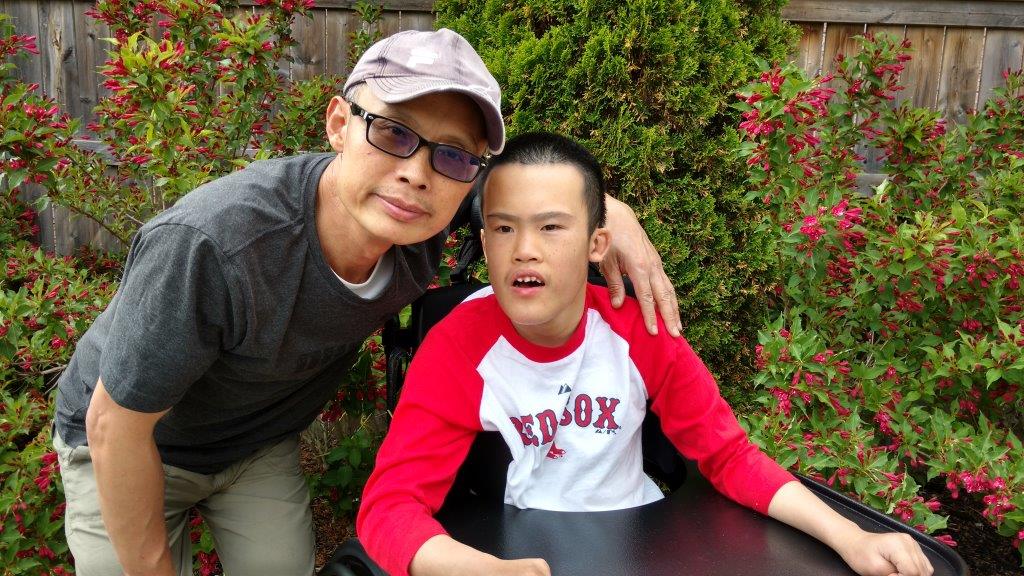
Thursday, June 16, 2016

The adventures of Team Jake

By Marcy White

“You’re having strangers stay at your house?” asked my friend tentatively.

“On their honeymoon?”

“Well, we’ve never met,” I said, “but they aren’t strangers.”

My friend was mortified.

I didn't think it was weird, and I wasn't worried, despite the fact that our only exchanges with this couple had happened on Facebook.

Kelly and her fiancé Kevin were part of Who I Run For, a Facebook group that pairs children and adults with disabilities with athletes to create a mutual support system. The athletes and their training and events provide excitement for those who can't be as active, and the buddies with disabilities provide a new kind of purpose and motivation that power the athletes’ workouts.

My 14-year-old son Jacob was matched with Kelly, who lives in New Hampshire, in 2014.

From the day they were matched, Kelly posted messages to Jake about her running adventures. She almost always included photos from her runs and it became clear that Kelly had recruited her fiancé, Kevin, and her son, Nick, to run for my son as well. Together they formed Team Jake.

As time passed, our family got to know Kelly and her family. We saw photos of them holding homemade signs that read We Run 4 Jake along the routes of their runs and we shared Kelly’s stress around the wedding plans, including the last minute aggravation with her wedding gown!

Team Jake came into our lives around the time that Jacob's health started to deteriorate. We didn't know Kelly during the 12 years that Jacob's health was stable and he was able to ski, attend sleep-away camp and be a full-time student. She wasn't around when we fought, successfully, to have Jake attend a regular school and she missed the time Jake was invited to listen to his favourite singer, Andrea Bocelli, rehearse before a concert.

We were matched shortly before Jake spent almost a year living in the hospital. Kelly was in our lives when Jake was rushed to the hospital and spent weeks in the intensive care unit, hooked up to machines helping him breathe. She was around when he celebrated his Bar Mitzvah as an inpatient. Kelly and her crew stayed abreast of Jacob's challenges and frequently sent notes of support and upbeat messages to us. She also sent Jake medals from races and t-shirts and other running paraphernalia that she, Kevin and Nick collected.

One cold Sunday morning, when my husband, Andrew, Jake and I were having our weekly coffee at Starbucks, my phone alerted me to a message from Kelly with the most exciting and unexpected news: she and Kevin were coming to meet Jake on their honeymoon.

They planned their post-wedding week so that they would arrive in Toronto on a Friday and we invited them to stay with us for the weekend.

How perfect would it be if the newlyweds and Jake could run a race together? It didn't take us long to find a race that coincided with Kelly’s and Kevin's visit. After a brief discussion with the race director, Kelly informed me that everything was set—they would run the race with their buddy and push him across the finish line.

It all sounded great in theory, but would Jake be healthy enough for the 30-minute drive to the race?

The run was scheduled to begin at 9 a.m., but my son hadn't been out of bed before 11 in over a year. That’s because it takes a long time to clear his airway so that he can sit up in his chair without struggling to breathe. And just two weeks earlier Jake was so ill that he narrowly avoided an ICU admission.

But Jake being Jake, and one to never miss a party (except for his 14th birthday when he was so sick he slept for almost five days) or a chance to be surrounded by friends, we had to try. So we crossed our fingers and made the plans.

I was only a little surprised when I went into his room at 7 a.m. on race day and saw a pair of large green eyes, fully awake, ready for his latest adventure. He was excited and blinked his eyes to confirm that he was ready to run with Team Jake!

Dressed in a teal blue t-shirt that read Kelly And Kevin Run For Me, my son fit perfectly between his runners, who were wearing the same shirts with the banner I Run For Jake. As they crossed the finish line, the trio gladly accepted their medals and posed for photos. 


Marcy White is the author of The Boy Who Can: The Jacob Trossman Story. You can follow her on her blog at Cure PMD. Marcy is a family leader at Holland Bloorview.

Wednesday, June 15, 2016

Good care? It starts with R-E-S-P-E-C-T, student says

By Louise Kinross

Emily Chan, 19, has come full circle.

This summer she’s a researcher in the Ward Family Summer Student Program at Holland Bloorview.

As a University of Toronto student who just finished her second year in mental health studies and health policy, Emily hopes to become a clinical psychologist working with children with disabilities.

To her studies she brings a lifetime of firsthand experience. Emily, who has a rare neuromuscular condition, spent the first six years of her life living on the complex continuing care unit at Holland Bloorview. She’s attended our reverse-integration kindergarten, volunteered to bring a patient voice to research projects here, participated in life skills programs and is currently co-chair of our youth advisory.

“I’ve had many people come up recently and say ‘What are you doing here?’” Emily says. “When I say ‘I’m working as a researcher’ and show them my orange badge, especially those who knew me as an inpatient, they’re shocked.” BLOOM caught up with Emily since we last interviewed her.

BLOOM: What did it feel like to walk through the doors of Holland Bloorview as a research student after your life-long connection as a client?

Emily Chan: I’ve come here for so long and seen so many staff working here, and to be able to now be one of them, feels very surreal. I have so much respect for everyone that works here and now I’ve joined that community of workers. It’s an honour for sure. I love the work that we do here and it’s nice to be part of something you can relate to in a very personal way.

BLOOM: Why did you want to be a student here?

Emily Chan: First of all I have a sense of familiarity. I’m very familiar with the people here, the researchers as well because I’ve participated in research. I know a lot of the clients here. It came naturally to gravitate here. Somewhere else I would feel more out of place. Being able to contribute to the whole of what we do is unique because I used to be part of it and now I’m helping to contribute in a different way.

BLOOM: What do you hope to learn?


Emily Chan: I hope to be able to apply knowledge I’ve learned at school to a real-life setting. I also want to learn how more about how the hospital conducts research and the internal workings of research: the ethics of it, how to write up a research proposal, how to conduct a study—skills that I’ll be able to carry with me through the rest of my academic career. I know the work we do here is so special and I’m interested to see the impact it has on children and families.

BLOOM: I know a lot of the buildings on the downtown campus of U of T aren’t accessible. What’s it been like to be a student who uses a wheelchair?

Emily Chan: I’m on the Scarborough campus, which is great. It’s very small and nice in the sense that I have a real sense of community with my peers and I see people I know and cross paths with them often. The Scarborough campus is also only a 10-minute drive from my house so it frees up a lot of my time to do extracurricular clubs. 


All of the buildings are modern and relatively new and there are lots of elevators and ramps already in place. Many of the buildings are interconnected so in the winter I don’t have to go outside in the freezing cold with snow on the ground and pray my wheelchair doesn’t break down. The structure of the campus is very accessible. The elevators do break down but there’s nothing I can do about that.

BLOOM: When we last spoke you talked about how you’d been teased because of your disability in Grade 2. And that at high school, some teens taunted you. How are you treated as a person with a disability at U o T?


Emily Chan: It’s shocking to me but I feel very much like any other student there. I used to always be stared at and feel out of place and obviously different from my peers. But at university—I don’t know if people have matured or it’s just the nature of the community—but I don’t get stared at very often. I don’t feel significantly different from my peers. They’re always willing to lend me a hand if I need something to be moved out of the way or if my table needs to be adjusted. They’re very accommodating and understanding. I haven’t had a bad experience there which is very interesting. I’m quite surprised.

BLOOM: What research project are you working on here?


Emily Chan: I’m working on a project with Sally Lindsay that looks at the benefits of volunteering for youth with and without disabilities. I’ve interviewed a bunch of participants and asked about their experiences: What they’ve gotten out of it, the benefits and challenges. It’s an interesting project because I myself have volunteered here for the last four years. When I’m doing my analysis it makes it easier for me to understand what people are saying because I’ve been through the experience.

BLOOM: What volunteer work have you done here?

Emily Chan: I’ve been a youth mentor and sat on a couple of research projects to give the perspective of youth who’ve had clinical experience here. I’m now the co-chair of the youth advisory council.

BLOOM: What part of the research on volunteering are you working on?

Emily Chan: I’m in the middle of analyzing the interviews for major themes. I’m working towards a poster presentation at the end of the program.

BLOOM: Has anything about the research surprised you?

Emily Chan: I think one thing that youth with disabilities struggle with a lot is finding their place in the volunteering world. As a person with a disability you can think 'how am I supposed to be able to contribute to society when the idea that people have is that I’m the recipient of volunteer services?' We have to turn the tables around. Youth with disabilities have something to offer and we don’t always need help. It’s a newer concept for people to grasp.

BLOOM: Do you think youth feel hesitant to apply for volunteer work because of stereotypes about disability, or do you think when they do apply, they may face negative attitudes?


Emily Chan: I think it’s a bit of both. They might feel scared to reach out and say ‘Hey I’m a person with a disability but I’m very interested in volunteering. Would you have anything for me to do?’ They might be afraid people will say no. It’s also an attitude thing that people perceive us as not being able to help but needing help. The word ‘help’ is a bothersome word that creates a hierarchy between the ‘helper’ and ‘helpee.’ The helper supposedly has something the helpee doesn’t have, that they’re lacking. That creates an unequal relationship between two people.

BLOOM: What does your personal experience with disability and Holland Bloorview bring to your research work?

Emily Chan: I lived here for the first six years of my life so I’ve received a lot of care and help from different people on that end. After I was discharged and came home and was growing up I felt an obligation to give back, so I came back and volunteered. I’ve also participated in Youth at Work and other life skills programs. Youth at Work was major in helping me develop skills. They gave me that hands-on experience to go out in the community and be able to find and work a real job for two weeks. So I’ve had a lot of experience that I can apply to the research I’m doing now.

BLOOM: What’s been the biggest challenge of being a research student?


Emily Chan:
Getting people to not see me as a client and more as part of the staff. It’s a little bit of a role shift for me and them. I need them to treat me more or less as an equal and not so much as a client who requires services here. And I have to make people see I’ve grown up and developed my own mind and I know what I’m doing and don’t need someone’s assistance—not that assistance is a bad thing. I need to break that image of me being a client as opposed to a researcher here. It seems that seeing a former inpatient who was discharged and came back into Holland Bloorview in a different role is not something they see often.

BLOOM: Would you like to see anything change in clinical care or research about children or adults with disabilities?

Emily Chan:
I think incorporating more of a client perspective here. Clients who have been discharged or are within the system have a lot to say about the workings of Holland Bloorview. Who else knows it better than people who have been through it themselves? About six months ago I approached the new CEO, Julia Hanigsberg, and said ‘I used to be a former client here and I have some things I want to discuss with you about it.’ She was willing and we had a nice conversation about my observations. I think it’s being able to embrace different lenses on how you approach an issue. We’re taking steps in the right direction but I think we could have more youth on different research projects to give their perspectives.

BLOOM: It would be wonderful to also adapt our research so that people who don’t speak conventionally can have a voice.

Emily Chan: Just yesterday I went to a talk where a researcher spoke about a project where she had people draw their interpretations of what it’s like to have a concussion. We rely so much on verbal communication that we can forget about other forms. Having a drawing can be so rich in and of itself. Sometimes words can’t capture the whole image of what you’re going through in terms of your feelings.

BLOOM: What advice would you give staff working with children with a variety of disabilities?

Emily Chan: Respect them. Respect is a very major one. We need to break down that barrier between helper and helpee and make it more of a collaborative effort. So instead of saying ‘How can I help you?’ ask more questions: ‘How can we work together to further advance your quality of life?’ We need to bring the client and family in as an integral part of care and knock down that barrier between clinician and client. Even though the clinician might be an expert in their field, the child is the expert in their own lived experiences. It’s important not to make assumptions.

BLOOM: What about advice for parents?


Emily Chan: A lot of disabilities can come with the whole mental burden of not being able to do the same things as your peers. Not being able to walk like your peers or not being able to communicate on the same level. It can be very mentally frustrating. I have some friends who struggle with feeling that no one in this world understands what they’re going through, because they have such a unique set of lived experiences. As children here grow older they can realize that they’re different from their peers and it can be a very isolating feeling. We need to start conversations by asking if someone is mentally okay, not just if they’re physically okay, and if there’s anything we can do to support mental health. We need to be very open and not treat issues like depression or anxiety as a taboo topic.


Friday, June 10, 2016

Confessions of a 'super sister'


By Helen Ries

For many of us, the sibling relationship is the longest and deepest relationship we experience in a lifetime.

This is certainly true for my brother and me. When he was born in 1972 he didn’t come home from the hospital right away. The doctors told my mother they needed to run some tests.

I can still remember my deep disappointment that the promise of a baby brother was taking so long to materialize. When he did finally come home, there was nothing better than dragging this baby around, dressing him up and pretending to feed him.

As we got older, he was my constant shadow. I made sure he was included as we played games with the other kids on our street. He was always there and under my constantly protective eye. I went away to university and then spent many years living in other cities trying to make my way in the world. Our bond faded, but didn’t weaken.

Recently we’ve become very close again.

Sadly, our parents both passed away unexpectedly within a short period of time. My brother came to live with me and my husband, and we became his primary caregivers. I had always known this day would come, but it was never really discussed as it was a painful and seemingly fictitious conversation that I wanted to avoid.

The change was shocking and difficult for all of us. Unlike me, my husband didn’t have a lifetime to anticipate becoming the primary caregiver of a person with Down syndrome.

Sibling caregiving is complex and very different from the parent-child relationship. My brother is his own decision maker. I am responsible but without authority.

As siblings, you are close because of circumstance, not necessarily choice. You are honouring family values and unspoken parental wishes but you also have your own to consider. You walk the grey line of ethical decision making every day and in everything that you do.

I wonder continually: “Is this decision about him, or about me?” 

These conditions are ripe for the emergence of the ‘super sister.' I am a super sister. I am not the only one. There are lots of us out there. Super brothers, too. As a super sister I have taken on this caregiving role with my whole heart and then some. It comes from a place of deep love.

I have shifted a lot of energy that was focused on my own life to my brother’s life. I organize, plan, arrange, boss and frankly dictate so much of my brother’s life. I feel I have to do it this way because I am new to this job and I don’t know how else to do it. If I throw everything I have into it, everything will be all right, right?

I have been a super sister for one-and-a-half years now and I’m thinking that it’s time to retire my cape. Or at the very least find a spot for it in my closet.

Over the last year I’ve learned that even the mightiest of us super sisters can’t make pain go away, do everything right or be wholly responsible for creating a good life for my brother.

When you love someone deeply and for a lifetime you want them to be happy. I think this is especially true when that person has a disability.

I know that the pain my brother has dealt with in a lifetime has superseded my own. I have not faced discrimination and prejudice daily. I have been able to make my own choices, accumulate assets, enjoy good health, have many friends and do so many other things I take for granted. My brother has watched all of this and wondered why life has been different for him. When our parents died, super sister was all over his pain, trying to scrub it off his life because that is what seemed fair.

I could articulate my pain, rationalize my grief, and express my feelings in a way that brought me relief. But my brother could not.

So instead, I provided an endless roster of tonics: from tubs of ice cream to a new cat, from singing childhood songs to taking him on an exotic trip. On a daily basis he got a speech about what our mother and father would have wanted for him, how he shouldn’t be sad, how he has so many good things in his life. One day he told me: “Leave me alone.” The shine fell off my super sister costume that day. After that, I tried to take a back seat.

One day recently someone was rude to my brother on the city bus. Actually it was beyond rude, it was harassment. I overheard it, because we were on the phone together at the time.

I cried and was lost in despair about it. How can people say those things? Don’t they know what he’s been through?

My brother yelled back at the offending passenger: “You are not very nice and you should watch your mouth.”

Later on, when the drama had subsided, I realized that being super sister had been all about me. He doesn’t need super sister. He just needs me. And only sometimes. This letting go is something I’m trying to figure out, and I don’t think I’ve quite got it yet.

It’s hard to accept as a super sister that you can’t erase pain. It’s hard to accept that you have to back off and let people be, let them travel their own path, and allow them to get there in their own time.

Even the deepest and longest relationship in a lifetime has its limits.

Helen Ries is a writer, community activist, and professional consultant, and is also in the role of primary caregiver of her brother, a person with an intellectual disability. Helen’s work aims to build caring communities, better programs and smarter social policies for a more inclusive society. You can connect with Helen on Twitter @helenries  or through her website greatriverconsulting.caOr visit The Sibling Network, a Facebook group Helen created to provide information and support to caregiving brothers and sisters.

Thursday, June 9, 2016

Make room for dads

By Louise Kinross

In the world of children’s rehab, it’s often moms who become experts on their child's disability or injury, take their child to therapy and medical appointments and carry out interventions at home.

We even ascribe a culture to them, calling them warrior moms or Mama Bears.

But what role does this leave for dads?

A largely invisible one, according to a new fact sheet from the Parenting Matters research team at the Centre for Research on Children and Families at McGill University in Montreal.

Parenting Matters is studying what it means to parent a child with a disability like autism, Down syndrome or cerebral palsy.

“Integrate fathers and increase their visibility in clinical practice and research” is one of four main recommendations in Why Focus on Father-Inclusive Practice? The strategies come from 83 parents, clinicians, managers, researchers and policy-makers who participated at a 2014 symposium for the Canadian Network of Children and Youth Rehabilitation and the Canadian Family Advisory Network.

Other recommendations include:

-create flexible service hours, including evenings and weekends, and use technology like Skype to allow working fathers to participate in clinic visits


-focus on gathering information from all parents or caregivers, recognizing that each family is unique

-and develop fathers’ groups that involve dads in an activity and informally provide the opportunity for peer support.

Before drafting these ideas, participants heard about findings from a doctoral study on the role of dads raising children with disabilities by researcher and social worker Aline Bogossian. They also discussed the myth that “fathers aren’t interested in being involved in their child’s care plan.”

BLOOM: Why don't we see fathers more often in children’s rehab?

Aline Bogossian: One of the reasons dads are invisible is likely the way work is distributed between parents—with mothers being present with the child in clinic and fathers being out in the work world.

The other is that in research, when we talk about parenting, we’ve been talking about mothering. I was involved in a large, comprehensive, systematic review of literature on parenting kids with disabilities that spanned over 25 years, and studies that included dads in their samples were few and far between. That may be because it’s easier for researchers to access someone who is in clinic than to ask for the parent who’s not there.

There are also a lot of single-parent families where the fathers are hard to reach and we haven’t attempted to find them. So we don't hear dads' voices in research.


BLOOM: What are the downsides of not having fathers involved in their child's care?

Aline Bogossian: Fathers who are interested in being in their children’s lives are important to their children and must be supported. The kids want their dads. We can’t assume that dads are not interested just because we don’t see them in clinics.

There is also the downside of having mom doing all of the work, which means that the burden of all of that work remains on her. She becomes the expert and more and more, over time, is the one called upon. So that restricts the role the dad can take on.

BLOOM: Something I found challenging as the primary caregiver when my son was young was that I often had to convey diagnoses or difficult news to my husband, and that can create a lot of stress.

Aline Bogossian:
Yes, that’s huge. It’s different when a parent hears something from a clinician as opposed to a partner. The mother may not have, or remember, all of the information. She may not have the tools to answer the questions the father has. We all have different information-seeking styles and needs. Having mothers assume that burden could drive a wedge in the family.


The other thing that happens when dads aren’t at clinic visits is that they aren’t able to access support. I’m a clinical social worker and also the parent of a child who had a pretty serious chronic illness early on. I was the one in clinic getting all of the information, but I was also in clinic feeling supported. I was able to break down there and have someone to speak to, which is another thing a spouse who isn’t there misses.

BLOOM: I think the roles that parents play is a very sensitive topic. I think if you were to ask moms if they’d like their partner to be more involved, they’d say yes. But to be honest, in some ways, I think they might push back when asked to give up some of that control.


Aline Bogossian:
Yes, it can be tricky to give up those parts of yourself. While caregiving is very difficult work, it’s also extremely meaningful work. I think most important is not to make assumptions that one person can adequately speak for the experience of two.


BLOOM: What were the most important ideas you heard on better including dads?

Aline Bogossian: It came out strongly that the clinic should be an inviting place where dads can see themselves as welcome. Perhaps there are images or pictures that include dads with their kids, or by using language that is inclusive. So refer to mother and father, instead of parent.

Clinicians need to be more creative in their use of technology or in the way they organize important meetings where decisions have to be made, to ensure that both parents can participate. So perhaps Skype is used to make a space for dad, or maybe advance notice is given so that dad can attend.

We need to recognize that each family is unique.

BLOOM: Some of the recommendations are about changing clinic hours to evenings or weekends, so that parents who work can participate. Have you seen rehab centres make these kind of changes?


Aline Bogossian: I’ve been on the road with some of this work and I've seen some clinics create shifts so that some staff work in the morning till around 2 or 3, and others come in later and work until 9. And they offer these extended hours once or twice a week.

BLOOM: Your fact sheet says that dads report feeling invisible in children’s rehab. Does this lead them to feel inadequate, which then makes it less likely that they will get involved?

Aline Bogossian: Fathers speak to me about feeling invisible. They say ‘Even when I’m here, no one asks me anything.’ There are also fathers who are on a solitary, lonely journey. They feel their role is to support their partner, who is doing a lot of the work, and they don't want to burden her psychologically. They don’t feel there’s a space where they could ask for help or talk about their suffering.

BLOOM: I interviewed a single dad who is raising his daughter with disabilities. And he mentioned that when his daughter was hospitalized, if her mother visited, the doctors and nurses would start addressing all of their questions to her, and ignore him
.


Aline Bogossian: What you’re describing is a culture that says a dad can’t be a primary caregiver. These are popular stereotypes that we need to be aware of and change. That came up in our recommendations. If dad is in clinic or hospital with mom, do not direct all questions to mom. Ask both parents what they think.

BLOOM: This same dad had attended some support groups for parents of children with disabilities and found he was the only dad there and didn’t feel very comfortable.


Aline Bogossian:
We recommend peer support for dads, but not in the traditional ways where mothers get together and talk. The idea is to get dads together to do an activity. For example, there’s a group for bereaved men that walks on Mount Royal here in Montreal. Apparently they start talking about sports or whatever, and then they eventually get into a space where they feel supported and conversations about what they’re going through naturally emerge.


Aline Bogossian is a social worker, a researcher coordinator at the Centre for Research on Children and Families, and a doctoral student in the School of Social Work at McGill University.

Monday, June 6, 2016

A dad asks: 'Did I do anything wrong?'

By Louise Kinross

Samuel Cheng (above left) is a decision support analyst at Holland Bloorview. He spoke at a Schwartz Rounds recently about what it’s like to have his professional and personal life intersect, as his son Timothy (right) has disabilities. I wasn’t able to attend the event, but many colleagues told me they were profoundly moved by Samuel’s story, so I interviewed him.

BLOOM: Tell us a bit about Timothy
.


Samuel Cheng: He’s 14 and he has a genetic disorder and requires 24-7 care. He can’t walk, but he moves, he can stand. He can crawl and he needs to be watched to be safe, which is demanding. He has his favourite games and favourite videos. He doesn’t speak, but he points and gestures and people close to him know what he wants.

He was diagnosed with autism and he has seizures and a heart problem. His health is fragile. He loves music. Whenever he hears music he will be jumping around and smiling a lot and laughing. He likes to press sound-and-effect toys. He’s come to Holland Bloorview on Sundays for respite and he likes to go on the elevator and press the up and down buttons. He goes to a special class in an integrated school.


BLOOM: Does he like school?

Samuel Cheng: I think he likes it, but we don’t really know because we can’t go inside his world to understand what he’s thinking. I know in the morning we see him excited and happy to go to school and when he comes home we see he’s even more excited!

BLOOM: Does he have a close relationship with anyone?

Samuel Cheng: Only his mother. There is something special there. After his shower everyday when he sees his mother he has endless things to talk to her about. He speaks with her, face to face and with facial expression, making sounds. It’s like he’s trying to tell her whatever story he has. He’s never talked to me like that. I feel bad sometimes because I look at him and this is my son, but I feel remote with him. I’m only someone to be in charge. It seems to me that to him I am only someone, ‘anyone.’ This is a really bad feeling.

BLOOM: Do you think it’s possible that he knows that you are someone important to him, even if he can’t tell you that?

Samuel Cheng: Maybe, but I don’t know. There are lots of unanswered questions.

BLOOM: You mentioned you have another son.

Samuel Cheng: Yes, Aidan is nine years old.

BLOOM: What kind of relationship do Aidan and Timothy have?


Samuel Cheng:
Aidan knows he has a brother with special needs but they’re so distinct in what they enjoy doing and they don’t communicate a lot. I know that Aidan loves Timothy so much. Sometimes if there’s a dangerous situation, Aidan will yell and run to us to let us know Timothy needs help. Whenever we ask Aidan to help with Timothy’s care, he loves to help.


BLOOM: When is Timothy most happy?


Samuel Cheng: He enjoys being outside in this weather, but lots of times we feel discouraged because it’s not easy to bring a wheelchair to push him in and people in the community look at you differently. So he enjoys being out, but sometimes we are discouraged. I feel like we live in a subculture or a subgroup that is outside the ‘normal.’

BLOOM: I understand that feeling. Have you connected with any families who have children with disabilities?

Samuel Cheng: No, we don’t have friends within the disability community. I always feel that I’m different. I have no social life and for many years I just go home and come here to work.

BLOOM: What is the greatest challenge of raising Timothy?

Samuel Cheng: Everyday facing uncertainty in terms of his health. This morning he had quite a severe seizure that lasted a few minutes. I don’t feel there’s anything I can do about it. The first time he had a seizure 13 years ago, I rushed to him and was so worried. It seems that I’ve lost that emotion over the years. Because the situation keeps recurring, I become less emotional. I feel guilty, and I’m not happy that I don’t feel more emotion. Inside I feel I owe it to him. He’s my child and he’s fragile.

BLOOM: It sounds like you're very hard on yourself. I think parents of children with disabilities often feel inadequate because they can’t change the situation in the way they would hope. So we always feel we are coming up short.

Samuel Cheng: Yes, I feel that I’m not doing enough. Sometimes I come here for appointments and the therapists say ‘you need to do this and you need to do that’ and I’ll say ‘yea, yea, yea,’ but actually, I don’t fully follow the instructions they’re giving me. Because it’s become a routine, and I don’t believe it’s something that will help anyways.

BLOOM: I can imagine that when your child has so many needs, you could be working with him 24 hours a day and you still couldn't fit everything in.

Samuel Cheng: Timothy has such a long list of problems. He has everything! If he only had one of these problems, it would be big. For example, if he only had seizures. Or if he only couldn’t talk. Or if he only couldn’t walk. Or if he only had a heart problem.

Sometimes I think about what I would say if a wizard told me he could take away one of his diagnoses. But the list is so long I don’t know which one to pick. Can I take five? Can I take 10?

I’m not talking about small things you can do something about. I’m talking about life and death situations. There’s a huge uncertainty that drags all the energy out of you. All of the uncertainty and the emotion, everything is linked together like a web. You pull on one thread and the whole thing collapses. It’s too much.

Now, if we are given one more diagnosis for Timothy, I’ll say ‘just add it to the list.’ I don’t know where to go. Every day I tell myself and I tell my family, my wife: ‘I’m here. I’ll try my best to carry through one day.’

BLOOM: Did you have experience with disability before Timothy was born?

Samuel Cheng: No, I had no experience. That’s why it was really a shock. Through this whole journey, every step you see something you’ve never seen before, but it’s not good. And then sometimes you ask yourself: ‘Did I do anything wrong?’

BLOOM: You ask yourself why this happened to your child?

Samuel Cheng: I’m not complaining. I just feel guilty that maybe I did something. I feel that I was so self-centred. From the beginning I wanted to go to university, I wanted to get good marks. I wanted to graduate and find a job and a lady and have a family. Everything is a want: 'I want, I want.' And then I come up with this situation. I feel that I did something that is impacting everybody.

BLOOM: I think it's natural for parents to agonize over a reason why this has happened, particularly when their child has many struggles. But I don’t think it's true that you caused Timothy's disabilities, and I don’t think people around you feel that way.

Before my son was born, I believed there was some kind of justice in the world. I thought if you were a good person, mostly good things would happen to you. I couldn't understand how my son was born with a genetic deletion that was a random change at conception.

Since then I’ve come to believe that there’s a lot that's random in the world, and outside my control, and that helps me not feel so guilty about it. Sometimes things just happen, and there is no 'reason.' It can be hard to accept. We want to attach a story to what's happened as a way of feeling like we have control, that there's some kind of order in life.


Samuel Cheng: The bad feeling is not because of how I feel about all of the hard work. It’s because of the people around us who are impacted. I worry about the people around me, that it’s not fair to them.

I feel sorry for Timothy, for my wife, and my family. For example, my mother is 80 and without her we can’t live everyday because she helps to take care of Timothy. And on Saturday and Sunday, when you see people out and so happy because it’s the weekend, somebody has to be home taking care of Timothy. So they can’t be out.


BLOOM: Maybe your mother feels that her contribution to Timothy’s care is very important.

Samuel Cheng: Yes, she loves Timothy very much.

BLOOM: Do you ever have workers come to your house so you can get out for a little while and have a bit of a break?

Samuel Cheng: No, we don’t. And we don’t use the overnight respite at Holland Bloorview. I don’t go on vacation often, but when I do, I will always bring Timothy.

BLOOM: I think it’s very hard if you don’t get breaks from caring for your child when they need you around the clock. I think you need even very short breaks, to help you re-energize.

Samuel Cheng: Yes, it’s like a battery, getting lower and lower.

BLOOM: What do you like about your job here?

Samuel Cheng: I’m a part of this whole business—disability, healthcare issues. Before I came to work here I’d come for appointments and knew the place, so when I heard they were looking for an analyst, it was the perfect match.

I know what we’re doing here. As a parent I always feel I’m a second set of eyes to look at things. I can look at the system and identify something we can do a little better, and tell my manager or tell the system. Instead of just sitting here, I can do something to make it a little better.


BLOOM: Do you ever talk to other staff who have children with disabilities?

Samuel Cheng: Not really. We are so isolated. We’ve built a wall around us—well, around me. I’m facing it, so I’m here, but with the wall around me.

BLOOM: What was it like to listen to the other staff, who are also parents of children with disabilities, at the Schwartz Rounds?

Samuel Cheng: I feel I related to them. And I feel so sorry for them. I know that people here care, because when they hear my story, they send me notes of encouragement. They may not be able to do much to help, but at least they care.

Friday, June 3, 2016

A trip to Disney without parents spurs independence

Today's Parent Magazine produced a beautiful video about two children who were part of a group of over 30 kids from Holland Bloorview who went to the Walt Disney Resort in Orlando for a day with volunteers. The event in April was supported by the Sunshine Foundation of Canada. For some kids it was their first time away from parents and first trip on a plane.

Tomas Tobon (above left) with volunteer Daniel Scott and his twin brother Martin are interviewed about this magical day where they got to make all the choices. 


Wednesday, June 1, 2016

QuickFlix: Can support workers be friends, too?


Holland Bloorview family leader Donna Cappelli discusses whether paid support workers can be considered friends of her son Julian, 15, who has high needs that make friendships with peers challenging.


QuickFlix is a series of short BLOOM clips about parenting, disability and health. Don't forget to check out our A Family Like Mine videos.