Thursday, September 30, 2010

Follow the leader


Follow the leader
By David Sexton


When my son was first diagnosed with cerebral palsy, and we had an MRI performed and learned the scope of the stroke, I had a hard time concentrating on what the doctor was telling us. I sat in his office holding my wife’s hand and balancing my son on my knee and I tried to focus. My head was a whirlwind though, and it was all I could do not to shut down and stop listening.


“You’ve got to listen and ask, you’ve got to listen and ask,” I kept saying to myself. “For your son, you’ve got to listen and stay cogent.”


I willed myself to attention and watched the doctor’s face the way I sometimes scan the face of an attendant on an airline flight when there’s turbulence; I looked for the signs of trouble that words might not convey.


While I listened, in that hour or so that the neurologist gave us, I heard him say three distinct things:


“This is permanent. This is not degenerative. We don’t know what the long-term impact will be.”


When I heard “...not degenerative,” I think I calmed a little, like I had caught the side of a boat after heavy swimming. I clung to that understanding. I was relieved that, whatever it was that had happened to my son, it was over. Later tests and blood work reinforced this understanding. There was no underlying condition that could make a second stroke likely; there were no accompanying conditions that would make his prognosis worse.


I took great comfort from those words and we set about doing everything we could to assist my son to recover physically.


I suppose at the time, my unequal weighing of the doctor’s message created a set of incompatible beliefs in my head. I somehow felt that the “not degenerative” part of the doctor’s message negated the “permanent” part. That his words would act like self-cancelling components to an algebraic equation. And like I often did in math class in high school, I ignored the “we don’t know” part of the equation all together. It didn’t seem to fit and I wasn’t ready for that.


I suspect this self deception was natural; I needed a way to move ahead and those tougher truths were too much for me at that moment. I was living as one of my literary heroes, Dr. Samuel Johnson, would say, not from day to day, but from hope to hope.


“I can help him now,” I thought. “I couldn’t prevent what happened to him, but now I can make it right.”


To a great degree that misconception has been helpful. The hope that it gave helped me to take a practical approach to my son’s conditions and treatment. We worked (and still work) very hard to make every therapy appointment count and to help him recover.


My son can walk now. He can talk. He can move his left arm, the affected arm, when he thinks about it. These changes mark real progress, and the smiles and confidence I see in his face tell me just how important this progress is. When I see him walk and climb and use the slide at the park, I might as well be watching him fly.


But even as my son has made these strides forward, it’s becoming more clear that when nature touched him with cerebral palsy, it left a mark that would always be a part of him.


“This is permanent. We don’t know what the true impact will be.” These words have come back to me as the immediate dangers have passed, and I’ve only begun to wonder about them.


I think I’ve put off thinking about these words, not only because they were hard to hear, but because they brought home the mystery that the future holds for our son. That no matter how much therapy we do, no matter how much coaching and early education we give him, or how much we include him with his age group in school, my boy is on a different and unknowable path. That as much as I like to feel that I’m clearing the way for him, all I can really do is follow behind him.


Sometimes I find myself doing this following literally.


“Uh oh, Daddy, he’s on the stairs,” my daughter will giggle when her brother breaks past the barricade we put in front of our first to second floor stair case. “There he goes!”


“No way!” I shout from behind as I race to catch up to him – he’s moving pretty quick these days – and prevent an unplanned stumble. “Get back here little man!”


He laughs when I catch him. He looks up at me with a twinkle in his mischievous blue eyes and lets out a terrific little belly laugh.


“No way,” he repeats with delight.


I look in those blue eyes and wonder how different things are for him. I think about the half of his brain that was hit by the stroke and the half that is now free to work as it will. I listen to the numbers and letters he identifies spontaneously from road signs and cereal boxes and wonder what’s in store for him and for us. I think about the songs and stories he’s beginning to memorize and wonder what he will do with his life.


Some of this is ordinary wondering about the future, I know. We all have our riddles, I suppose; the traits and qualities that surface in us seemingly from nowhere. My children will sometimes exhibit a look or a laugh or a peculiar talent or weakness that seems new and inexplicable. When I see this, I imagine lost ancestors before us in the forgotten past whose once familiar qualities are resurfacing. I think these seemingly new qualities are like a flower bulb that has lain dormant in a garden for many years, only to spring up unexpectedly to the owners of a home who never recall having planted it.


But when I think of the doctor’s words, “We don’t know what this will mean,” I know some of what I see in my son can’t be attributed to a distant forefather or mother. Some of these traits that surface now are part of his body’s response to the stroke. His brain forced into use pathways and circuits that would otherwise have remained dormant. The resulting changes and growth of his person are ancient beyond the reach of family memory or even written history; they are the inheritance of ages of human evolution that have made our bodies tough and robust and resilient - even to stroke. I wonder what miraculous traits of humanity are now coming alive in our boy and what they will mean for him.


There is no way to know for sure, but it puzzles me mightily now.


These days, when I find myself trying to riddle these unknowns out, I feel as though I’ve taken up a difficult book that has suddenly become intelligible. That my mind and heart have grown with our struggles and that I am now ready to acknowledge certain truths about the cerebral palsy that I was not ready to accept before. I feel as though we’re out of danger and like a man will sometimes do after a hurricane, I’ve tentatively stepped out and am looking around to see what the great winds and rains have changed in their passing.


I’ve been afraid I think, and the fear is just beginning to pass. I never thought the words “permanent,” or “we don’t know,” would mean anything else but a fearful burden, but this seems to be changing.


“What a mess!” my son says, imitating me again, as he overturns a bucket of toys on the floor in front of him and sets about ordering those same toys into some arrangement of his own imagination.


I watch him play and I can do nothing but smile.


“He’ll make his way,” I think hopefully. “He’ll find a way.”


I’m not ignoring the realities. I know that way won’t be easy. I know he’ll have unexpected struggles ahead and that the world can be a hard place. We still have a long way to go with his therapy. We still have a long way to go to see what help he may need along the way. There will be many tough days I’m sure.


But when I look at my son now and accept both his progress and the ongoing mystery of his condition, I see mostly good in his future; I see his unique and remarkable potential. Whatever the future may hold for him, I expect that he will be able to face it with confidence. What I see mostly now, for my son, is hope.


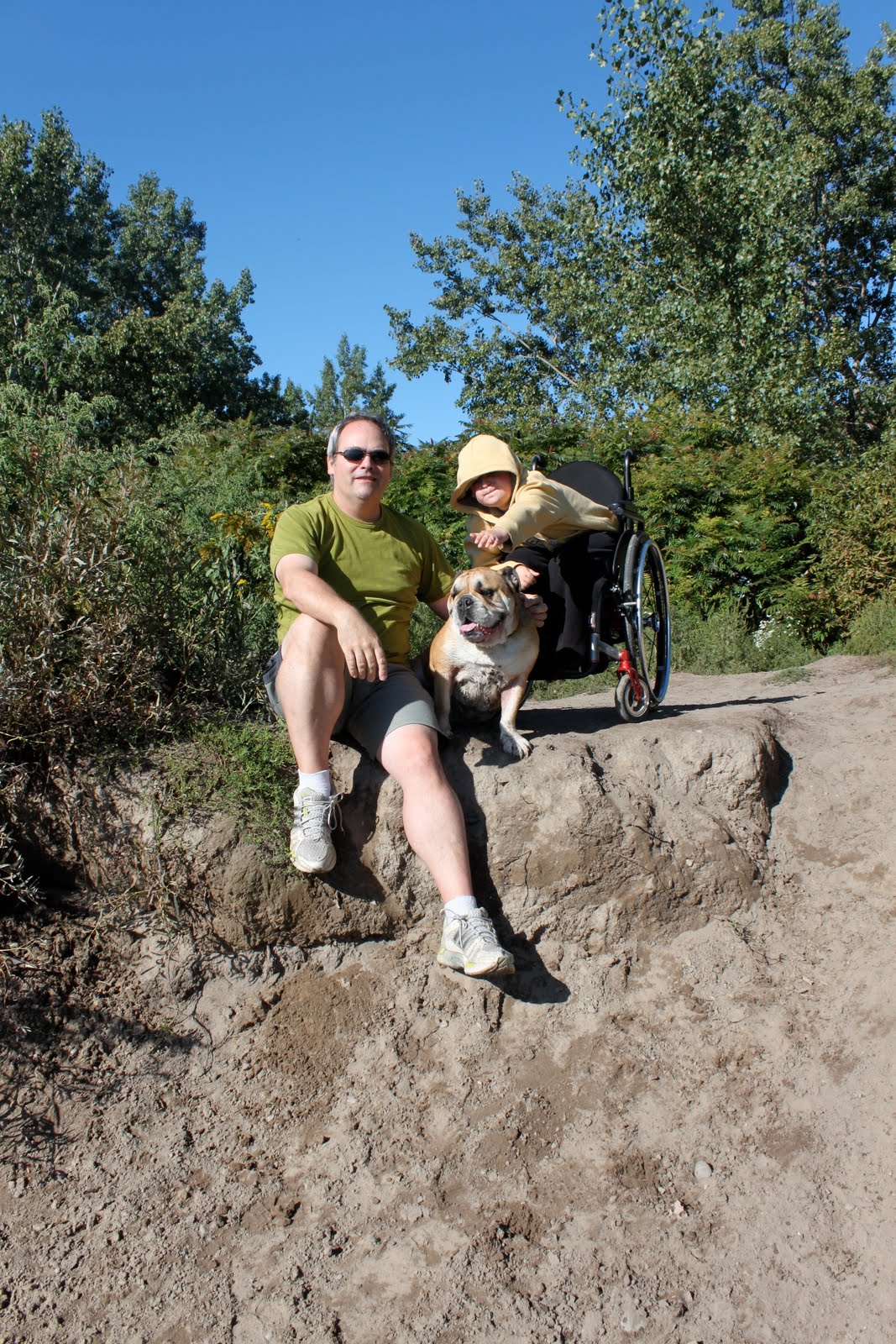
David is a software development manager in Hoboken, New Jersey who writes about parenting in Scattering Bright. You can read an earlier piece he wrote for BLOOM at Breaking windows with my son. Pictured above is his adorable boy.

Thursday, September 23, 2010

Beauty: It's ours to choose


A part of me was terrified. Was I about to see something now, 14 years after my son’s birth, which I hadn’t seen then?

I’d contacted the genetics clinic at the children’s hospital to ask for a copy of photos that were taken when he was four days old.

That day back in 1994 had been our own little 'D-day' – D for diagnosis. We’d brought Ben to the clinic to see if they could match his unusual facial features with a syndrome. An hour after Ben was born, the hospital pediatrician arrived, unswaddled him and looked at him disapprovingly: "He has anti-mongoloid eyes, low-set ears and a bit of a hare lip,” he said. These were soft signs for mental retardation, he added, though he didn't know what he was dealing with.

Four days later, the geneticist told us she thought he had a greater than 50 per cent chance of having a genetic condition associated with “abnormal facies.” In addition to having blood drawn for chromosome testing, she wanted the hospital photographer to take pictures she could show her colleagues to help them identify other newborns “like Ben.”

We trudged through the huge hospital, melting in our heavy winter coats, passing Ben back and forth in his car seat. They’d given us a paper with a room number on it, but we couldn’t find the room. We got lost in a labyrinth of white corridors with stark fluorescent lights that made my eyes water. Step – pain. Step – pain. My seat throbbed with the raw tears of childbirth and my chest ached with unexpressed milk. I felt dizzy.

I saw an old rotary phone in an empty office and left a quaking voice mail for my therapist: "Hi Jan, it's Louise Kinross calling. Ben was born and they think he has a greater than 50 per cent chance of having a chromosome problem. D'Arcy and I are really struggling and I was hoping you might be able to help us."

We eventually made it to the studio and the photographer was as nice as could be expected.

But I hated the hospital for taking Ben’s photos – face on, side views and shots of his feet, which were apparently extra wrinkly. It felt intrusive, stigmatizing and unnecessary.

And 14 years later it bothered me that the hospital still held these photos and I didn’t.

So I called the genetics counselor and asked for copies.

When I finally had the CD in my hands, I was afraid to pop it in the computer and pull the images up on the screen.

When he was still a newborn, my boy had grown beautiful before my very eyes. His differences dissolved in my sight because I saw his face and being as a whole.

When I was immersed in the everyday tasks of loving and caring for Ben, he was so much more than his unusual features: he was a cuddly ball of heart, giggles, interests and charms, whose chest rose and fell at precisely twice the rate of mine.

But in others' eyes the odd features superseded the boy. In their eyes he was different, an oddity, something "wrong."

Would I only see the clinical defects in the hospital’s photos?

I clicked on the first one (above) and my heart flooded with joy. What I saw was my beautiful, lovable boy, his four-day old eyes gazing right at the camera, his chubby arms, his round, full face. His right ear was cupped, yes – and I recognized the other anomalies – but it wasn’t scary. I saw the spirit and light in his eyes and it drilled a hole of tenderness in my heart, like it had so many times before.

Beauty, I believe, is something we choose to see.

Monday, September 20, 2010

Not so funny


Not so funny
By Amy Julia Becker


I absorb a lot of news every week. We listen to National Public Radio morning and evening. We subscribe to Time, The New Yorker, and the Sunday New York Times. I read a handful of blogs and receive a daily Google update on stories with the key words “Down syndrome.” And usually, when an article or story catches my eye, I write about it. That might be because I appreciate the perspective or information shared, or because I’m saddened or opposed by the view it presents.

But then there are the stories that bother me so much they don’t even seem worth commenting upon. The church that wanted to burn the Koran on September 11th, for instance, left such a bad taste in my mouth that I didn’t even want to mention it. And last year, when the TV show “Family Guy” ran a series of episodes with a character with Down syndrome, I refrained from wading in to the debate it inspired. Then it came to my attention that a song from “Family Guy” had been nominated for an Emmy. The song was called “Down syndrome girl.” It included the following lyrics:


Her kiss is so inviting
and her hugs are so delighting.

And what makes them really nice
is that they’ve got a little spice
Because they’re tighter than a vice
and they go on for an hour.

My boy, between the two of us
we’ll get you on that shorty bus
And then you’re going to take it for a whirl…

Now go impress that…
As of Monday, shoelace-tying
Mega-rocking, pillow-talking
Just a little crooked walking,
Coyly pouting, booby-sprouting,
For some reason always shouting,
Fascinating, captivating,
Happiness and joy creating…
Down syndrome girl!


Even then, I ignored the news. I shrugged my shoulders at a Hollywood establishment that bends over backwards to embrace various forms of political correctness and yet rewards shows and movies that poke fun at people with developmental disabilities (Tropic Thunder is the other glaring recent example). I shook my head as I read the back and forth between the National Down Syndrome Congress and Mr. John Shaffner, CEO of the Academy of Television Arts and Sciences. A group of individuals with Down syndrome requested that the Emmys not broadcast a performance of “Down syndrome girl.” Mr Shaffner responded: “The Television Academy is always sensitive to these types of issues and had already planned not to air this song.” I rolled my eyes at the fact that nominating the song didn’t fall under the category of utterly-insensitive behavior.


Then, in the midst of learning about this accolade for “Down syndrome girl,” and in the midst of my decision not to write about it, my sister had a baby. Her baby has the typical 46 chromosomes, but over the course of her hospital stay, she ended up talking with her nurse about her niece, my daughter Penny, who has Down syndrome. My sister Kate is one of Penny’s favorite people in the world. Whenever they are together, there is laughter. And Kate is the only person who has ever said to me, “I think people with Down syndrome actually have greater value than the rest of us, because there are so few of them.”


When Kate was talking with her nurse about Penny, the nurse said, “It has been many years since I have helped deliver a baby with Down syndrome.” She didn’t spell it all out, but it was obvious to Kate that women who deliver in this hospital, who come from a wealthy and highly-educated community, tend to avail themselves of prenatal testing and terminate their pregnancies if they’ve conceived a child with Down syndrome.


In the same week, I happened upon a research paper by Dr. Brian Skotko of Harvard Medical School. He wrote about the decreasing population of individuals with Down syndrome even though average maternal age has increased in recent years: “For example, in the USA, there would have been a 34 per cent increase in the number of babies born with DS between 1989 and 2005, in the absence of prenatal testing. Instead, there were 15 per cent fewer babies born, representing a 49 per cent decrease between the expected and observed rates.”


I’m not shrugging my shoulders at “Down syndrome girl” anymore, nor at the Emmy nomination for a song that makes fun of my daughter and contributes to devaluing human life. From crass comedians to doctors, from high culture to low, individuals with Down syndrome are considered undesirable by many people in America. There’s a place for protest, for letters to Mr. Shaffner and picketing films and the like. But protests also draw attention to the offense. Tropic Thunder was a blockbuster hit, and after the brouhaha over Family Guy last year, it soared to the top of the most-watched TV list.


The more important response happens on a much more mundane and local level. It happens as Penny goes to school with her typically-developing peers; as she orders her breakfast at the local coffee shop; and as she works hard during swimming lessons to keep her head above water.

Across the nation, individuals with Down syndrome have just returned to school, and many of them are in classrooms with typical peers. I can only hope that relationships of trust, respect, and reciprocity are developing as a result. I can only hope that future comedians, future doctors, future mothers will remember the value of getting to know someone with Down syndrome.


Amy Julia Becker writes about theology, disability, family and culture at Thin Places. She's mother to Penny and William and a recent graduate of the Princeton Theological Seminary.

Sunday, September 19, 2010

Wordless Sunday


Wednesday, September 15, 2010

This and that


I tried to upload a video of our therapeutic clowns here, but it didn't work. Click here and then scroll down to the videos at the bottom. Click on "clowns with child" on the left to see them in action and "clowns together" on the right to hear an interesting interview.
-------------------------
In other news, our very own Amy Julia Becker, who has written a number of BLOOM guest blogs, has a piece on the New York Times' Motherlode blog today about choosing not to test for Down syndrome in the child she's carrying: Why prenatal testing harms as much as it helps.

The October issue of The Atlantic magazine has a fascinating piece about a man diagnosed with autism 67 years ago -- apparently the first known case -- and about the issues facing adults with autism: Autism's first child.

And this disturbing comment was brought to my attention in a story about a lawsuit that could set a precedent in end-of-life decisions. The case alleges that physicians unilaterally went against the stated wishes of a patient and his daughter that he receive "full code" if he went into arrest. The patient was not resuscitated and died.

This comment from a professor of health law about whether end-of-life decisions need to be negotiated with family has ominous overtones for people with disabilities. It suggests a doctor can withhold treatment based on his own definition of a 'meaningful' or compromised life:

“If the patient’s life cannot be saved in a meaningful way and if intervention would deny resources that would benefit other patients . . . then the doctor is justified in clinical judgment to withhold treatment,” says Bernard Dickens, professor emeritus of health law at U of T. “Clinical judgment is not negotiated with patients.”

Monday, September 13, 2010

'He was, simply, there, a part of us'


This weekend I read The Power of the Powerless by Christopher De Vinck.


The title drew my attention because I think our culture promotes a false sense of power – one that hides behind masks of competence and invulnerability.


De Vinck’s book is about the gifts he received from his brother Oliver, who had severe brain damage, was blind and lay on his back in bed until he died at age 32. “Oliver could do absolutely nothing except breathe, sleep, eat, and yet he was responsible for action, love, courage, insight,” De Vinck writes.


The book defies common logic about strength and weakness, ability and disability, and explains the value a person can hold for others, simply by being present, simply by ‘being.’ "Our room was separated from Oliver's room by a single wall," De Vinck writes. "Five inches of wood and plaster divided us from each other during the night. We breathed the same night air as Oliver did, listened to the same wind, and slowly, without our knowing, Oliver created a certain power around us which changed all our lives."


Here’s an excerpt from an op-ed piece by De Vinck that ran in the Wall St. Journal in 1985, and which formed the basis for the later book.


I grew up in the house where my brother was on his back in his bed for thirty-two years, in the same corner of his room, under the same window, beside the same yellow walls. He was blind, mute. His legs were twisted. He didn’t have the strength to lift his head or the intelligence to learn anything.


Oliver was born with severe brain damage which left him and his body in a permanent state of helplessness.


Today I am an English teacher, and each time I introduce my class to the play about Helen Keller, The Miracle Worker, I tell my students the story about Oliver.


One day, during my first year of teaching, I was trying to describe Oliver’s lack of response, how he had been spoon-fed every morsel he ever ate, how he never spoke. A boy in the last row raised his hand said, “Oh, Mr. de Vinck. You mean he was a vegetable.”


I stammered for a few seconds. My family and I fed Oliver. We changed his diapers, hung his clothes and bed linens on the basement line in winter, and spread them out white and clean to dry on the lawn in the summer. I always liked to watch the grasshoppers jump on the pillowcases.


We bathed Oliver, tickled his chest to make him laugh. Sometimes we left the radio on in his room. We pulled the shade down on the window over his bed in the morning to keep the sun from burning his tender skin. We listened to him laugh as we watched television downstairs. We listened to him rock his arms up and down to make the bed squeak. We listened to him cough in the middle of the night.


“Well, I guess you could call him a vegetable. I called him Oliver, my brother. You would have loved him.”


And later in his book De Vinck writes: “My brothers and sisters and I rarely discussed Oliver. He was, simply, there, a part of us...It is difficult to explain the hidden reality which is all around us. The poets know how to peel back what we see every day and expose that hidden beauty or truth.”

Friday, September 10, 2010

Travel success stories


That’s Max and his mom Katharine on their recent trip to Washington. Here’s what Katharine had to say about it:

“Washington was stress-free because it was the MOST accessible place we've ever visited! All buses are accessible, all subway stations have an elevator and all taxis had a trunk big enough for a wheelchair. Even the hop-on, hop-off double-deckers were accessible. And Washington has 19 free museums all in walking/wheeling distance of each other!”

Send us photos of the most accessible holiday you’ve taken so we can spread the word. Let us know where you went and why it worked so well. Don't forget a photo!

Here are some interesting (unrelated) links:

Just Because, a new children's book: 'My big sister Clemmie is my best friend. She can't walk, talk, move around much, cook macaroni, pilot a plane, juggle or do algebra. I don't know why she doesn't do these things. Just because.'

Snap is an annual photo competition by Mencap, a group that represents people with intellectual disabilities in the UK. Check out the 2010 winners.

My twins have different destinies: 'My son is studying to be a rocket scientist. My daughter has epilepsy and her seizures take many forms, including opening the car door on the highway.'

The baby I never expected: Blogger Kelle Hampton shares the birth story of daughter Nella in the October issue of Parents magazine.

Think College: US college options for people with intellectual disabilities.

Happy weekend! :)