Showing posts with label cancer. Show all posts

Wednesday, April 18, 2018

Christa Couture sees beauty in resilience

Photos by Jen Squires

By Louise Kinross


I was scrolling through Twitter when my eyes locked on an image of a pregnant woman. Taken from the side, her belly was the centre of the photo, and her closest leg had a brilliant floral pattern on it that matched her cropped shirt. It was a prosthetic leg. I clicked on the link to find this CBC piece by Canadian folk singer and songwriter Christa Couture: I Couldn’t Find Any Disability Maternity Photos, So I Created My Own.

In the article, Christa writes: “I struggled to imagine my own maternity photos when I couldn’t find any examples of them with a body like mine…There aren't a ton of one-legged people out there, true, but it wasn’t just that I didn’t see any amputees in maternity photos—I didn’t see any kind of disability. At all. Or really any other body differences.” So she did a shoot with photographer Jen Squires.

Christa's leg was amputated at age 13 due to bone cancer. She's experienced the loss of two sons: Emmett and Ford. “It took time to be open to a pregnancy," she told me. “I knew it would be hard because I have a disability, and because it would bring up stuff around Emmett and Ford that I probably wouldn’t have to confront if I didn’t go through another pregnancy. But I kept coming back to how much I wanted it, and I wanted so badly for it to be different. That desire overpowered the fear.”

We spoke about her amputation and why she hopes the next person who does a search for 'disability and pregnancy' finds her photos.


BLOOM: What was it like as a young teen to experience having your leg amputated?

Christa Couture: I was first diagnosed with Ewing's sarcoma when I was 11. I had chemotherapy and radiotherapy and went into remission. Then, just before my 13th birthday, the pain came back. Very quickly, a couple of days after they did a biopsy, my leg was amputated.

When people ask me about what it was like, I tell them ‘I don’t know what it’s like not to have cancer.’ Not only was it normal for me, but I was spending a lot of time in hospital where I was surrounded by other kids with cancer. As much as that’s a painful reality and now, as an adult, I’m like ‘Oh my God, we were so small,’ at the time, we didn’t have that perspective. It was just our world.

I had cancer when we lived in Edmonton. I have great memories of nurses who were so fun and made the experience as good as it could be. It was hard, because I was really sick, but it was so normal. It wasn’t until my later teens that I came to terms with the fact that it was really difficult at the time. 

When I was in high school with a thousand other people, none of whom have cancer, I realized I’m kind of unusual. This is an extraordinary experience. I felt separate, especially after losing my leg and being in the regular world, knowing it wasn’t normal, and everyone was going to stare and ask me what happened.

I didn’t even recognize it as permanent until I was in my late teens—that I have one leg and as I move toward being a young adult, things were physically harder. Like finding a first job when you can’t be on your feet all day.


In some ways it was like an exaggerated adolescence. It’s already this time of change, and becoming aware of your body, and for me it was a dramatic, radical change, and I had to learn how to walk again.


BLOOM: I’ve seen other kids who learn how to walk with prostheses here, and it’s always struck me how hard it is. I think there’s a public perception that you just put on the technology and get up and go.

Christa Couture: People don’t realize how challenging a prosthesis is, because they see what looks like a limb, and they think it must operate like a limb. But this is not a limb that works like any other part of my body. It’s a device that doesn’t come naturally.

I had to program my brain to use this equipment, and it was a long, slow process. It was like taking my first steps again. It wasn’t until some point in my 20s when I felt like I could function pretty easily. It’s a huge learning curve, and it’s not at all like having two legs. As someone who has an acquired disability, I remember what it was like before, and it’s completely different.


I don’t know if people expect it to be easy because they see Paralympic athletes.


BLOOM: Elite athletes.

Christa Couture: We don’t tend to see people who are using prosthetics in an ordinary, daily way. The reality is that it’s challenging and slow and it means not doing a lot in a day physically.

BLOOM: What advice would you give a child who's at the beginning part of rehab?

Christa Couture: I would say it gets easier, but it takes a long time. There’s good cause to be hopeful, and to know that your body will get stronger and will adapt and will learn. But it’s not quick, and it’s realistically difficult to do. Eventually everything is possible, but you’re going to be doing it a little differently.

Now, I love the way things are different for me. At this point, the experience of losing my leg and having a disability feels like I’ve been to a country most people haven’t been to, and I have this perspective which is so rare and feels precious. It feels amazing that I’ve gotten to know something about myself that many don’t—as far as resilience and adaptation and adjusting. There’s ways that it’s harder and it’s a major bummer. And then you get used to it, and you get good at it.

BLOOM: I read that your current leg has a micro-processor in the knee?

Christa Couture: My folk music community raised $25,000 to buy a knee that costs $40,000, and is not covered by public health care. Then I got this floral thing done to make it decorative.

Because there was media coverage, a lot of people knew about the knee, and they thought she’s now part robot. People would say ‘Is everything better now?’ And I had to tell people it’s a little better, but I can’t leap over buildings. It’s not a super power.

What is better is that I fall less often and I have better stability when walking on rough terrain. That for me is a huge difference. But it’s not a super computer and it’s not like I can charge my iphone with it.

The things I can do now, for anyone with two legs, are really basic.

BLOOM: The design on your leg is gorgeous. It looks like it’s painted.

Christa Couture: It’s actually a fabric that’s laminated. It’s a linen upholstery fabric that I found in this ritzy furniture store and I really loved the design. I had seen hand-painted prostheses. There’s a company in London called the Alternative Limb Project that does them, and they’re very artful. I showed a picture to my clinic and asked ‘What’s the affordable version?’

BLOOM: We laminate all kinds of things here on prostheses for kids, like their favourite characters or sports teams.

I read an essay that you wrote about your children Emmet and Ford, who died. You wrote about how challenging it was to know how to respond to people when they ask you if you have kids.  

I also read a piece where you shared your favourite books on loss, and Ian Brown’s The Boy In The Moon was there. You wrote that you read it while you were at Ford’s bedside in the hospital. How did you find the courage to get pregnant after these experiences?

Christa Couture: They were such painful experiences that it took a long time to be open to trying. I knew being pregnant I would be terrified. 

Losing one child is something, but losing two doesn’t happen that often. People kept saying ‘It’s so rare,” but for me it was 100 per cent of the time. With Emmett it was because of complications of labour and with Ford, he had a rare heart defect that's not genetic. Then I met other bereaved parents at a group at Canucks Place in Vancouver, and I learned about every way that a child could die.

I knew the best-case scenario would be what I have now, which is a healthy child at home.


But I knew it would be hard because I have a disability, and because it would bring up stuff around Emmett and Ford that I probably wouldn’t have to confront if I didn’t go through another pregnancy. But I kept coming back to how much I wanted it, and I wanted so badly for it to be different. That desire overpowered the fear.

My son Ford lived most of his life in an intensive care unit. He had hypoplastic left heart syndrome. Most of his life he was in hospital, and much of that time he was intubated and had multiple surgeries. I wanted so much for this pregnancy to be okay. I don’t know how I would survive if something happened to my daughter, but we never really know what we’re capable of.

BLOOM: You said on Metro Morning that when you searched for other maternity photos of moms with disabilities online, you didn’t find them. 

Christa Couture: It was discouraging. Especially because I was considering being a single parent. There were lots of stories about single parenting, and about single moms by choice, but never did I ever see any of those people with disabilities. Even though intellectually I thought surely disabled people are parenting, when I couldn’t find them, I thought maybe this is a bad idea. Maybe they all realized it was a bad idea, and I’m fooling myself.

BLOOM: What was so interesting about your CBC piece was that you said it was the first time you’d taken your prosthesis off for a photo.

Christa Couture: That was really significant. I’d wanted to do it for a few years. I wanted to do it for myself, and to confront my conflict about it.

It felt vulnerable because my leg is scarred and it’s—whatever shape it is. I think people see my prosthesis with the flowers and hear about the micro-processor and think she’s part robot and that’s cool. They see a cyborg and think it’s edgy and a fun thing to do. I was worried in taking it off that I would lose that—that people were going to conjure more deformity or injury or a lack.

But I wanted to make it public, because any time I see someone share their difference—it doesn’t have to be a missing limb—I feel more empowered in my own difference. I knew people might do a double take, because they’ve only been fed images of certain bodies. But we need to normalize these differences.

There were two women who really inspired me to think I could do this. One is Alexis Hillyard with her cooking show Stump Kitchen. She uses her arm with a stump to clean bowls and get peanut butter out of jars. CBC Parents has created a kid-friendly version of it.

The other was Kaleigh Trace, who wrote Hot, Wet and Shaking. She was in a car accident when she was a child and had a spinal-cord injury. I loved reading about how she figured things out. She wrote about crawling around, and being so amazed when she figured out that she could carry stuff in her teeth.

It was those two women who made me believe that maybe I could see myself as someone cool.


Wednesday, January 25, 2017

A mother wishes her son's cancer 'never comes back'

By Louise Kinross

Noah, 1, has blonde hair that stands up in exuberant spikes on his head. He loves to smile. When his dog licks his head, he giggles. If his mom Ivona Novak tells him not to go near an electrical outlet, he laughs and moves faster. He takes great joy in eating croissants, which he calls ‘Cru Cru.’ Only his mini-wheelchair hints at the cancer he was diagnosed with at less than three months.

Noah was successfully treated with chemotherapy. But the cancer came back in his spine, and he had to be treated again. He now has a spinal cord injury. “The doctors said they’d never seen a case of neuroblastoma like this in a kid under 18 months,” Ivona says. Recently Noah received physical, occupational and speech therapy for three months in Holland Bloorview’s day program. We talked about their journey.

BLOOM: What are Noah’s favourite things?

Ivona Novak: He likes to army crawl. He’ll take a car and hit it and then chase after it all over the house. He loves coming here. He loves attention and when people talk to him he’s all giggly and smiley. He loves Keith.

BLOOM: You mean Keith Adamson?

Ivona Novak:
Yes, he always plays with him.

BLOOM: How is Noah doing now?


Ivona Novak: He’s in remission. He has an incomplete spinal cord injury from a tumour. His chest and up is functional and he has use of his arms, but he has no functional use of his legs. Before he came to Holland Bloorview he couldn’t sit on his own, move from lying to sitting, or army crawl. He was fully dependent on me. The therapists here were fantastic at using toys to try to get him to do different things, and he’s made remarkable improvement. It’s incredible how much strength he has in his upper arms. That’s made my life easier and made him so much happier.

BLOOM: You mentioned you liked our therapeutic playroom
.

Ivona Novak:
It helped him become more comfortable with people. He was scared of adults because of the poking and prodding in the intensive care unit and wouldn’t let anyone else pick him up. Having adults who were just going to play with him helped him be more confident and mobile. He was able to make friends with kids who are more like him. I had been worried about how other parents and children in the community might respond to him. The playroom was a safe environment without any judgment. That experience gave me the confidence to take him to our Early Years Centre.

BLOOM: That's great. Did you have any experience with serious illness prior to Noah’s birth?


Ivona Novak: No experience. It was such a huge learning curve. I used Google so much.

One thing I learned is a parent’s intuition is better than a doctor’s. Before we knew cancer had come back, I kept saying something was off. The oncology unit said they couldn’t see anything and thought he was teething. I took him to emergency and they sent us home that night. The next morning he hadn’t moved from the position I put him in and he hadn’t peed overnight. We went back to emergency and I said ‘Something is terribly wrong, he’s not moving his legs.’ Finally that night they did an MRI and said there appears to be a tumour blocking his spine.

BLOOM: How did you cope with such drastic swings in Noah’s condition?

Ivona Novak: Your baby is in ICU, and you know not everyone gets out of ICU. We were a crying, giant mess. I needed to sleep, but when I lay down, I couldn’t. We called our doctor for sleeping pills and my husband was on his drugs and I was on my drugs—to survive.

BLOOM: What advice would you give other parents in similar situations?

Ivona Novak: You have to take it day by day, which is hard. We got big pieces of paper and whenever there was an improvement, or he did something good, we’d write it down and hang it up. So there was a room full of hanging papers to track progress and help us feel better. The other thing I'd suggest is to really advocate for your child if you’re not satisfied with an answer, or with what someone’s doing. No doctor or nurse was offended when I came with more questions or did my own research.

BLOOM: Did anything else help?

Ivona Novak: I used to meet with Val Lusted, the social worker here, once a week. She was fantastic. It was nice to have an hour where Noah is not with me. It was nice to rant and put my thoughts on the table.

I follow a very active spinal cord injury forum called the CareCure Community. There aren’t many people with kids with spinal cord injury. This is a forum of mostly adults that’s hosted at a university and there’s a nurse that joins in on discussions. I heard about a Shriner’s program in Chicago on this forum. They’ve seen some kids as young as Noah and we’re going there for two to three weeks in March. It’s a non-profit and they will cover the costs and our airfare. They have equipment there—like the Lokomat—for kids Noah’s size.

The more I’m immersed in this community, the more I realize you have to do your own research. Every person has a piece, but they don’t have the whole picture.

BLOOM: Were you generally happy with Noah’s medical care?

Ivona Novak: Yes. The only thing that was hard was the way we were given information when Noah was in the ICU. We had a team lead from each unit—neurology, neurosurgery and oncology—coming in. They would give different information, which was confusing. It would have been better to have a funnel where all of them spoke to one person, who then communicated to us.

BLOOM: So right now Noah is in remission?

Ivona Novak. Yes. As long as the cancer never comes back, no matter what happens, I’m happy that he’s alive. We always get nervous around exam days—like when he has to get an MRI. We haven’t stopped thinking about the cancer.

No one can give us an answer on how the spinal cord injury will affect Noah. Every spinal cord injury is different. It’s hard to accept not knowing what his outcome is going to be. I’ve asked every doctor and physiotherapist ‘What do you think the chances are that he’ll walk?’

Getting a wheelchair was a huge step to realizing he has a disability. You see a kid in a stroller and you see a cute kid. You see a kid in a wheelchair and people stare and wonder what’s wrong. That transition between having an image of a normal-style family to accepting that we have a kid with a disability, regardless of how much function he gains or doesn’t—is hard. But we have to live in the now.


Monday, October 17, 2016

Why I can't be 'for' the 'SickKids vs' ad


By Louise Kinross

Disability is personal. It’s part of identity. When your child has significant disabilities, it becomes part of your identity too.

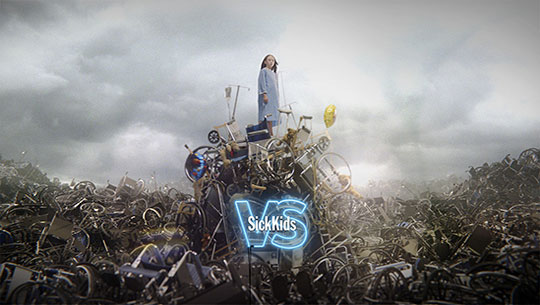
Perhaps this is why the Hospital for Sick Children's latest campaign video SickKids vs—which positions the hospital and its patients against cancer, kidney failure and autism, and includes this image of a girl standing defiantly atop a huge pile of discarded wheelchairs—feels like a betrayal. It’s trending now on YouTube with close to 200,000 views.

“We’re on the front line every day. And we are winning,” says the copy on the foundation page. Indeed, in the video, patients join a simulated battle line with armed 'Fort York' soldiers, hop in a boxing ring to fight cancer and smash apart a kidney dialysis machine with a bat.

I get why it’s so appealing. Viewers are encouraged to choose a fight and donate. Who doesn’t want to be a “winner?” 
From a fundraising perspective, I'm sure this ad has hit the ball out of the park.

But what about the messages it sends to kids and families who aren’t on the winning side?


When you define things in simple terms, you also imply that those who don’t beat their illness or disability are “losers.” Were they not as tough as the kids wearing the super hero costumes in the video? SickKids vs. plays to the song Undeniable by Toronto rapper Richie Sosa. The chorus goes We undeniable.

Are the kids who live with permanent disabilities or chronic illnesses, or who die from their condition, not “undeniable” enough? The word “defeat” flashes during the video. Does that mean some kids “surrender?” Do we really want to believe that children have that much control over their medical conditions? And at some point, doesn’t the concept of fighting just miss the point when we're talking about health and healing?

In her 2015 book Malignant Metaphor: Confronting Cancer Myths, science writer Alanna Mitchell writes about why the battle metaphor isn’t helpful to cancer patients and their families (she also writes about why it's not a great analogy for the latest clinical treatments). “A main concern is that when someone dies of cancer, the message that remains is that that person just hasn’t fought hard enough, was not a brave enough soldier against the ultimate foe, did not really want to win,” she writes.

Many children with congenital disabilities or complex medical problems are patients at SickKids. Their conditions and disabilities are not ones that can be defeated. Did they, or their parents, not try hard enough?

And is it really so easy to define “the enemy?”

The inclusion of autism in the video as something to be battled against is surprising given our current understanding. Autistic adults tell us that accepting and valuing their differences is the way to go. To them, eradicating autism isn’t possible without eradicating who they are as people. Most people in the disability field don’t believe autism can be “cured,” any more than sexual orientation can be changed. Even Autism Speaks just removed cure as an objective from its mission. The focus now is on helping people live good lives that they value.

I honour and respect the families who participated in the video. I understand why viewing their kids as warriors is empowering. I certainly think of my son, and our family, as warriors, but as fragile ones.

From a health organization, I expect a more complex, nuanced depiction—one that includes all kids, whether their disease is cured or not. One that shows that there are many rich ways of living, and dying. In the video, all of the triumphant patients stand on two feet. I’d like to see one rocking a wheelchair, because that’s how she’ll get around for the rest of her life. And I’d like to see more images of kids who look different, like my son, due to their genetic conditions or disabilities. These kids are SickKids patients as well. I’d like to see a video that expands our conception of human value, beauty and diversity. 

We are fierce, but we are also afraid. As parents, we often feel inadequate to the enormity of our child's illness or disability. And that's okay. My dad, who served for almost six years in World War II, told me: You learned to live with fear. 

We don't need to buck ourselves up with flashing neon lights that say: 
Sick isn't weak. For one, who ever said that patients and families were weak? And for two, what is wrong with weak? Weak just means vulnerable. It's who we humans are. 

As someone whose child has had close to 20 surgeries at SickKids, I would say the humanity, the compassion, of the doctors and nurses, is what's made all the difference in our care. 

I asked Alanna Mitchell what she thought of the ad.

“Yeesh!” she wrote back. “Imagine if they had those patients dancing, instead of fighting.
” 

At the end of her book, she asks readers if dance, rather than battle, might be a more apt metaphor for cancer. I think it’s a useful one for any disability or difference. Indeed, for any life. “Not a win or a loss,” she writes, “but a pirouette.”

Thursday, August 18, 2016

'Without disability I don't know if I'd have discovered my sport'

By Louise Kinross

Erica Scarff, 20, is on her way to Rio next month to race a kayak in the paracanoe event as it makes its debut at the Paralympics. BLOOM talked with Erica about how she found her passion on the water after she had an amputation at age 12 to treat cancer.

BLOOM: What led up to your amputation?

Erica Scarff: I was running at gymnastics and my leg broke. I found out I had cancer and the only way to get rid of the tumour was to remove it. My whole thigh on my right leg was removed. Then my calf was attached backwards, so I had to train my brain to make my ankle function as a knee. At the time I was very involved in gymnastics. I was about to move to competing at the provincial level.

BLOOM: What was the hardest part of adapting to your new body?

Erica Scarff: For me, I was still really sick when I lost my leg so I didn’t have the energy or feel motivated to learn how to walk. Being really sick was the hardest part for me. I had the amputation in September and nine months later I finished chemo and it wasn’t until then I started to feel better. It took a long time for my scar to heal, which meant I couldn’t be fitted for a leg until about April. Also, before I even started walking, I had to train my brain to know my ankle as my knee. At first I couldn’t even move my ankle. My ankle is now functioning where my knee did.

BLOOM: What helped you keep going during this process?


Erica Scarff: I was always looking forward and thinking about what was next for me. I never really thought about the possibility of things going wrong. What helped me was I’m really into science. I wanted to be involved in understanding not just what they were doing, but why they were doing it. So I asked the doctors lots of questions and understood everything and that helped. Of course having my family around was important and my mom was always with me in the hospital.

BLOOM: What was it like when you returned to school with your prosthesis?

Erica Scarff: When I got back to school I noticed a lot of the kids were standoffish and a bit apprehensive. Maybe they just didn’t know what to say to me, so they didn’t say anything. But I still had my good friends. I knew this was something I had to do to save my life, so it didn’t bother me too much.

BLOOM: Is there anything you do that helps people feel more comfortable with your prosthesis?

Erica Scarff: I’m very open with it. If someone asks me a question I can explain it to them. That’s not necessarily something I have to address right away, or that I have to explain, unless someone asks me. I’m pretty comfortable with myself. If I make a joke about it, it helps people see ‘Oh, it’s not that big of a deal.’ Because I can feel comfortable with it, others can feel comfortable with it.

BLOOM: How hard was it to learn how to walk with your prosthesis? I’ve spoken to other people who found it incredibly difficult.

Erica Scarff: It was pretty hard. When I first started walking I couldn’t imagine every being able to walk without holding on to something. It was quite painful and I was still quite swollen from the surgery. Because walking is something that comes so naturally to most people, not having it come easily was hard. Not only was I working with a prosthetic and trying to control it as if it’s my own, but I was dealing with the fact that I’m using my own body in a way that it’s not made to be used – I was using my ankle as my knee. In my brain I had to adapt. Now I don’t even remember what it’s like to walk with two legs. For me, it’s normal.

BLOOM: How did you learn about kayaking?

Erica Scarff: I was at the prosthetics clinic at Bloorview and there was a coach there helping another patient design a leg for paddling. The other patient was a friend I knew from Bloorview. The coach asked me if I wanted to come out and try the sport. I’ve always been an athlete and I wanted to go back into sports after my leg amputation.

BLOOM: What do you love about kayaking?


Erica Scarff:
I love the outdoors, so it’s nice to enjoy the summer on the water. I really like training and the feeling of pushing your body and seeing your improvement. With paddling, it’s a very technical sport. You’re not only pushing yourself physically but it’s a mental thing too, to improve your technique. That technical side of it was really cool, because it was like gymnastics: it was about body awareness and knowing where your body is in space. So even though paddling is quite different for me, in some ways it was similar to gymnastics.


BLOOM: What was it like to become part of the Paralympian community?


Erica Scarff:
At my club there were other para athletes, but it was so cool in 2015 to go to the world championships and see these world-class para athletes and how hard they train. Some people don’t realize that we’re real athletes and really competitive. It’s real sport and a real competition. To see how seriously the other athletes took it – yet we’re still really friendly to each other – was really great.


BLOOM: Have your thoughts about disability changed as a result of having your amputation?

Erica Scarff: Having a disability, I can understand and relate to other people with disabilities more and, even though I would say my disability is considered less severe, I understand what it’s like to struggle with differences within your body.

BLOOM: What are your hopes for the future?


Erica Scarff: I’m in school studying kinesiology and I’d like to be a physiotherapist. Being in sports I have a good understanding of the body and how it moves. But also, being in the hospital and going through a lot of physio myself, it was something I watched. I thought their job looked fun, to be able to help people in that way, and something that I could be good at.

BLOOM: What advice would you give other kids with disabilities?

Erica Scarff: Sometimes I visit kids in the hospital who are going through the same thing I did. I tell them it’s going to be okay, even though when you’re going through it, in the moment, it feels really tough. 

I tell them it’s okay to have a hard time with it and struggle with it and to go through all of your emotions. In the end it’s something new: you’ll be living with your disability and it’s not the end of the world and you’ll adapt. There will be a lot of the same things in your life and then maybe you’ll find some new things. Maybe your disability could even bring you opportunities you wouldn’t have had otherwise. Without disability I don’t know if I'd have discovered my sport. So you don’t always have to look at it as a disadvantage.

Monday, January 4, 2016

Why are we at 'war' with cancer and disability?

By Louise Kinross

I heard a fascinating interview with science writer Alanna Mitchell on CBC Radio's The Sunday Edition with Michael Enright a few weeks ago.

She and Michael note that cancer is seen by society as simultaneously “inevitable, preventable and deserved,”which of course it can’t be, and which leads us to blame people who have cancer.

This reminded me of our religious, psychological and public-health history of blaming mothers for their children’s disabilities.

In fact, when Alanna shares her reaction to learning her 21-year-old daughter has cancer, it’s eerily similar to the one we hear mothers recount when given the news that their child has a disability.

“I was absolutely convinced that I had somehow done something wrong…I went over every moment of her childhood. What had I done, what had I failed to do...I went back to the day she was conceived, to gestation…It was so much better than it being random.”

Alanna notes that rather than acknowledge the unpredictability of cancer, “the disease has to mean something bigger than it is. It's not just a cell that's gone rogue...We write a narrative about it.”

That typically involves dropping the person, metaphorically, into battle. “…with enough pluck and positivity, you can vanquish the Goliath, and even if you don’t win, you are expected to go down fighting,” Michael notes.

Doesn’t this mirror the common storyline we read in mainstream media about a person “overcoming” their disability?

How does fighting fit in with healing?

Doesn't the war metaphor strike you as simplistic, ridiculous and often harmful to a person living with an illness or disability?

Friday, May 8, 2015

Wesley goes for a spin

Wesley has been an inpatient at Holland Bloorview twice, following treatment for a rare form of cancer. Read about why seeing Wesley ride off on this specially-fitted tricycle meant so much to his mom Laura Ritchie.

And in case you missed it, check out The Toronto Star's special section on families at SickKids which came out this week.

Author Julie Keon is launching her new book What I Would Tell You: One Mother's Adventure with Medical Fragility this Saturday May 9 at Holland Bloorview at 1 p.m. There's a lovely video about Julie and why she wrote her book in this Ottawa Citizen video. Hope to see you there!

Monday, January 19, 2015

BLOOM media roundup

Girl advocate for disabled American Girl doll to write book Kickstarter

Last year Melissa Shang, then 10 (above), got almost 150,000 people to sign a petition asking American Girl to release a doll with a disability. The company hasn't. BOO! So Melissa, who has a form of muscular dystrophy, is moving on to write a book about a middle-schooler with a disability. You can also hear Melissa and her older sister Eva calling for more visibility for girls with disability in the media in this TEDx talk: Why girls with disabilities matter. Rock on sister!

Ode on a stethoscope The New Yorker

How poems and medicine fit together in medical journals. Great quote from a seasoned doctor at the end: 'When you get in the twilight of your career, relationships, connections—with patients, and connections with those who help you care for patients—matter as much as or more than the chart, the medical record, the lab tests,' LaCombe said.

Girl invents Hello Kitty IV backpack for chemo and transfusions The Huffington Post

Kylie Symonds, 11, invents a wearable, portable IV machine for kids receiving chemotherapy or transfusions so they don't have to bother pulling cumbersome IV poles around. 

Disabled girl types with nose, opens online store to sell apples Shanghaiist.com

A young woman in Yuncheng, Shanxi province has sold over 350 kilograms of apples from her village over the Internet, using her nose to type and her chin to manipulate the mouse.

We wouldn't accept actors 'blacking up' so why accept 'cripping up?' The Guardian

'When it comes to race, we believe it is wrong for the story of someone from a minority to be depicted by a member of the dominant group for mass entertainment. But we don’t grant disabled people the same right to self-representation.'

Harsh critics in public spaces New York Times Motherlode blog

Blogger David Perry writes about how parents who take kids with disability out in public face constant judgment and prejudice that is isolating.  

Trapped in his body for 12 years, man breaks free NPR

Martin Pistorius was a healthy 12-year-old until meningitis took his ability to move and speak. Doctors told his parents he was 'a vegetable' but years later Martin regained the ability to communicate and said he had been aware and understanding.

Teen invents snap-on underwear for people with disabilities The Huffington Post

A girl who had to wear a fixator on her leg which meant she couldn't easily slip her legs into undies designs cool underwear that you put on with snaps.